What would the result have been if Mourinho and Wenger swapped places?

October 6, 2014

There are few things in football on which most of us would agree, but the fact that Arsene Wenger and Jose Mourinho are polar opposites when it comes to their respective personalities and football ethos is undeniable.

So allow yourself a flight of fantasy, cast aside the thought that most Arsenal supporters can’t abide ‘the chosen one’ and put Mourinho in charge of Arsenal from the start of the last transfer window and Wenger in charge of Chelsea – would the result of yesterday’s game been any different?

Would Arsene have brought in the players to Chelsea that Jose did and vice verse Jose to Arsenal?

Would the teams have set up differently and played differently in yesterday’s derby? Undeniably yes – but would either have been an improvement?

This raises so many questions in terms of style, vision, ruthlessness, class and motivation …. you decide

Written by ‘The Devil’s Advocate’


Is Silent Stan good enough for the club and the fans?

October 4, 2014

Stan Kroenke and the club have generated some adverse publicity in the press recently.

There have been some insightful discussions on the topic over the past few days on AA. Now that Crystals is back to the fold, I thought maybe we could do a “Kelsey” and put comments by AA patrons together to try and generate some consensus, or better still, some disagreement.
chas says:
September 24, 2014 at 6:26 pm

Bad PR, whichever way you look at it?

http://www.theguardian.com/football/2014/sep/23/stan-kroenke-arsenal-dividend-fans-anger

Arsenal owner Stan Kroenke angers fans by taking £3m out of club

• Payment matches 3% rise in season ticket prices
• Kroenke has dodged issue of receiving dividends

Amy Lawrence, The Guardian, Tuesday 23 September 2014

Excerpts: “Arsenal’s majority shareholder, Stan Kroenke, has taken a payment of £3m out of the club according to the latest company accounts.

“Having never taken dividends from his American sports franchises, … this is a move that has gone down badly with Arsenal supporters. Coincidentally, the £3m figure tallies with the amount the club raised from a 3% rise on season-ticket prices for this season.

“The money has been paid to Kroenke’s company, KSE LLC, for strategic and advisory services which relate to Arsenal’s broadband division, the media department which raises funds by selling a three-hour block of weekly content to the lucrative international market.

“No doubt the Kroenke payment will be a subject on the agenda at Arsenal’s AGM on 16 October.”

This then generated insightful comments from the AA in-house accountants.

LB says:
September 24, 2014 at 6:53 pm

Can one of the plethora of accountants that frequent this site please comment on the article in the Guardian about Stan Kroenke taking dividends out of the club. Thank you in advance.

RA says:
September 24, 2014 at 7:23 pm

[F]rom what I briefly heard on a local radio station, the fans are upset that Kroenke took £3m out of the club as expenses, and justified it, by saying the Glazers were brilliant owners and had taken very much more out of Manure than he was taking out from Arsenal for his personal expenditure. this would not be a dividend – as it would have had to be issued to the other shareholders, like Usmanov, and any fans who are still holding shares.

His salary as a director is peanuts too.

This might be a straw in the wind? Perhaps he is going to want a return on his investment in the club, though he has never previously done this with his US franchises.

chas says:
September 24, 2014 at 8:15 pm

I think it’s a piece of misleading journalism (surprise surprise) to suggest it was a ‘dividend’. The bad PR aspect of it for me was the fact that the amount taken out more or less equals the ticket price increase.

Gööner In Exile says:
September 25, 2014 at 7:26 am

Where I stand on £3m….it’s a Non story.

It’s literally at the arse end of the Accounts under a section called Related Party Transactions where any dealings with companies related or Directors related have to be disclosed. It is required to demonstrate that a fair value has been placed on those transactions. It can also be used to show services that were provided but not charged (eg KSE could provide Contracts Lawyers, but never charges for them….this would have to be reported so that Investors would know a change in ownership could increase costs of running company if they had to pay for it themselves).

There are about £260m of Operating expenses, a large portion is player wages, the accounts do not provide a full breakdown of these expenses, the £3m paid to KSE for strategic, consultancy advice is in reality peanuts compared to our overall costs, would Arsenal fans be happier if this was paid to Bodgeit Flogitrun & Co for Marketing advice? Or to WeChargeEverySecond & More Lawyers…..we wouldn’t even know.

Not sure Stans answer was the best, but in a season where our player trading was £32m out compared to consistently in, and wages went up £12m, is it a surprise that the media find something else to focus on?

chas says:
September 25, 2014 at 7:34 am

“would Arsenal fans be happier if this was paid to Bodgeit Flogitrun & Co for Marketing advice? Or to WeChargeEverySecond & More Lawyers”

I think the answer is a resounding, ‘YES”  🙂

Eddie says:
September 25, 2014 at 7:50 am

I would not believe a story stating that Kroenke takes nothing out of the club. Why shouldn’t he? Had I invested millions I would want to see some returns, even if it was from the AFC

RA says:
September 25, 2014 at 8:01 am

Up until recently, Eddie, it is true that Kroenke has taken very little out of the club.

His director’s salary really is minimal, no dividends have been paid to shareholders, of which he is the major shareholder of course, and he seems content to see the value of the club rise due to good fiscal management and therefore when he eventually sells Arsenal, and in due course he will, even if it is in many years time, he will reap the rewards of his investment then.

On the other hand he may get peed off with the constant sniping about the club and his stewardship and start taking a huge salary, and authorise huge dividends to the shareholders to shut them up. 🙂

chas says:
September 25, 2014 at 8:09 am

I doubt he’d authorise huge dividends to the shareholders because it would mean giving money away to Mr Creosote.

Big Raddy says:
October 3, 2014, headline post “Friday’s Rant”

Complaints about Stan Kroenke taking money out of the club: Why?  When I owned a business if one of my customers told me that I couldn’t take a smidgeon out to enjoy a self-finding mission to the Berkshire countryside I would have given them short shrift (whatever a shrift is?). The man has invested heavily into AFC and yet to take a dividend, his company did some work for the club, they got paid. So what?

Anyone who thinks Silent Stan is in it for anything but profit is beyond naive.

mickydidit89 says:
October 3, 2014 at 6:02 pm

Agree about Stan. I’d of thought he’s about the perfect owner. Hasn’t leveraged the company, takes nothing out and doesn’t interfere with football matters.

Eddie says:
October 3, 2014 at 8:49 pm

I too think that Kroenke is a perfect owner. He keeps his views to himself, doesn’t go to all the games sitting there like Abramovitch with a teenage girlfriend and a face like a slapped arse; doesn’t attempt to run the team or impose transfers. And last but not least – does not want to change our name to Arsenal Lions/Donkeys or Giraffes or shirt colour to blue. Perfect, he has my vote of confidence.

*****************************

I have unashamedly pilfered material from these discussions and just put these together. So what do you think?

Here are some questions for you ………

1. Has silent Stan been a good owner for the club?

2. Is Stan Kroenke a better owner than the likes of Abramovitch and the Glazer family?

3. Was it wise to pay KSE LLC £3m for strategic and advisory services?

If your answer to 3 is yes do any of the following apply?

  • Stan deserves some return on his investments in the club
    Stan has been a good director and he deserves to be rewarded
    These services had to be procured, better pay KSE because they have a stake and will deliver
    better services
    Better than paying dividends which would then go to unworthy shareholders as well

If your answer to 3 is no do any of the following apply?

  • This is poor publicity for the club
    The club is not providing good value to fans, better invest every penny in developing the squad
    This is just a clever way of fleecing fans and redistributing their money to the owners

Over to you, readers, contributors and patrons.

Arnie.


THE DEFENSIVE MIDFIELDER – Is there more to it than meets the eye?

September 25, 2014

Yesterday when commenting on Chas’ report on the game against Southampton, I made the comment that I would have liked to have seen how Francis Coquelin would have performed in the holding midfield role.

My reasoning for this comment is that I feel the holding midfield role is a highly important cog in our wheel with regard to our current squad and best formation, or at least what I consider, and reading between the lines, maybe what Arsene considers to be our best formation. It is also an area where I feel we are currently lacking in top level quality and would need an upgrade in if we want to compete for the top prizes with the best in England and Europe.

RA in response to my comment said the following :-

Forgot to mention, GB, that we or that is to say you – should as a group, or you as an individual should define what you mean by a ‘holding midfielder’.
To me a HMF is not the same as a ‘beast’ of a DMF (defensive), much as I like dislike the term ‘beast’, and should be someone who links the central defense and the forwards, and to do that should break up play, and pull the strings when we are attacking.
The trouble is many will see that as a No.10s role, or the guy who ‘sits in the hole’ behind the forwards, and maybe it is all of those things, so how you can say that Diaby, in particular, or Jack, or Rambo could not be such a player in that role, mystifies me.

So indeed I think firstly an examination and definition of what one considers to be a holding midfielder and what one considers is a defensive midfielder, and whether they are different or one and the same, is warranted.

RONALDO VIEIRA

To my mind the great PV4 has undoubtedly been our best player in the heart of midfield in recent times but how would you define him?

I would also like to also ask which players in our current squad do you see best fitting the above definitions and why? In addition do you feel we have adequate strength and quality in these defined roles or do you feel we need to bring in a player of greater quality? If so who would you prefer and how would you view them in terms of the definitions of holding or defensive midfielder.

Over to you A.A’ers.

Written by GoonerB


Arsenal’s pre-season starts today

July 19, 2014

Morning all

Pre-season kicks off today with a game at Borehamwood’s Meadow Park where they have just had a new stand built and Gooners get to watch a match featuring some of their idols.

fa cup pic

I started to think about who would be playing and as the boss mentioned that he would change the team for both halves I wondered if we could have a stab at a couple of teams.

I’ve had a good look at the pictures from the training ground, there’ll be some fresh faces on show this afternoon – always an exciting prospect.

Coquelin is back with the squad, Zelalem too. Gnabry should feature and I hope we’ll see Eisfeld.

The FA Cups – Mens and Ladies – will be on show and I’m sure all the Gooners that are going will give Aaron Ramsey and all the players a massive welcome.

Here’s my stab a team

Szczesny – who else is there?

Jenks  Miquel ? Gibbs

Matthieu

Gnabry Rosicky Arteta Coquelin

Yaya Sanogo

Can anyone help out with another centre-back?

If you’re going to the game have a great time. If you’re watching it on Arsenal.com then come and chat about it afterwards and let us know what you think.

peachesgooner


Blast from the Past No. 18 England’s World Cup History

June 13, 2014

world-cup

The World Cup competition began in 1930, and has since become the world’s largest sporting event. It has been staged every four years since then with the exception of 1942 and 1946, when the Second World War forced its suspension.

England did not enter the first three competitions of 1930, 1934 and 1938. Although FIFA sought England’s participation, the Football Association declined all invitations. Not until the fourth tournament in 1950 did England take part.

England has entered all 16 post-war competitions. They reached the final tournament 13 times. They qualified through play in the preliminary competition on 11 occasions (1950, 1954, 1958, 1962, 1982, 1986, 1990, 1998, 2002, 2006 and 2010), as host country once (1966) and as reigning champions once (1970). They failed to qualify for the final tournaments on only three occasions (1974, 1978 and 1994).

England has had only moderate success in the World Cup, and that is perhaps a fair reflection of their standing in world football.

englandwcteam66

They have won the tournament just once, in 1966, when it was held on English soil and they played all their matches at their home ground, Wembley Stadium, an advantage extended to no other team in World Cup history. Their 4-2 extra-time victory against West Germany in the only final match they have reached has remained clouded by the controversy over whether their third goal, the first of extra-time, actually crossed the goal line.

ENGLAND SOCCER WC 1966

England reached the semi-finals on only one other occasion, at the 1990 tournament in Italy, where, following extra-time victories over Belgium and Cameroon, they went down to West Germany on penalty kicks after a 1-1 extra-time draw. They then lost the third-place match to the host nation, 2-1.

Englands WC placing

England has reached the quarterfinals on six other occasions, at the 1954, 1962, 1970, 1986, 2002 and 2006 tournaments. At the 1982 competition in Spain, where the final tournament was conducted through two group stages with the teams topping the four second-round groups proceeding directly to the semi-finals, England finished the second group stage unbeaten but was therefore eliminated.

England have been eliminated in the round of 16 teams stage on two occasions since the final tournament was expanded to more than 16 teams in 1982–at the 1998 final tournament in France and the 2010 final tournament in South Africa.

England have been eliminated at the first round group stage on two occasions 1950 and 1958, when they finished level in group play with the USSR but lost a playoff match.

The World Cup has been a frustrating odyssey for England, particularly since 1966. At several tournaments, their performances have filled their fans with justified hope, but in the end, they have just not had enough to overcome the world’s most powerful teams in crucial knockout matches.

Consolation-seekers like to point out that it has been England’s misfortune to meet the eventual World Cup winners in the knockout stages of four tournaments. They went out to Brazil, 3-1, in the quarterfinals of the 1962 tournament, to Argentina, 2-1 by way of Maradona’s “Hand of God” goal, in the quarterfinals of the 1986 tournament, to West Germany, on penalty kicks after a 1-1 extra-time draw, in the semi-finals of the 1990 tournament and to Brazil again, 2-1, in the quarterfinals of the 2002 tournament after holding the lead.

On three occasions they have been eliminated in penalty-kick shootouts, in the 1990 semi-final against West Germany, the 1998 round-of-16-teams match against Argentina following a 2-2 extra-time draw in which they played a man short following the expulsion early in the second-half of midfielder David Beckham. On a third occasion, in the 2006 quarter-finals, England were eliminated by Portugal following a 0-0 draw.

Perhaps most disappointing was their elimination at the 1982 tournament in Spain. Having won all three of their group matches quite handily, all they could muster in their second-round group was a pair of goalless draws against eventual finalist West Germany and hosts Spain. They went home unbeaten, having yielded only one goal in five matches.

Our first game in the 2014 group stage is on June 13th vs Italy.

There will be no predictions from GN5 I simply want our team to play up to their top potential and hope that Lady Luck favours us.

world cup history

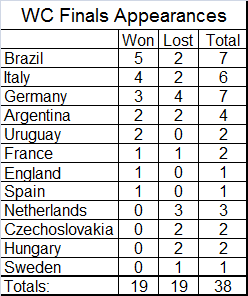
World Cup Finals
1 Jul 30 1930 Uruguay 4 Argentina 2
2 Jun 10 1934 Italy 2 Czechoslovakia 1
3 Jun 19 1938 Italy 4 Hungary 2
4 Jul 16 1950 Uruguay 2 Brazil 1
5 Jul 04 1954; Germany 3 Hungary 2
6 Jun 29 1958; Brazil 5 Sweden 2
7 Jun 17 1962; Brazil 3 Czechoslovakia 1
8 Jul 30 1966; England 4 Germany 2
9 Jun 21 1970; Brazil 4 Italy 1
10 Jul 7 1974; Germany 2 Netherlands 1
11 Jun 25 1978; Argentina 3 Netherlands 1
12 Jul 11 1982; Italy 3 Germany 1
13 Jun 29 1986; Argentina 3 Germany 2
14 Jul 08 1990; Germany 1 Argentina 0
15 Jul 17 1994; Brazil* 0 Italy 0
16 Jul 12 1998; France 3 Brazil 0
17 Jun 30 2002; Brazil 2 Germany 0
18 Jul 09 2006; Italy* 1* France 1
19 Jul 11 2010; Spain 1 Netherlands 0
* Won on Penalty Kicks

wc finals appearances


GunnerN5


Blast from the Past No. 17 … Arsenal’s Exclusive 10,000th game club

June 6, 2014


Joined Left Years Games Goals
1 David O’Leary 1973 1993 20 722 14
2 Tony Adams 1983 2002 19 669 48
3 George Armstrong 1961 1977 16 621 68
4 Lee Dixon 1988 2002 14 619 28
5 Nigel Winterburn 1987 2000 13 584 12
6 David Seaman 1990 2003 13 564 0
7 Pat Rice 1964 1980 16 528 13
8 Peter Storey 1961 1977 16 501 17
9 John Radford 1962 1976 14 481 149
10 Peter Simpson 1960 1978 18 477 15
11 Bob John 1922 1937 15 470 13
12 Ray Parlour 1988 2004 16 466 32
13 Graham Rix 1974 1988 14 464 51
14 Martin Keown 1981 2004 23 449 8
15 Paul Davis 1978 1995 17 447 37
16 Eddie Hapgood 1927 1945 18 440 2
17 Paul Merson 1982 1997 15 425 99
18 Dennis Bergkamp 1995 2006 11 423 120
19 Patrick Vieira 1996 2005 9 406 33
20 Frank Mclintock 1964 1973 9 403 32
Total: 306 10159 791

These are the players who have each played in over 400 games for Arsenal, between them they played in an incredible 10,159 games, an average of 508 games per player. Many of us will be familiar with 18 of them as they played in the past 41years but I doubt that any of us would have been around when the final 2 played.

Bob John 1922-1937 – 470 games

Bob John 2

Bob John

Born in Barry, Wales, Bob played for Barry Town and Caerphilly, before joining Arsenal, who signed him despite stiff competition for his signature. He made his Arsenal first-team debut on 28 October 1922 in a 2-1 home defeat to Newcastle United, and soon became a regular, succeeding Tom Whittaker at left half.

He lost his place from the Arsenal side in the 1923-24 season due to stiff competition from Billy Blyth and Andy Young, but after switching to left back, he once again became a first team player. Eventually he was put back to left half, and this time he remained a first-team regular. A prodigious ball-winner and noted passer of the ball, Bob reached (but lost) in the 1926-27 FA Cup Final, after an error by his compatriot and close friend, goalkeeper Dan Lewis whose one mistake led to Arsenal’s loss. It was Bob who consoled Lewis after the final whistle, assuring him he would get another chance to a win a medal, but Lewis never did get the opportunity.

Despite some very strong competition he remained a first team regular, finally winning some silverware in the 1929-30, FA Cup Final. This was followed by three First Division titles in 1930-31, 1932-33, and 1933-34. He also scored Arsenal’s only goal in the 1932 FA Cup Final when Arsenal were controversially beaten by Newcastle United. Newcastle benefited from scoring a goal that was later determined to have been out of play just before the goal was scored. By this time he was one of the senior members of the Arsenal squad, and mentored many of the club’s younger new arrivals, such as Alex James. He played for Arsenal until he retired in 1938, playing for the final three years of his career mainly as a reserve player, missing out on a medal in the League win of 1934-35.

After his retirement he had a largely unsuccessful career as a coach, finishing his football career as a scout for Cardiff City.

His 470 games place him 11th on the all time list.

He passed away in 1982 aged 83 years.

Eddie Hapgood 1927-1945 – 440 games

eddie hapgood 2

Eddie Hapgood Highbury006

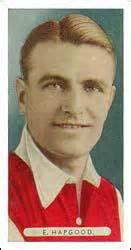
He was born in Bristol. Eddie started his football career in the mid-1920s as an amateur playing in local football (while still employed as a milkman), after which he played for Kettering Town in the Southern League. In 1927 Herbert Chapman signed him for Arsenal at a fee of £950. He was so thin and fragile that Arsenal’s trainer Tom Whittaker forced him to take up weight training and to start eating meat, as he was a vegetarian. This turned to Eddie’s advantage outside of football as his new found muscular physique allowed him to supplement his minimum wage, as a footballer, by fashion modelling and advertising confectionary.

He made his Arsenal debut on 19 November 1927 against Birmingham City; initially he was used as backup for left back Horace Cope. Eddie had to wait until 1929 before he became a first team regular, after that he made the position his own, right up until the outbreak of WW11 in 1939. He played 35 or more matches in every season in that period and went on to succeed Alex James as Arsenal’s captain and he led the side to the League title in 1937-38, while personally winning five League titles and two FA Cups.

He was capped by England on 30 occasions making his debut in1930, and was England’s captain for 21 games including his first match which was the infamous “Battle of Highbury” against Italy in November 1934. Italy was the reigning World Champions at the time and England had declined to take part in the World Cup, so the match was billed as the “true” World Championship match. The match was notoriously dirty, with many players sustaining injuries, including Hapgood who had his nose broken. England beat the Italians (who were reduced to ten men for most of the match) 3-2. He was also captain when the English team played Germany, in Berlin and were forced (under pressure from British diplomats) to give the Nazi salute before the match, England won 6-3.

When WW11 started, Eddie who was only 30 served in the Royal Air Force, while also playing for Arsenal and England in unofficial matches. In 1945, he wrote one of the first football autobiographies, entitled “Football Ambassador”. After that he left football completely; he fell on hard times and wrote back to his old club Arsenal asking for financial assistance (as he had never been given a testimonial match) but the club only sent him £30. He spent his later years running YMCA hostels.

His 440 games place him 16th on the all time list.

He passed away on Good Friday 1973 aged 64 years.

Two of the other members of the 10,000 game club are John Radford and Dennis (God) Bergkamp and they are also among only 16 players to have scored 100 or more goals for Arsenal, Paul Merson fell one goal short at 99.

GunnerN5


FA Cup win 2014 – A Canadian Celebration

May 23, 2014

The Game is still to be played………..

The Cup is still to be raised……….

The Story is still to be written………..


The game has now been played the Cup has been raised and here is GunnerN5’s story –

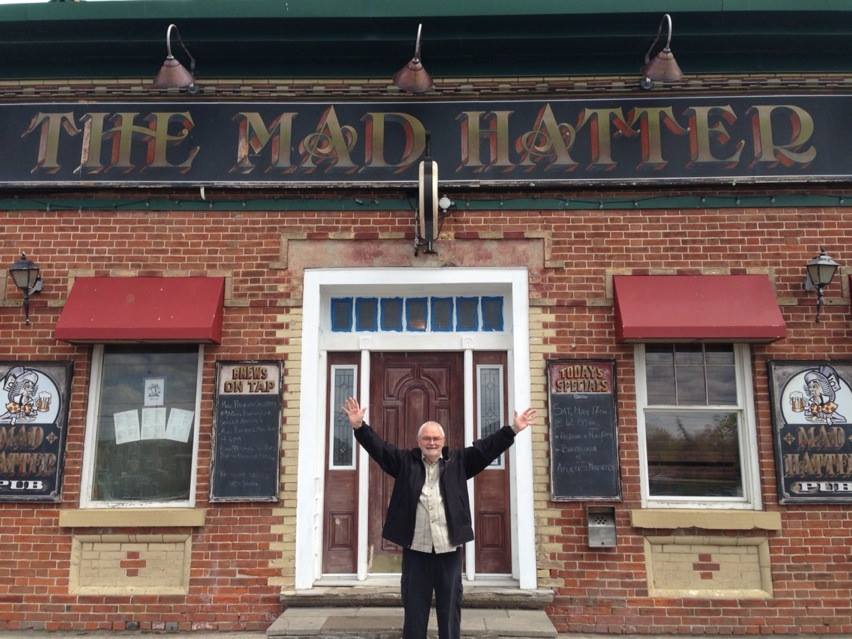
At 8:00 a m on May 17, 2014 GunnerN5, JnrGunnerN5 and Mrs. GN5 left London Ontario for the 2.5 hour drive to The Mad Hatter in Mississauga Ontario, we dropped Mrs. GN5 off at a friends house on the way. JnrGN5 was supposed to be the driver but he was still exhausted after attending a junior hockey cup play off game on Friday evening and partying into the early hours of Saturday morning, but at least he picked us up on time. Anyway GN5 ended up being the driver and was accompanied on the journey by snoring from both Mrs.GN5 and JnrGN5, which they both adamantly deny.

We arrived early expecting a full house but to our pleasant surprise we were the first to arrive and they let us in even though the pub would not officially open for another 45 minutes.

GN5 Before FA Cup (1)

We picked the best table, with an unrestricted view of the TV and saved a spot for neamman, who was meeting us there. The Mad Hatter is not a big pub and is only licensed to hold 180 people but on big game days the pub overflows.

GN5 at Mad Hatter

Arsenal doesn’t command a huge amount of supporter’s in Mississauga but they are a loyal, loud and passionate group and by the time the game kicked off our section was full, so arriving early really helped. Suffice to say that we were all left stunned after 9 minutes, going down 2-0 was totally unexpected and quite shocking, but we felt that by Hull getting their goals early left us with more than a fighting chance of getting back into the game. Sheer pandemonium broke out after Santi’s incredible goal from his laser guided free kick and our undying faith in the team was being justified.  GN5 was drinking alcohol for the first time in two months and the effect of the red wine was enhanced by the goal, so I ordered another carafe.

Arsene made a critical substitution by bringing on Sanago for Podolski, changing to a 4-4-2 system which caused Hull’s 3 center backs trouble for the first time in the game but the tying goal was still elusive. At the 71st minute Laurent Koscielny managed to make the noise level (after Santi’s goal) seem quiet, as this time I felt the noise reverberating off of the ceiling and I desperately wanted to hear that noise just one more time – I ordered another carafe of red wine.

When extra time started my instinct told me that there would only be one winner as the calmness of our manager and the resolve in our team would prevail, however I still felt a tinge of apprehension. Arsene made two more astute substitutions by bringing on Jack Wishere and Tomas Rosicky their combined energy and inventiveness created havoc in the Hull defence.

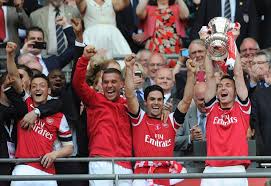
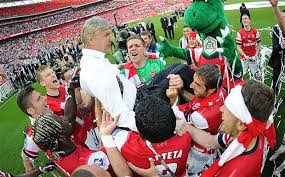
However, it was left to Aaron Ramsey – who left Wembley in tears as a schoolboy following defeat with Cardiff in the 2008 final against Portsmouth – to complete a remarkable turnaround, when from the edge of the box, he crashed home a smart back heel from Olivier Giroud on 109 minutes. Our Welsh wonder boy turned my apprehension into euphoria and the Pub simply exploded into unadulterated elation and everybody went insane, the noise level was deafening, the singing was loud and it seemed to last an eternity.

GN5 Arsenal win FA Cup

GN5 has not felt this good about a FA Cup victory since Alan Sunderland slid in the winner against Manchester United in the 1979 Cup Final. The wine and the team had cast a magic spell over GN5 and I was too deep into my trance to be the driver on return trip – and long may the trance last….

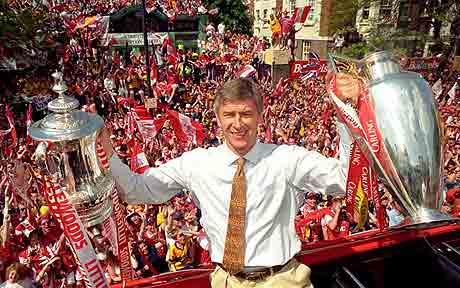
Arsene lifting fa cup


Arsene getting tossed

 We are The Arsenal – who are we? – We are The Arsenal

Finally lets have a look a bit further back in our history and look at Arsene Wenger. He has won an incredible 5 out of 6 of his FA CUP FINALS – we are simply blessed to have him as our manager and history will eventually silence his critics.

We are The Arsenal – who are we? – We are The Arsenal


Written by GunnerN5


An Arsenal Blast from the Past No. 14 Arsenal’s FA Cup Final History

May 16, 2014

Original FA Cup 001

Tomorrow Arsenal plays Hull City in their record eighteenth FA Cup Final appearance; they are tied with Manchester United. Hull City will be making their first appearance.

Here is a brief accounting of our Cup Final appearances.


1926-1927 – Arsenal vs Cardiff City

Arsenal’s first final, but sadly we lost 0-1 and it’s the only time the FA Cup left England.

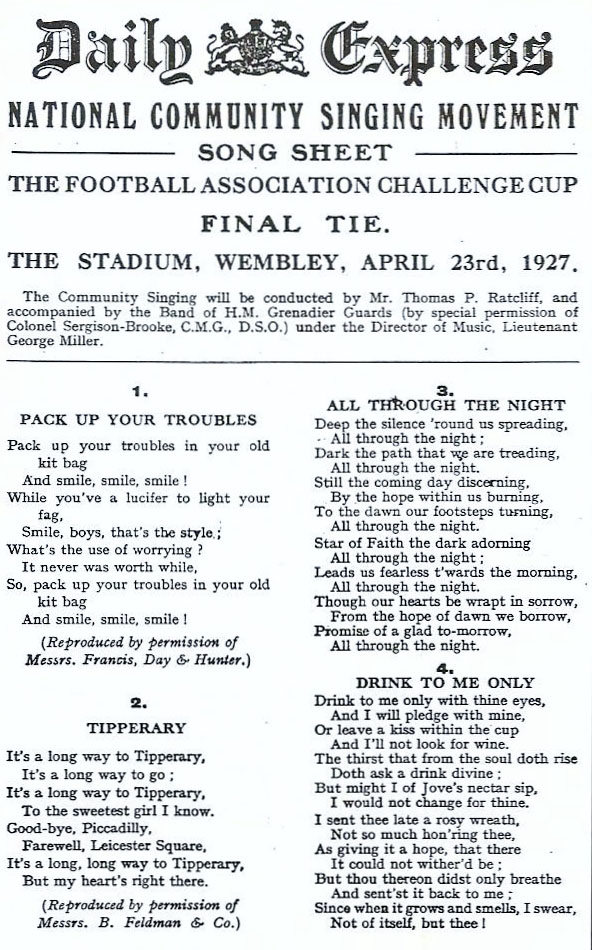
This was also the first time that there was community signing at a FA Cup Final.

The tradition of signing “Abide with Me” which was written in 1847 by a vicar from Devon also had its debut performance.

FA Cup Song Sheet 1927 001


1929-1930 – Arsenal vs Huddersfield Town

Our first FA Cup victory, and first ever trophy, we won 2-0 on goals by Alex James and Jack Lambert. This was the start of one on our most successful decades, we were led by Herbert Chapman undoubtedly the greatest Manger of his time and arguably Arsenal’s best ever Manager. The Final was interrupted by a fly over of the German airship Graf Zeppelin.


1931-1932 – Arsenal vs Newcastle United

Our second loss we were beaten 1-2 with Bob John scoring our only goal.

In the thirty eighth minute with Arsenal winning 1-0 Newcastle attacked down the right wing, a long pass appeared to go over the line but it was hooked into the middle and they scored an easy equaliser. The linesman was ninety feet away and the referee sixty feet but the referee still gave Newcastle the goal. Newsreel confirmed that the ball had crossed the line.


1935-1936 – Arsenal vs Sheffield United

Our second victory we won 1-0 with Ted Drake scoring our goal.

Having won the League Championship three seasons in a row we now added our second FA Cup to our trophy collection. Herbert Chapman had died suddenly two years earlier and George Allison was now our manager. It was our sixth success in League and Cup in seven seasons.


1949-1950 – Arsenal vs Liverpool

Our third victory we won 2-0 with Reg Lewis scoring both goals.

This was the era of the Compton brothers, Denis and Leslie, both were famous footballers and cricketers. They played in both sports for England with Leslie not making his football debut for England until he was thirty eight years old.


1951-1952 – Arsenal vs Newcastle United

Our third loss we were beaten 0-1.

Newcastle became the second club to win the Cup in successive years after Blackburn Rovers in 1890 and 1891. Arsenal was down to ten men in the thirty fifth minute after Wally Barnes was injured, Newcastle scored the only goal of the game six minutes from time. Winston Churchill made the Cup presentation to Newcastle; he is the only Prime Minster to have made the presentation at Wembley.


1970-1971 – Arsenal vs Liverpool

Our fourth victory we won 2-0 with goals by Eddie Kelly and Charlie George.

Bertie Mee Double 001

This was indeed Red Letter day for Arsenal, having won the League Championship at White Hart Lane the victory secured our first League and Cup double. We were drawn away in every round of the competition and needed a replay to beat Leeds United in the semi-final. Charlie George scored his unforgettable winning goal from twenty five yards out in the twenty first minute of extra time.


1971-1972 – Arsenal vs Leeds United

Our fourth loss we were beaten 0-1.

This was a disappointing day for Arsenal but it set up the first stage of the “Double” for Leeds. They went to Wolverhampton just forty eight hours later needing only a draw to clinch the League Championship but to their disappointment they lost 2-1.


1977-1978 – Arsenal vs Ipswich Town

Our fifth loss we were beaten 0-1.

This was the fiftieth Cup Final and Arsenal was the odds on favourites to win their fifth FA Cup but Ipswich, managed by Bobby Robson, had other thoughts. They reduced Arsenal to nothing more than a supporting role and won the game with a goal in the seventy sixth minute but they also hit the post or bar on three other occasions.


1978-1979 – Arsenal vs Manchester United

Our fifth victory we won 3-2 with goals by Brian Talbot, Frank Stapleton and Alan Sunderland.

The game was described as the “Five Minute Final” a routine heavy weight bout with a finish that matched the “Matthews Final” in raw excitement. Arsenal led 2-0 with less than five minutes remaining when Manchester United scored two goals in 115 seconds. Extra-time appeared inevitable until Liam Brady, who was the architect of Arsenal’s first two goals picked up the ball straight from the re-start. He passed to Graham Rix, on the left, who centered to Alan Sunderland and he slid the ball into the net for the winning goal.


1979-1980 – Arsenal vs West Ham United

Our sixth loss we were beaten 0-1.

One of the most disappointed Arsenal fans on this day was GunnerN5 – I drove, on my own, four hundred miles through the mountains from Coeur D’Alene, Idaho to Cranbook, British Columbia. I had booked a hotel room in Cranbrook as the game was not being shown in the USA. Even a bottle of Macallan could not mask my disappointment and the return journey, the next day, was one of the longest and loneliest drives of my life.


1992-1993 – Arsenal vs Sheffield Wednesday

Our sixth victory we won 2-1 with goals by Ian Wright, Wright, Wright and Andy Linighan.

Arsenal became the first club to win both the FA Cup and the League Cup in one season but Sheffield United would prefer not to talk about that as they were the team that lost to Arsenal in both Finals. Andy Lineghan headed home the winning goal from a Paul Merson corner kick in the last minute of extra time


1997-1998 – Arsenal vs Newcastle United

Our seventh victory we won 2-0 with goals by Marc Overmars and Nicolas Anelka.

arsene-wenger_double

Arsenal finally beat Newcastle in a FA Cup Final having lost to them in both 1932 and 1952. This was Arsene Wengers first full season as Arsenal manager and he ended the season with a fist full of silver after winning both the FA Cup and The League Championship to secure Arsenals second “Double” season.


2000-2001 – Arsenal vs Liverpool

Our seventh loss we were beaten 1-2 with Freddie Ljungberg scoring our only goal.

Arsenal dominated the game but Liverpool came from behind to win 2-1, thus winning the FA Cup for the sixth time. It was the second trophy of their treble-winning season of 2000–01: they had won the Football League Cup in late February and would win the UEFA Cup four days later. As well as being the first FA Cup Final to be staged outside of England, it was also the first in which the managers of both teams were from outside the British Isles – Liverpool’s Gérard Houllier and Arsenal’s Arsène Wenger both coming from France.


2001-2002 – Arsenal vs Chelsea

Our eighth victory we won 2-0 with goals by Ray Parlour and Freddie Ljungberg.

Ljungberg, having also scored in the 2001 final, became the first man to score goals in successive FA Cup Finals since Tottenham Hotspur’s Bobby Smith, who scored in 1961 and 1962. The match took place with one week remaining in the Premier League calendar for the 2001–02 season. Arsenal were in first position, but still needed a point from their final two games to secure the championship, which they achieved in their next match with victory over second-placed Manchester United. It was Arsene Wengers second and Arsenals third League and Cup double.


2002-2003 – Arsenal vs Southampton

Our ninth victory we won 1-0 with Robert Pires scoring the only goal.

The Gunners won their second Cup in 2 years with a dominant performance over Southampton. The gulf in class between the 2 teams was not evident in the score line as Arsenal won by the single goal, a scrambled shot by Robert Pires. The last 7 minutes of the game saw Arsenal retain almost constant possession accompanied by a string of cheers from their supporters. Southampton had a mere 2 chances to score. the last of which came in the dying seconds as Ashley Cole saved the day with a goal line clearance.


2004-2005 – Arsenal vs Manchester United

Our tenth victory we won a penalty shootout 5-4 with Patrick Vieira scoring the decisive penalty.

The game was dominated by Manchester United who did everything but score a goal, Arsenals defence was stubborn to the end and forced the game into a penalty shootout.

Van Nistelrooy took the first penalty for Manchester United, in front of the United fans, and sent Lehmann the wrong way to give United the early advantage. Lauren then converted the next penalty for Arsenal, before Scholes stepped up to take United’s second, only to see it saved by Lehmann, diving low to his right. The next six penalties were all scored – Ljungberg, Van Persie and Cole for Arsenal, Ronaldo, Rooney and Keane for Manchester United – leaving Vieira with the opportunity to win the FA Cup for Arsenal in his last match for the club before moving to Juventus. Although Carroll guessed the correct way to dive, Vieira’s kick was just out of his reach, giving Arsenal their 10th FA Cup. Manchester felt aggrieved to have lost a game where they outplayed Arsenal – but frankly who gives a damn?


2013-2014 – Arsenal vs Hull City

The game is still to be played.

The Cup is still to be raised.

The story is still to be written.

FA Cup Trophy


GunnerN5


An Arsenal Blast from the past …… The birth of the FA Cup

May 9, 2014

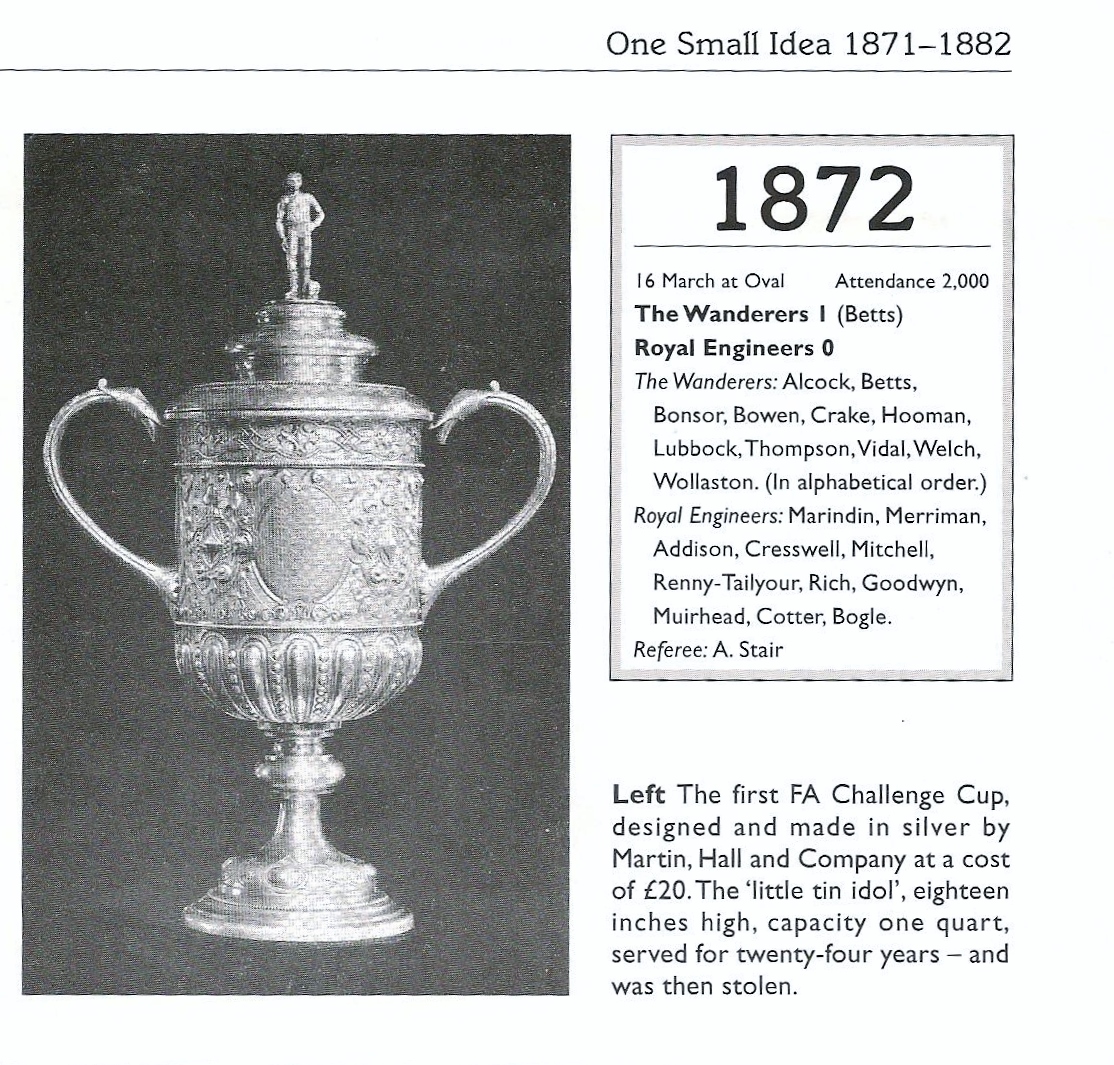
Original FA Cup 1872 - No.10 001

Although there are no official records it is thought that The FA Cup was a concept first proposed by Charles Alcock after official business had been concluded at a Football Association meeting on July 20, 1871 – Alcock proposed:

“That it is desirable that a Challenge Cup should be established in connection with the Association, for which all clubs belonging to the Association should be invited to compete”
last blast 1
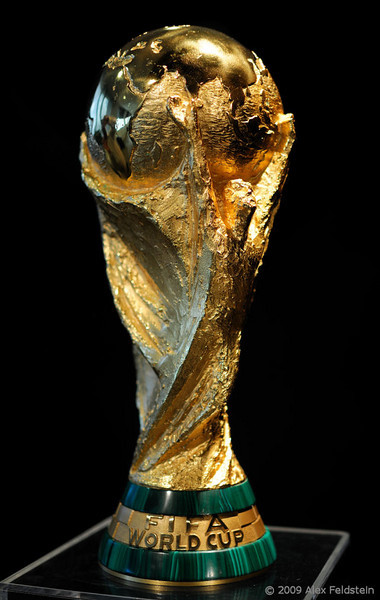
The FA’s first minute book records that the proposal was approved unanimously. The seven man committee that approved the resolution included the captains of the first final, Charles W. Alcock and Francis Maridin its referee Alfred Stair and the games only goal scorer Morton Peto-Betts. The idea was generally well favoured and at a subsequent meeting on October 16th, 1871 the rules for the competition were drafted. The original committee could never have imagined the time when their concept would become one of the most loved sporting events in England and would be seen by millions of people around the world. Nor could they have foreseen that it would become the forerunner to all knock out competitions including the World Cup, which has a worldwide audience of over one billion.

FA Cup Resolution No.10 001

Fifteen clubs entered the first competition: Barnes, Civil Service, Clapham Rovers, Crystal Palace, Hampstead Heathens, Harrow Chequers, Hitchen, Maidenhead, Marlow, Reigate Priory, Royal Engineers, Upton Park, The Wanderers, Queens Park of Glasgow and Donnington School. It was a somewhat erratic affair with Harrow Chequers, Reigate Priory and Donnington School scratching without playing a single game. Queens Park was given an exemption to the semi-finals due to the distance involved and the cost of travel, sides which drew were also allowed to move on to the next round. Queens Park received public donations which allowed them to travel to Kennington Oval for their semi-final against Scottish pioneers the Wanderers and played to a draw, a lack of funds ruled them out of a replay at the Oval so they were forced to withdraw from the competition.

The Wanderers faced the Royal Engineers in the final which was played at the Oval on March 16, 1872. Two thousand spectators paid a shilling each when the average weekly wage at the time was under twenty shillings. The crossbar was either a piece of tape or rope, teams changed ends after each goal and the field was unmarked inside the touchlines. The Wanderers, who were captained by Charles Alcock, won the game on a single goal scored by Morton Peto-Betts of West Kent, he was a member of the FA committee that had approved the birth of the FA Cup. Wanderers went on to win five out of the first seven FA Cups.

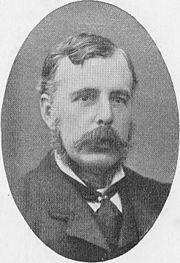
Morton Peto Betts was the scorer of the games only goal and the very first FA Cup Final goal but early reports indicated that the game was won with a “well placed shot under the tape” by A. H. Chequer, however this was actually Betts who played using the pseudonym of A. H. Chequer because he had started the competition as a member of the Harrow Chequer side, who had scratched without playing a game.

Here is a picture of Betts which was taken at Bickley Park Cricket Club in Kent.
Morton Peto-Betts 002

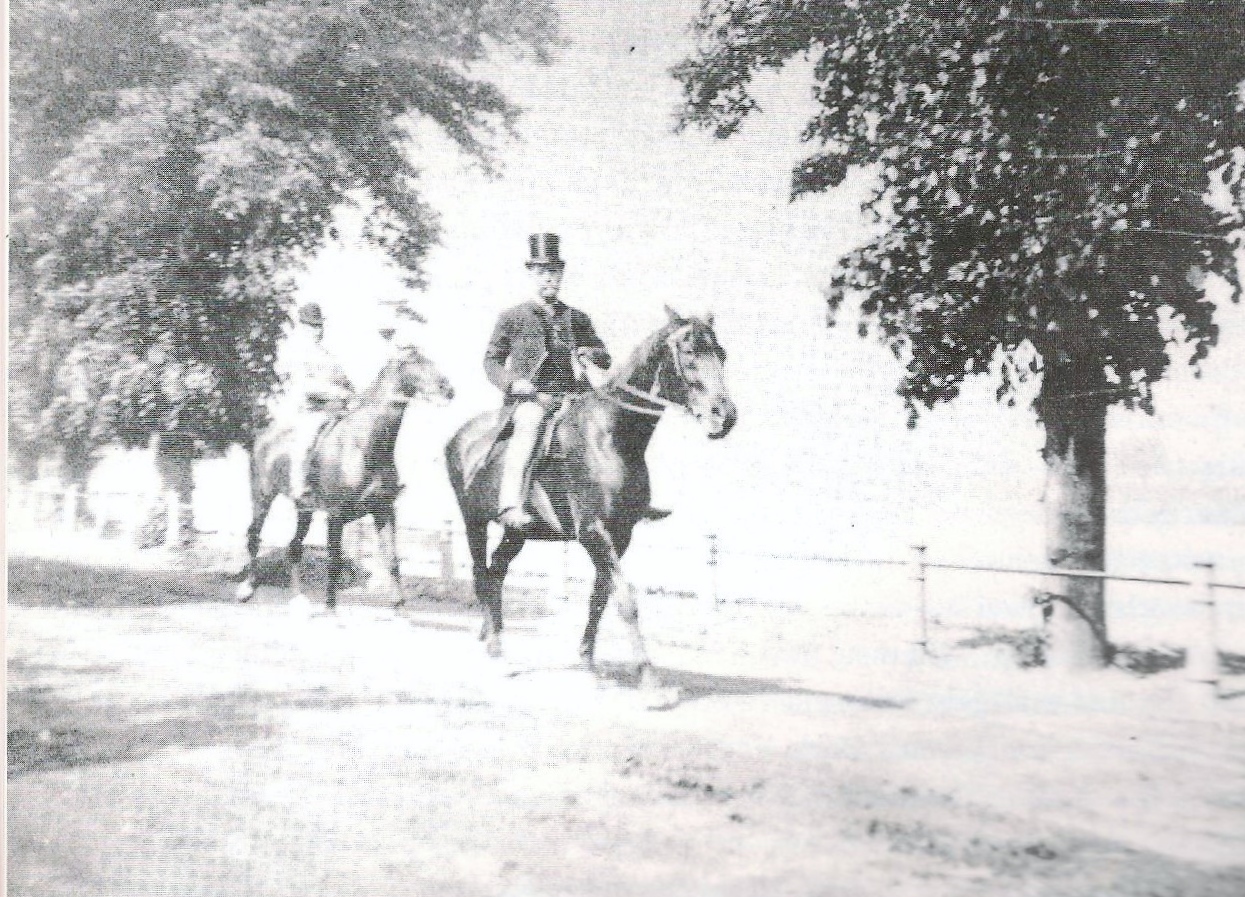
The president of the Football Association, Ebenezer Cobb Morley was the first man to present the FA Cup. The cup presentation took place four weeks after the Final at the Wanderers annual dinner at the Pall Mall Restaurant at Charing Cross.

Ebebezer Cobb Morley No.10 001

Fast forward to May 17, 2014 for the one hundred and thirty third FA Cup Final – the game will be between Arsenal and Hull City. Arsenal is appearing in its record eighteenth Final and has won the trophy on ten occasions, the last being in 2005, while Hull City will be making their first ever appearance in the Final.

This is the last Blast from the Past.
GunnerN5.


An Arsenal Blast from the Past No. 12 …… Players with the most club appearances. No. 1

May 2, 2014

Lets have a look at the only four players who have each made over Six Hundred appearances for Arsenal.

We start off with the only player to have played in over Seven Hundred games, David O’Leary; he is also the only player to have played for Arsenal in Twenty consecutive seasons. He appeared in an amazing Seven Hundred and Twenty Two games, from 1973 to 1993, a record that will be extremely difficult to exceed.

o leary

He was born in Stoke Newington, London on 2 May 1958 and moved to live in Dublin at the age of three. David played for Shelbourne as a schoolboy and signed for Arsenal as an apprentice in 1973. He quickly progressed through the ranks at Highbury, playing in the reserves at the age of 16. He made his first team debut  against Burnley on 16 August 1975, and despite being only 17, went on to make 30 appearances that season. For the next ten years he was ever-present in the Arsenal side, playing more than 40 matches a season (except for 1980–81, where he was injured and only played 27). When the former Arsenal manager George Graham was put in charge at Leeds United in September 1996, O’Leary was installed as his assistant. He remained in this position for two years until Graham moved to Tottenham.

David was voted into 21st position in the Arsenal Arsenal all time best players list.

Honours with Arsenal

Football League First Division

Winner: 1988–89, 1990–91

FA Cup

Winner: 1979, 1993

Runner-up: 1978, 1980

Football League Cup

Winner: 1987, 1993

European Cup Winners’ Cup

Runner-up: 1980

Records with Arsenal

Most appearances: 722

Most consecutive seasons 20

Youngest player to reach 100 and 200 games

400 appearances under the age of 26

These are some of his thoughts after Arsenal won the FA Cup replay in 1993.

“We did a lap of honour with the trophy and before I got to the tunnel I thought to myself “‘this is the last time I’ll ever wear the Arsenal jersey again”. It was an amazing night, a brilliant way to end 20 years, but it was such a sad night for me as well.”

It was a night that stretched well into the early hours as the players let off steam after making history. And O’Leary went home with an extra companion when the celebrations finally died down.

“That night – I’ll always remember this – I took the FA Cup home. No one else seemed to be responsible for it so I took it with me.

“My wife drove us home and I remember sitting in the front with the FA Cup in my lap and somebody pulled up at the lights, seconds before it went green, and he looked over and then looked over again, thinking ‘is that David O’Leary with the FA Cup?!’ We pulled away and I still don’t know if that guy thought he was imagining things.

“I remember getting home that night and I thought, if my house gets robbed they are not going to take the FA Cup, so I took the cup up to my bedroom. My kids were young then and the following morning they came in and saw the FA Cup there on the side of the bed.

“That morning I took it to the club and gave it to Ken Friar. I said goodbye to Ken, I actually went to the steps of the old directors’ box at Highbury, had a look out there for the last time, and said to myself ‘hey, it’s been a fantastic 20 years, I’ve been so proud to play here, thanks for putting up with me’.

“Then I walked away, and that was that.”

(Copyright 2013 The Arsenal Football Club plc.)

The player with the second most appearances at Six Hundred and Sixty Nine is Tony Adams, he played for a total of 19 seasons from 1983 to 2002.
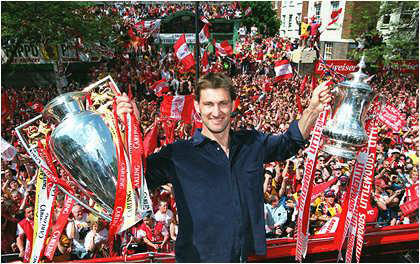
tony-adams 1
Born in Romford, London, Tony grew up in Dagenham, signing for Arsenal as a schoolboy in 1980. He made his Arsenal first team debut in November 1983 just four weeks after his 17th birthday and became a regular player in the 1985–86 season, winning the Football League Cup Final, his first major trophy, in 1987.

Alongside Lee Dixon, Nigel Winterburn and Steve Bould, he was part of the “famous back four” that lined up in Arsenal’s defence – they became renowned for the use of their well-disciplined offside trap. On 1 January 1988, he became Arsenal captain at the age of 21 and remained as such until his retirement 14 years later.

Nicknamed “Mr Arsenal”, he was honoured by Arsenal with a testimonial game against Celtic in May 2002 with many Arsenal legends playing, including Ian Wright, John Lukic and Adams’s fellow back four stalwarts, Dixon, Winterburn and Bould. The game finished 1–1 with Lee Dixon, in his final appearance for the Gunners, getting their goal.

In 2004, Tony was inducted into the English Football Hall of Fame in recognition of his impact on the English game. A statue of Adams was placed outside Emirates Stadium in celebration of the club’s 125th anniversary on 9 December, 2011. He has also been honoured with the MBE for his contribution to football.

Tony placed 3rd in the Arsenal Arsenal best all time player poll.
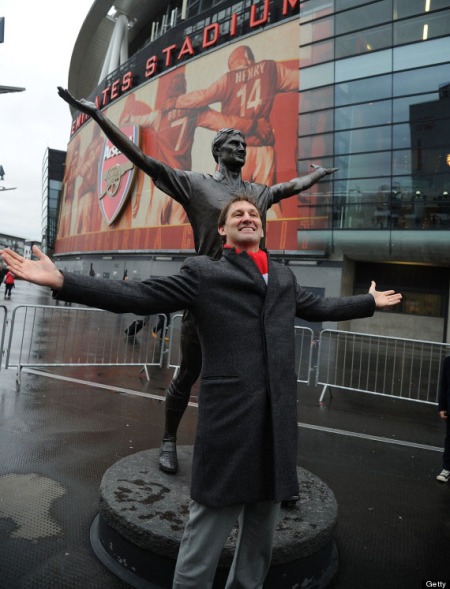
Arsenal v Queens Park Rangers - Premier League

Honours with Arsenal

First Division/Premier League: 1988–89, 1990–91, 1997–98, 2001–02

FA Cup: 1992–93, 1997–98, 2001–02

Football League Cup: 1986–87, 1992–93

FA Community Shield: 1991 (shared), 1998, 1999

UEFA Cup Winners’ Cup: 1993–94

Runner-up:

Premier League: 1998–99, 1999–2000, 2000–01

FA Cup: 2000–01

Football League Cup: 1987–88

FA Community Shield: 1989, 1993

UEFA Cup Winners’ Cup: 1994–95

UEFA Cup: 1999–2000

UEFA Super Cup: 1994

Individual Honours

PFA Young Player of the Year: 1987

PFA Team of the Year: 1994, 1996, 1997

Member in The Most Excellent Order of the British Empire (MBE): (1999 Birthday Honours)

Overall Team of the Decade – Premier League 10 Seasons Awards: (1992-93 – 2001-02)

Fantasy Teams of the 20 Seasons – Premier League 20 Seasons Awards: (1992-93 – 2011-12)

The player with the 3rd most appearances is George Armstrong, he played in Six Hundred and Twenty One games, in 16 seasons from 1961 to1977.
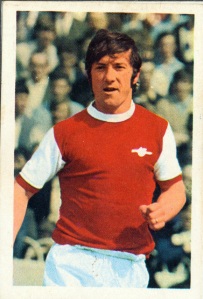
george-armstrong

Born in Hebburn, County Durham, George joined Arsenal as a youth player in August 1961. He made his debut against Blackpool in 1962 while he was still 17 and by the 1963-64 season he had become a regular in the side.

Over his long career with the Gunners, George became one of Arsenal’s most consistent players, and was noted for the quality and accuracy of his crossing and corner kicks, as well as for his tireless running up and down the wing; he primarily played on the left, but was also effective on the right. As he matured, he became one of the few players of the Billy Wright era (along with Jon Sammels and Peter Storey) to become an integral part of Wright’s successor Bertie Mee’s Arsenal side, which ended the club’s long trophy drought.

After losing two successive League Cup finals in 1967-68 and 1968-69, George helped the Gunners win the 1969-70 Inter-Cities Fairs Cup and the 1970-71 League and FA Cup double; he was a regular in the Double-winning team that season, setting up a number of goals for his team-mates, which included teeing up Ray Kennedy’s winning header against Tottenham Hotspur, in the match that won Arsenal the League title. He was also voted Arsenal’s Player of the Year in 1970.

In 1990, before the Iraqi invasion, he returned to England and joined Arsenal as reserve team coach, a post he remained at for the remainder of his life, despite the many managerial upheavals the club underwent.  On 31 October 2000, while conducting a club training session he collapsed after an unexpected brain haemorrhage; he died in Hemel Hempstead Hospital in the early hours of the following morning.

George had a pitch named after him at the Arsenal F.C. training ground, in London Colney

The player with the 4th most appearances is Lee Dixon, Lee appeared in Six Hundred and Nineteen matches in 14 seasons from 1988 to 2002 .

Lee Dixon of Arsenal

Born in Manchester, he was signed by Arsenal boss George Graham in 1988 following the departure of England right back, Viv Anderson, to Manchester United. This was the first time that he had played in the First Division and it took a while for him to be given a first team role at Highbury. Nigel Winterburn had been a guarded success in the unfamiliar role of right back, though Lee did make his debut against Luton Town in February 1988 and played six times in total before the season ended. In the new season, Winterburn moved across to left back, allowing Dixon to take over the No.2 shirt, which he duly did for well over ten years.

He and Winterburn made the full back positions their own for the next decade or so, while Captain Tony Adams and the long-serving David O’Leary operated in the middle. Later in 1988 they were joined by Steve Bould who, like Dixon before him, had been spotted by Graham playing for Stoke City. These five defenders, often playing as a back five together and were the foundation stones of much of Arsenal’s success.

His career at Arsenal saw him collect four league champion’s medals, three FA Cup winner’s medals and a UEFA Cup Winners’ Cup medal. He was named in the PFA Team of the Year twice, for the seasons 1989–90 and 1990–91.

His retirement came at the end of Arsenal’s domestic double-winning 2001–02 season, their second in his time at the club.

Lee came in 18th place in the Arsenal Arsenal all time best players poll.

GunnerN5