A Blast from the Past No. 11 The birth of the FA and International Football

April 26, 2014

The early years 1872 – 1900

C. W. Alcock, one of the founder members of The Football Association in 1863, was one of football’s visionaries. He was the inspiration for both the FA Cup and the annual fixture between England and Scotland, these two events sparked a huge interest in the game and it spread quickly, firstly through Britain, followed by Europe, Africa and then to South America and beyond. Due to his imagination football quickly became a national obsession and by the early 1900’s numerous clubs had been formed in the heart of the country’s industrial communities. Prior to Alcock’s vision, football played outside of the country’s top public schools was considered to be no more than a loose and disorganised riot.

The England – Scotland fixture was drawing crowds of 100,000 and spawned debates over team selection and tactics both before and after the games. His idea for the annual fixture came after he witnessed the enormous interest aroused by rugby’s first international between the two countries in 1872 and he saw the publicity potential in a Football Association equivalent. However his announcement of the fixture, in the FA minutes of October 3rd 1872, did not indicate any real excitement – it read;

“In order to further the interests of the Association in Scotland, it was decided that a team should be sent to Glasgow to represent England”

England Scotland scrum 1878 001

Following the first international game football boomed in Scotland and many new clubs came into existence. The associations intention was for them to teach and for Scotland to learn but in the first ten matches England were humiliated by Scotland only winning twice in the first ten games including losing 6-1 in 1881 and 5-1 in 1882 – and to compound their dismay they only won four of the first twenty fixtures. The Scottish Football association secretary Robert Livingstone did not like the English dribbling game, he thought it was suicidal and instead he adopted the tactic of kicking the ball up the field and running after it and it proved to be very successful. The popularity of the annual fixture was encapsulated in an article which appeared in Bells Life prior to the 1878 match.

“All available conveyances were picked up long before two o’clock and a continuous stream of hansoms, dog carts and buses kept pouring their living freight to the foot of Hamden Hill…every inch of the locality was covered by spectators, In some places, it was packed like herrings in a barrel, but the majority bore it with Christian resignation”

English team -1890 001

The English Football Association Team, 1890

1900 – 1914

The dawn of the twentieth century did nothing to change England’s fortunes Scotland subjected them to a 4-1 pounding at Parkhead. The Football Sun reported;

“As soon as the gates were swung open people flocked in and the long wait was enlivened by patriotic songs, not to mention the whisky”

Two years later football suffered its first major crowd disaster during the England- Scotland game at Ibrox when a stand collapsed. It left 25 dead and hundreds injured but most of the crowd were unaware of the catastrophe in their midst. Early reports indicated that there were only a few injuries so the decision was made to continue with the game to avoid widespread panic. The stand was new and Ibrox had an official capacity of 80,000 but it was estimated that over 100,000 were in the ground – which led to the disaster. The original game ended in a 1-1 tie and was later downgraded to a “friendly”. It was replayed at Birmingham a month later and ended 2-2 with the gate proceeds going towards the disaster fund.

Between the turn of the century and the start of WW1 Scotland continued to be England’s only real competition of the 53 official internationals England lost just 7 games, 5 to Scotland and 2 to Ireland.  The 1909 Home Championship came within a whisker of being cancelled due to industrial unrest across England. The Players Union affiliated itself to the General Federation of Trade Unions and strike action in support of the miners threatened to bring the country to a standstill.

With just days left before the matches were due to begin the Players Union issued a statement announcing that “England would play and do their utmost to win” This was interpreted to mean that the team contemplated deliberately losing. The FA insisted that the players sign a statement declaring their determination to win. England went on to win the Championship without conceding a goal.

England players in 1911 001

England players conferring during a match in 1911

1919 – 1939

The 1920’s were an unsuccessful decade in England’s history. Following WW1 England, and other allied football associations, made the decision not to play against Germany, Austria or Hungary or any other country that agreed to play against their former enemies. This decision was shelved, two years later, when it became apparent that there was no reasonable opposition left to play against. But despite this change of heart England’s only foreign opponents were Belgium, France, Luxembourg and Sweden.

The 1930,s began promisingly with a triumph in the Victory International over Scotland; the game was played in appalling conditions and England’s team, nine of whom had seen service in WW1, found themselves 4-2 down at half time.  But in the second half, despite the continuous downpour, they turned the game around and won 5-4. Andrew Ducat, a member of the English team, died while batting at Lord’s during WW2. The win proved to be only a brief respite for England as they only won 6 of the next 17 games against Scotland during this period and had to wait until 1930 to win their first Home Championship since 1913.

Everton’s Dixie Dean played his first game for England against Wales on February 12th, 1927.  In the 1927/28 season he scored an astonishing 60 league goals, including a hat trick against Arsenal in the last match of the season, a record that is unlikely ever to be broken

Dixie Dean 001

England had a habit of stepping up their performances in important games and this showed in games against Italy and Germany. The match against Italy in 1934 was dubbed “The Battle of Highbury” it proved to be so violent that The FA seriously considered ending its participation in international football. Italy were the reigning World Champions and Italian newspapers called it the most important football game played anywhere in the World since the Great War.

An ankle injury to Italy’s Monti after just 3 minutes sparked a match of unrelenting violence. Centre- forward Ted Drake one of 7 Arsenal players in the line up, was punched on the chin early on and Captain Eddie Hapgood suffered a broken nose after a deliberate elbow flattened him. England went up 3-0 and after the game Hapgood recalled that the Italians started to hit everything in sight and fought back to 3-2. Arsenal’s Wilf Copping was in his element, he was considered to be the “hardest” man to ever pull on an England Shirt. His specialty was the, then legal, two footed lunge and he shoulder charged and tackled with ferocious enthusiasm. He more than any other player saved the day for England when their goal was under siege and they hung on for a famous, but ugly, victory.

England vs Italy 001

England’s Captain Eddie Hapgood wasn’t smiling after his nose was broken.

England faced Germany on May 15th, 1938 amidst a growing tension between the two nations, like Mussolini, Hitler’s Nazi re3gime understood the symbolic power of sport and the game against Engald provided an ideal arena for their propaganda machine.

110,000 spectators greeted the players in Berlin’s Olympic stadium amid a mass of red swastika flags with just the odd Union Jack.

Amid a storm of controversy back home English diplomats had agreed that the English team would give the Nazi raised arm salute. Captain Eddie Hapgood later reflected;

“I’ve been in a shipwreck, a train crash and inches short of a plane crash but the worst day of my life was giving the Nazi salute in Berlin”

Hitler was desperate for a symbolic victory over the mother country of football but the German team proved to be no match for Stanley Matthews and company and England ran out 6-3 winners.

England vs Germany 001

Action from the game in Olympic stadium May 15th, 1938

More to come………..

GunnerN5


1936 and Arsenal win their 2nd FA Cup

April 18, 2014

It’s April 25th 1936 and Arsenal return to Wembley to face Sheffield United in their fourth FA Cup Final in nine years. Previously they lost 1- 0 to Cardiff City in 1927, won their 1st FA Cup in 1930, by beating Huddersfield Town 2-0, and then lost to Newcastle United 2-1 in 1932. Having won their first League Championship in 1930 and then again in three consecutive seasons from 1933 to 1935 they were now looking to add a second FA Cup to their 1930’s trophy collection. Herbert Chapman had died, suddenly, two years before and David Jack had hung up his boots. George Allison who was BBC Radio’s first football commentator, was now the new Arsenal manager. The attack was led by the formidable Ted Drake, who earlier in the season had scored seven goals against Aston Villa.

1936 FA Cup Final

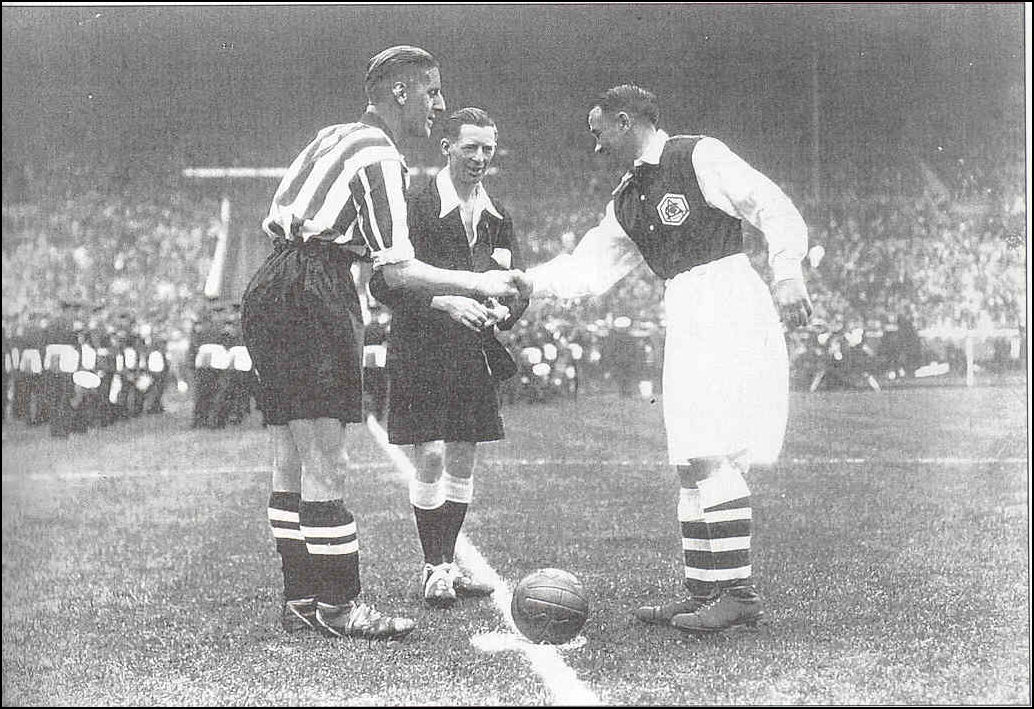
1936finalkickoff

Harry Hooper of Sheffield United and Alex James of Arsenal shake hands at the start of the match.

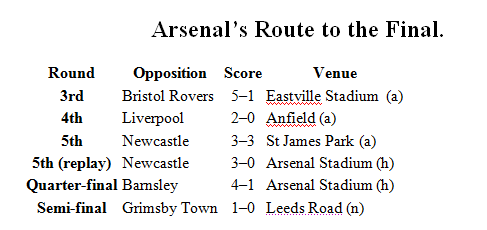
The 1936 FA Cup Final was the sixty fourth and the fourteenth at the national stadium. Each team received a bye to the third round of the tournament, and then progressed through five rounds before reaching the final.

blast 10 1
Both Arsenal and Sheffield United were seeded into the third round of the FA Cup. In the third round itself, Arsenal was drawn away against Third Division South, Bristol Rovers Arsenal missed a penalty, and the third Division team went a goal up in the first half; Arsenal were playing so poorly that it seemed they would struggle even for a draw. The turnaround in the match occurred when manager George Allison moved Cliff Bastin to the inside left position. Arsenal equalized in the 65th minute, and scored a further four times over the course of the following fourteen minutes to win the game by five goals to one, with a single goal from Bowden and two each from Ted Drake and Cliff Bastin.

They followed this in the fourth round with a 2–0 victory over Liverpool Anfield. The match was played seven days after the death of King George V, with both teams wearing black armbands. The crowd of 60,000 stood to sing Abide by Me and God Save the King before the kickoff. In the fifth round they were drawn against Newcastle United, in a rematch of the 1932 final Newcastle had already knocked out the current cup holders, Sheffield Wednesday, in an earlier round. On the day, the gates to St James Park needed to be closed before the match started to keep additional spectators out, some 64,484 fans already being inside the ground. The match resulted in a 3-3 draw, Arsenal having gone a goal ahead each time, but Newcastle coming back and equalizing, in the replay at home, Arsenal won the game 3–0. They had gone a goal up in the first half from a penalty scored by Clifff Bastin after the Newcastle centre half handled the ball in the box. The second goal came during an advance by Arsenal, where the Newcastle goalkeeper, Norman Tapken, cleared the ball directly to Arsenal midfielder Pat Beasley, who promptly shot the ball into the back of an empty net. The final goal was another penalty, caused when Cliff Bastin was brought down in the box, who then took and scored the goal himself.

In their quarter final, they defeated Second Division Barnsley 4–1, having outplayed them right from the start, the first goal coming in the fourth minute from Pat Beasley in an attacking move. Bowden scored the second goal, and the third came from a penalty scored by Bastin. The fourth and final Arsenal goal was Beasley’s second, with Barnsley’s consolation goal coming a couple of minutes from the end of the match. In the semi final, played at Huddersfield Town’s ground, they defeated Grimsby Town 1–0 in a match that was described by reporters as completely one sided, with the goal coming from Bastin five minutes before half time.

Arsenal played in red and white shirts in an FA Cup final for the first time, on previous occasions in 1930 and 32 they wore fully red shirts. Additionally, before the 1967/68 season, Arsenal only wore team badges on their shirts on special occasions, such as FA Cup Finals. The 1936 cup final was the fourth occasion such a badge was worn.

150px-Arsenal_Crest_1936.svg The following is a match report that was taken from the Daily Telegraph
DRAKES GOAL WINS CUP FOR ARSENAL
SHEFFIELD UNITED NEARLY WIN MATCH
Drama of Dodds Header That Hit Post *
A Champagne Shampoo
By Frank Coles

Arsenal are Cup holders again for the second time in six years As expected, they beat Sheffield United in Wembley’s fourteenth Final Tie, but not as comfortably as 2-to-1-on favourites are supposed to win .
The honours of a match which rarely produced a high standard of play should go to Sheffield United, whose defence held out for an hour and a quarter and who twice narrowly missed taking the lead before Drake scored.

In winning the Cup for Arsenal at the 29th minute of the second half, Drake accepted the only scoring chance that came his way The opening was made by Bastin, who tricked Hooper very cleverly before pushing the ball squarely across to his unmarked centre-forward.

It was the kind of opportunity Drake had been waiting for all the afternoon and, quick as thought, he swung his left leg at the ball Before Smith, the goalkeeper, could move an inch a crashing drive had found the roof of the net.

Sheffield United could argue with justification that Bastin, might not have put Drake through if Hooper had not been handicapped by a leg injury They could also point to the fact that Jackson, playing immediately in front of Hooper, was also limping.

Drake’s goal gave new life to a game which for the greater part of the second half, had lapsed into a dull, humdrum affair, so lacking in quality and thrills that the 93,000 crowd was almost silent.

BAD LUCK FOR UNITED
However, a touch of genuine drama was to follow No sooner had United set the ball rolling again than Barton streaked past Hapgood and swung over a beautifully accurate centre Dodds, pounding down the middle, got his head to the ball and a thrilled crowd yelled “Goal!

But no, the ball hit the crossbar with a bang instead of going into the net, terribly bad luck for United. They had struck back gallantly, and for practically the first time Arsenal’s magnificent defence was shaken The movement, swift and sudden skilfully executed was a reminder of what had happened in the opening quarter of an hour, and it set me wondering why United did not exploit their five-men-up attack more often. As I had prophesied, United were an extremely dangerous team in the first 15 minutes because they were willing to gamble on attack They threw the last ounce into a grand assault on Arsenal’s goal and, as early as the third minute, nearly succeeded

BRILLIANT DEFENDERS
For 20 minutes United had Arsenal’s defence at full stretch All this time Smith, in the United goal, was a spectator When, at length, he was called into action he ought to have been beaten; from Bastin’s pass Bowden had an easy scoring chance To the undisguised dismay of Drake, who was by his side, Bowden shot weakly outside the post.

This, Arsenal’s first rejoinder to United’s beginning gesture, marked the transfer of the initiative. Whereas Arsenal’s goalkeeper was untroubled for the remainder of the opening half, Smith became the busiest man on the field incidentally, he proved himself a first-class workman.

The half hour after the interval did not provide the onlookers with much excitement.

Fortunately, Drake’s goal and United’s bid to save the match made the last quarter of an hour worth while, but I am bound to say that as a spectacle this latest Final Tie disappointed me. The Sheffield forwards were unlucky. On their first Wembley appearance they met the most astute defence in the country And if they had shown a sign of wavering, United’s attack assuredly would have won the match.

Barclay and Pickering, the inside forwards, were a long way ahead of Bowden and James They tried mightily hard to draw a cast-iron defence by holding the ball, and their understanding with the wing men was excellent.

At outside right Barton was as effective as Hulme, without attempting to be as spectacular – he was always a worry to Hapgood – and, until he was slowed down by injury, Williams was dangerous, despite the fact that he was up against Male, the best back on the field.

The experience of Dodds was in one respect similar to that of Drake Both met master stoppers But Dodds was given a far better service than Drake received If his luck had been good he would have converted a flashing cross from Williams midway through the second half The pace of the ball just beat him

I have described Male as the outstanding back Second to him I rate Hooper, United’s captain, who had the difficult job of subduing Bastin. Johnson, the centre-half, also played a great game.

Arsenal – Wilson, Male, Hapgood, Crayston, Roberts, Copping, Hulme, Bowden, Drake, James (Captain), Bastin

Sheffield United – Smith, J, Hooper (Captain), Wilkinson, Jackson Johnson, McPherson, Barton, Barclay, Dodds, Pickering, Williams

Referee H Nattrass (Durham) Linesmen: J M Wiltshire (Dorset) and Dr A W Barton (Amateur FA.)
Attendance 93.384

ted drakes winning goal
Ted Drake’s winning goal.

It was Arsenal’s sixth success in League and Cup in seven seasons but their triumph did not get the deserved news coverage. A dispute over terms between Wembley and the news reel companies led to the ban on film cameramen inside the stadium. The companies still took to the air and shortly before kick off a whirl of auto-giros rose above Wembley. The only film taken inside the ground was an official one.

alex james

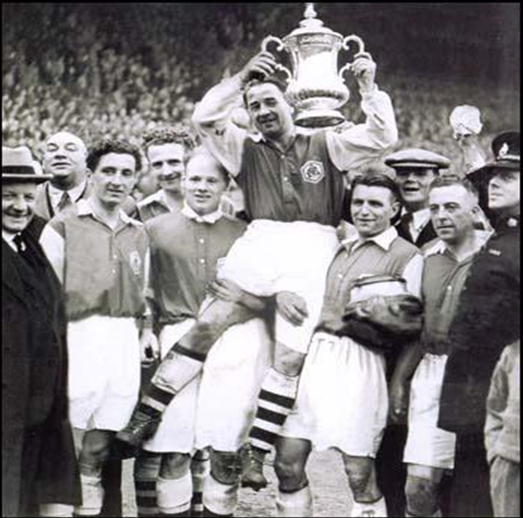
Alex James holding the 1936 FA Cup.

GunnerN5


An Arsenal Blast from the Past No. 9 …… George Graham – his Arsenal Years

April 11, 2014

George was the youngest of seven children, his father died of tuberculosis when he was less than a month old. He displayed considerable promise as a young footballer, and was signed by Aston Villa on his 17th birthday, in 1961, but only made eight appearances for them in three seasons. He was transferred to Chelsea in July 1964 where he scored 35 goals in 72 league games and also and won a League Cup medal in 1965, however his time at the club became uncertain after he clashed with his volatile manager Tommy Docherty.

At the time Arsenal were looking for a replacement for Joe Baker, and paid £75,000 plus Tommy Baldwin in 1966 to bring gg1Graham to Highbury and he immediately became a first team regular and was Arsenal’s top scorer in both 1966–67 and 1967–68. After being a runner-up in both the 1968 and 1969 League Cup finals, he finally won a medal with Arsenal’s victory in the1969–70 Inter-Cities Fairs Cup. He followed it up by being a key member of Arsenal’s Double-winning side of 1970–71. Midway through the 1971-72 season Alan Ball became an Arsenal Player which led George to being transferred to Manchester United in December 1972. He had played in 308 matches for Arsenal, scoring 77 goals.

After retiring as a player he turned to coaching and managed at Crystal Palace, Queens Park Rangers and then Millwall. He guided Millwall from bottom of the old Third Division to the old Second Division and after he left the club in 1986, they went on to win the Second Division gaining promotion to the First Division in 1987–88.

In the mean time Arsenal were going through a torrid period in their history and had only won 4 trophies in the 33 year period from 1953-54 to 1985/86. The European Fairs Cup in 1969/70 and the double in 1970/71, under Bertie Mee then there was an eight year wait until we won The FA Cup under Terry Neill in 1978/79. The club dismissed manager Don Howe in March 1986 following yet 3 more trophy less seasons and finishing an average of seventh in the league.

Arsenal expressed interest in appointing Aberdeen manager Alex Ferguson as their new manager with Graham as his assistant but Ferguson decided to wait until after the World Cup that summer before deciding on his future, and so the Arsenal directors gg man3appointed Graham as the new manager on 14 May 1986. Graham cleared out much of the old guard and replaced them with new signings and players promoted from the youth team, while imposing much stricter discipline than his predecessors, both in the dressing room and on the pitch. Arsenal’s form immediately improved, so much so that the club were top of the League at Christmas 1986, the club’s centenary, for the first time in a decade but they eventually finished in fourth position. The following season they went on to win the 1987 League Cup and reached the final again in 1988 where they suffered a shock 3–2 defeat to Luton Town.

His sides displayed tight defensive discipline, embodied by Captain Tony Adams, who along with Lee Dixon, Steve Bould and Nigel Winterburn, formed the basis of the club’s defence for over a decade. To compliment his stingy defence he also had capable midfielders like David Rocastle, Michael Thomas and Paul Merson, plus a prolific striker in Alan Smith.

At the end of his third season in charge (1988-89) Arsenal won their first League title since 1971, when Graham had been an Arsenal player, and they won in a highly dramatic fashion, in the final game of the season against Liverpool at Anfield; Arsenal needed to win by two goals to take the title; Alan Smith scored for Arsenal early in the second half to make it 1–0, but as time ticked down Arsenal struggled to get a second, and with 90 minutes gone on the clock, Arsenal still needed another goal. With only seconds to go, an Alan Smith flick-on found Michael Thomas surging through the Liverpool defence he calmly lifted the ball over Bruce Grobbelaar and into the net, and Arsenal were League Champions. After finishing fourth in 1990, he signed goalkeeper David Seaman and Swedish winger Anders Limpar in the close season; both players proved to be important as Arsenal went on to win Graham’s second title in 1990–91. In the autumn of 1991 season he signed Arsenal’s eventual second all-time top scorer Ian Wright and gained the club’s first entry in the European Cup for 20 years.

champions1991

After the 1991-92 season he changed the teams tactics; he became more defensive and turned out far less attack-minded sides, which depended mainly on goals from Wright rather than the whole team. Between 1986–87 and 1991–92 Arsenal averaged 66 League goals a season (scoring 81 in 1991–92), but between 1992–93 and 1994–95 only averaged 48; this included just 40 in 1992–93, when Arsenal finished 10th in the inaugural season of the FA Premier League, scoring fewer than any other team in the division and 1-0 to The Arsenal began to echo around the grounds.

cc cup

In the 1992–93 season Arsenal became the first side to win the FA Cup (in a replay) and League Cup double, beating Sheffield Wednesday on both occasions by a 2–1 score. The next season they continued in the same vein, winning the UEFA Cup Winners’ Cup, their second European trophy; in the final Arsenal beat favourites and holders Parma 1–0 with a typically tight defensive performance and Alan Smith’s 21st minute goal.

Unfortunately the 1994 Cup Winners’ Cup proved to be George Graham’s last trophy at the club; the following February he was dismissed by Arsenal after nearly nine years in charge. It was discovered he had accepted an illegal £425,000 payment from Norwegian agent Rune Hauge following Arsenal’s 1992 acquisition of John Jensen and Pål Lydersen, two of Hauge’s clients. After admitting he had received an “unsolicited gift” from Hauge the Football Association banned him for a year – due to his involvement in the scandal.

The Arsenal statement

“Arsenal FC has now been informed by the FA Premier League Inquiry of the results of their investigations into alleged irregularities concerning certain transfers and the Board have concluded that Mr Graham did not act in the best interests of the club. The Board have therefore terminated Mr Graham’s contract as manager. The chairman said that it was sad that Mr Graham’s distinguished career with Arsenal FC should have to end in this way and he paid tribute to Mr Graham for the success that he had brought to the club over the past eight and a half years. Stewart Houston will assume the responsibilities of manager.”

It was an unpleasant way to bring his career at Arsenal to an end.

GunnerN5


An Arsenal Blast from the Past No. 8 1970/71 – Arsenal’s 1st Double

April 4, 2014

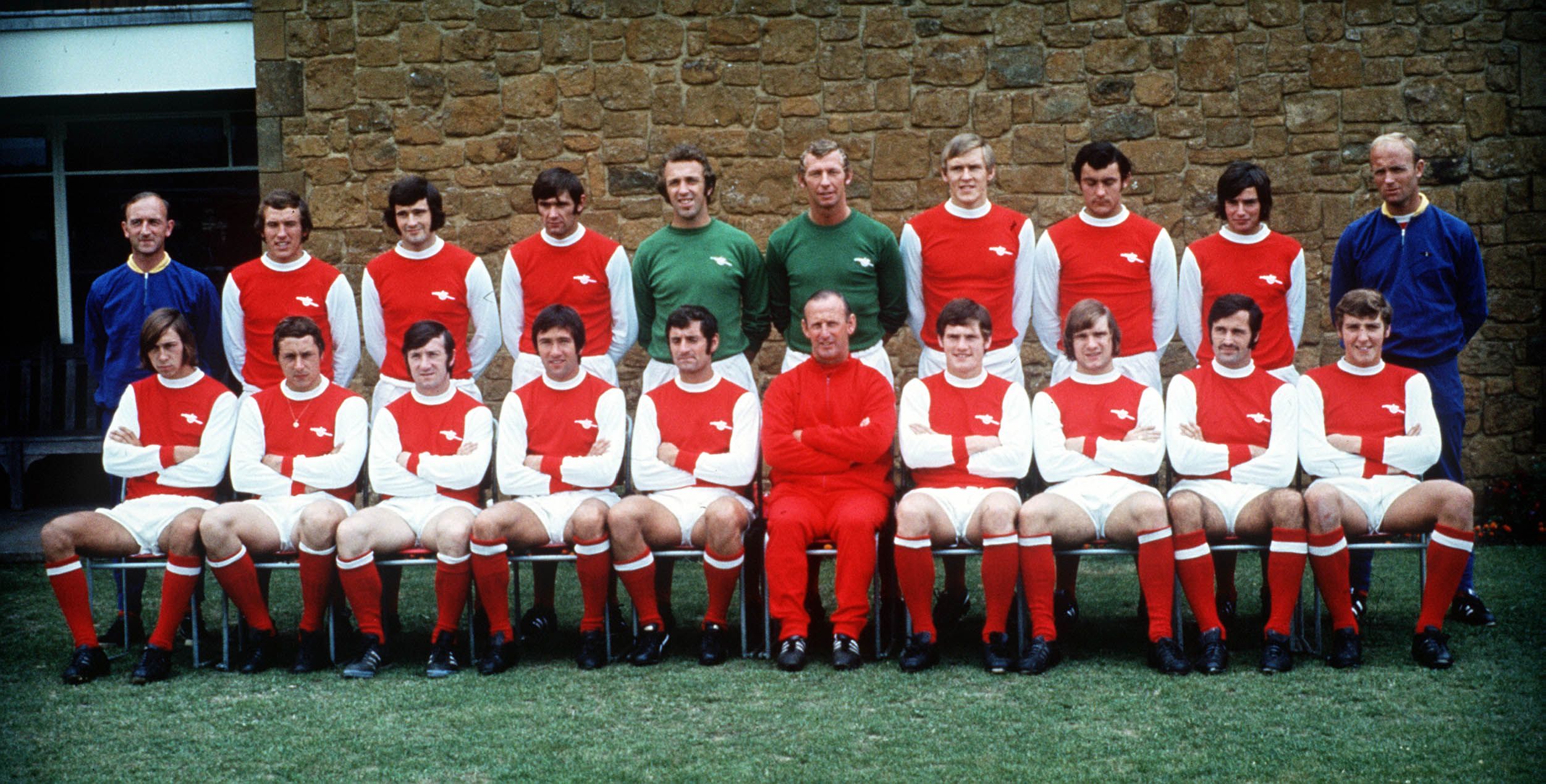
Let’s start off with a picture of one of our most Famous teams.

1970 71 team photo

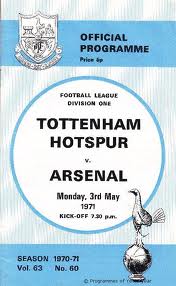
Arsenal’s first double in 1970/71 was a triumph for collective efficiency and steely resolution. At one point in the league they were seven points behind Leeds United and of all places to go the Gunners had to travel to White Hart Lane, for the final game of the season on Monday May 3rd, 1971. They knew that they needed either a win or to secure a scoreless draw to bring the title back to Highbury for the first time since 1953. A score draw would not do as Leeds United was waiting hoping for an Arsenal slip-up.

programme

51,192 fans managed to squeeze into White Hart Lane (The Cockerel Coop) with thousands of fans outside hoping to get in – (GN5 included, but sadly to no avail). Spurs were desperate to deny Arsenal the bragging rights in North London. It was a difficult situation to be in for the Gunners as oddly enough if they scored, they still couldn’t dare concede for as I mentioned above, a score draw would have shattered Arsenal’s dreams.

A Spurs goal at any stage was most unwelcome. Tottenham goalkeeper Pat Jennings was in splendid form and made many fine saves throughout as Arsenal tried to break the deadlock. In the end, Arsenal was the team to break that deadlock.

In the 88th minute, Ray Kennedy headed in a George Armstrong cross via the underside of the bar.

kenedy goal

The goal only meant Tottenham increased their pressure further in hopes of preventing Arsenal winning the title. A Tottenham goal would have been enough for Leeds to win the title, but there was very limited time for them to do it in.

In the end Arsenal prevailed. Bob Wilson prevented any Spurs equaliser from happening and Arsenal sealed the first half of the Double by winning the league in front of Tottenham supporters at White Hart Lane, much to the delight of our ecstatic fans.

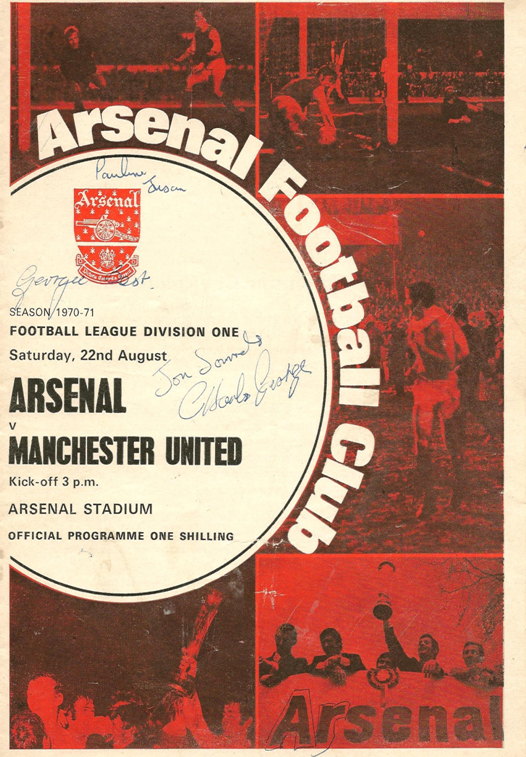
One of GN5’s program’s from the Double season with some very famous autographs.

gn5s programme

Next up was the FA Cup Final at Wembley on Saturday May 8th, 1971 – it turned out to be a classic encounter with Liverpool in front of a crowd of 100,000 raving supporters.

Arsenal had been drawn away in every round of the Cup and in the semi-final were 2-0 down to Stoke City, before equalising with a very controversial last minute penalty.

peter storey

This forced a replay at Villa Park four days later, a game Arsenal won 2-0 with goals from George Graham and Ray Kennedy.

Now to the small matter of the most important game in our history – The FA Cup Final

A victory over Liverpool would give us our 1st League and Cup double.

Due to the clash of Liverpool’s red strip with Arsenal’s red and white colours, Arsenal wore their away strip of yellow shirt and blue shorts.

Arsenal won 2–1 after extra time, with all three goals coming in the added half hour. Steve Heighway opened the scoring for Liverpool with a low drive past Bob Wilson on his near post. However, Arsenal equalised with a scrambled goal from substitute Eddie Kelly – the first time a substitute had ever scored in an FA Cup final. The goal was initially credited to George Graham, but replays showed that the decisive touch came from Kelly after Graham had struck the shot. Charlie George then scored a dramatic winner late in extra time, when his long range effort flew past Ray Clemence. This prompted George into a famous celebration – lying on his back on the Wembley turf waiting for his team mates to pick him up.

CharlieGeorge_468x301
The match was played in a great spirit of sportsmanship by the players and was responded to as such by the fans. When Liverpool’s Lawler was floored with cramp late in extra time, he was helped to recover by two Arsenal players. Arsenal’s victory – and double win after a gruelling 64-match season – was greeted with an ovation by both their own and Liverpool’s fans at the stadium, and Liverpool were also cheered by both sets of fans as they took a lap of honour after the presentation of the trophy and medals.

c g with medals
This picture is reprinted from Gunner N5’s original copy of the Evening Standard. Boy oh boy – that’s hair to make even our own Kelsey jealous.

Finally some more details of the Double winning team.

newspaper
GunnerN5


It’s 2017 and FFP has failed – what next for Arsenal?

April 3, 2014

Picture this. The year is 2017 and the corrupt authorities in charge of The Beautiful Game have managed to wiggle their way around FFP to accommodate the needs and wishes of their new very wealthy football owning chums. Of course these friendships have nothing to do with the Christmas Presents.

Also, you will have noticed that since 2014  Newcastle, Liverpool and Totteringham have also “oiled-up”. The net result of all this is that Cup upsets such as The Wigan did a few years ago have been condemned to history.

Arsenal have been condemned to eternal also rans and simply play each season to avoid relegation, followed by playing beautiful football to entertain the reduced numbers at The Emirates now that the glory hunters have gone.

The new European Super League is in full swing, which admittedly gives us mid weeks off.

A little history now. Arsenal at some point were the wealthiest club in England, and some fans really couldn’t care less who owns the place.

My question is this: suppose we found a good guy with squillions and a deep love of football and Arsenal in particular, would this change our minds?

In other words, is there ever a time when you would consider it ok for Arsenal to Oil Up?

MickyDidIt89


An Arsenal Blast from the Past No.7 – The Post War Years.

March 28, 2014

Arsenal_fc_old_crest

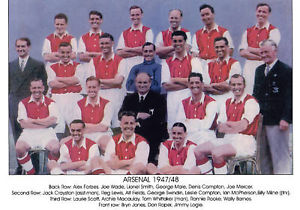
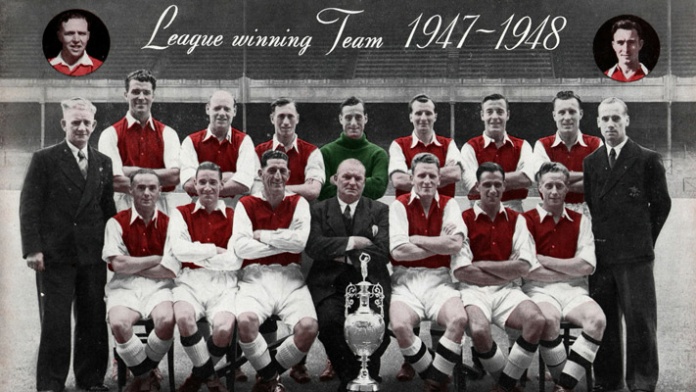
On taking over from George Allison, Tom Whittaker enjoyed immediate success by leading Arsenal to their sixth League Division 1 Championship in 1947/48.

1947 48

Tom needed to start changing his team the aging stars in the squad could no longer keep up with the strenuous work routines. He brought in Doug Lishman, Alex Forbes and Cliff Holton but even with the new players Arsenal was unable to challenge for the league title.

The 1950/51 FA Cup proved to be a different story:

3rd Round Arsenal 1 Sheffield Wednesday 0

4th Round Arsenal 2 Swansea Town 1

5th Round Arsenal 2 Burnley 0

6th Round Arsenal 1 Leeds United 0

Semi Final Arsenal 2 Chelsea 2

SF Replay Arsenal 1 Chelsea 0 after extra time with Freddie Cox scoring the winning goal.

Both the Semi final and the Replay were played at White Hart Lane.

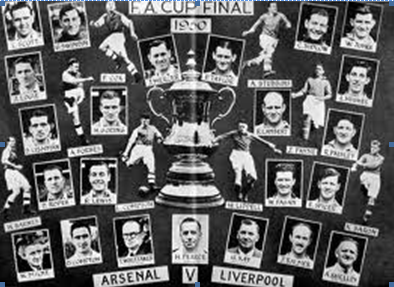
In the final Arsenal met Liverpool at Wembley on April 29th 1950 in front of a crowd of 100,000 – although some reports claim 127,000 were at the game.

team in programme

The Arsenal team consisted of : George Swindin, Laurie Scott, Walley Barnes. Alex Forbes, Leslie Compton, Joe Mercer, Freddie Cox, Jimmy Logie, Peter Goring, Reg Lewis and Denis Compton.

Denis Compton was now nearing the end of his career as a footballer, he experienced an indifferent first half so during half time he was given a stiff brandy, in the second half he perked up and played a major part in a sparkling move which led to Reg Lewis scoring his second goal of the game.

Arsenal won the game 2-0 to claim their third FA Cup trophy.

Later in 1950 Leslie Compton became the oldest England debutant at 38 years and sixty five days in a game against Wales. Denis and Leslie were also Middlesex cricketers but Denis was more than just a first class player he was a brilliant batsman and scored over 123 centuries.

1951-52 saw the club nearly win their first Double, but it ultimately ended in disappointment; a series of injuries and a fixture pile-up at the end of the season saw Arsenal lose their last two matches, including the title decider against eventual champions Manchester United at Old Trafford on the last day of the season; the Gunners finished third, equal on points with Tottenham. A week later, Arsenal played Newcastle United in the FA Cup final, with several recovering players rushed back into the first team; Walley Barnes was taken off injured with a twisted knee after 35 minutes (no substitutes were allowed then), and ten-man Arsenal suffered further injuries so that by the end of the match they had only seven fit players on the pitch; Newcastle took full advantage and won 1-0.

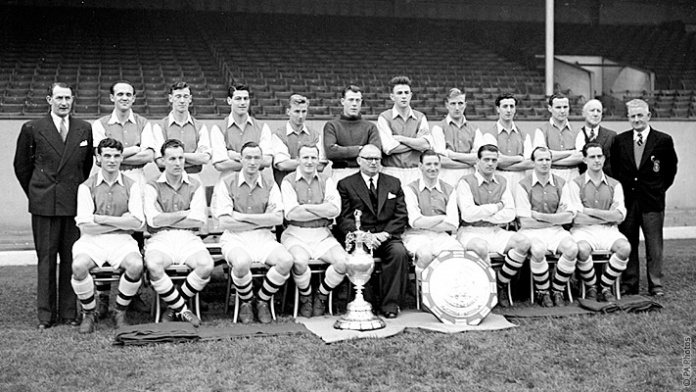
Unbowed by the disappointment of the previous season, Arsenal won their seventh League title in 1952-53; in one of the closest title races ever, they beat Preston North End to the title on goal average after finishing level on points.

gun__1367406903_arsenal_1953b

1952/53 League Division 1 Champions

That proved to be Arsenal’s last trophy for seventeen years; unable to attract many stars, the club’s fortunes began to wane, particularly after the unexpected death of Tom Whittaker in 1956. Apart from finishing third in 1958-59, Arsenal usually figured around mid-table. Nor did the club have much luck in the FA Cup – after reaching the final in 1952, Arsenal would not get beyond the quarter-finals again until 1971.

photos

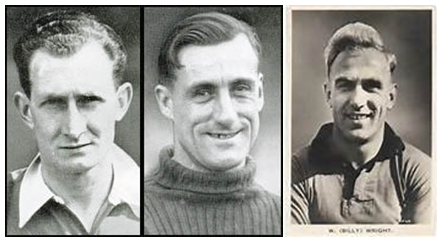
Jack Crayston and George Swindin, both former players, followed Whittaker as manager but could not replicate his success. In 1962, Arsenal made the bold but ultimately unsuccessful step of appointing England legend Billy Wright as manager, despite his lack of managerial experience. Like his predecessors, Wright could not achieve much either, although it was under his leadership that the club made their debut in European competition, in the Fairs Cup after finishing seventh in 1962-63. In his final season, Arsenal finished 14th, their lowest position in 36 years, and recorded the lowest-ever attendance at Highbury (4,554).

GunnerN5


Irresponsible Arsenal …… it’s not just the loss of 3 points

March 27, 2014

I know I should be over it by now but the 6 nil loss to chelsea has ramifications that go way beyond just the loss of 3 points. The only word I can come up with to describe the way we played in that game and the other two heavy losses is ‘irresponsible’.

GoonerB and others have commented on how our performance against Swansea was evidence of the psychological effect on the team of such a heavy defeat. The games immediately after our other two drubbings were also drawn – so the loss of 3 points becomes 5.

But beyond the fact that it is a graphic illustration of our vulnerability against top sides, there is a more potentially damaging effect to these losses. We’ve conceded 17 goals in 3 games to Liverpool, Man City and Chelsea (a net loss of 13 goals). Our goal difference is currently 19 whereas Everton’s is 16. They are 6 points behind us with a game in hand. If we lose to City by just one goal and they beat us at Goodison, we would be equal or behind them on goal difference – that could cost us 4th place.

Everton are a team in the ascendancy and Arsenal are a team whose confidence is in shreds, and that in part is of our own making. It would appear that at no point in those games did we consider damage limitation – no, we continued to play into the opposition’s hands and they continued to punish us.

The game against City is not just another 3 points. It’s our last chance this season to show that we can man up and go toe to toe with a top team and not capitulate if we go behind. A big loss to City and our season will be in freefall and Everton will be favourites to grab 4th place and Champion’s League football next season.

Rasp


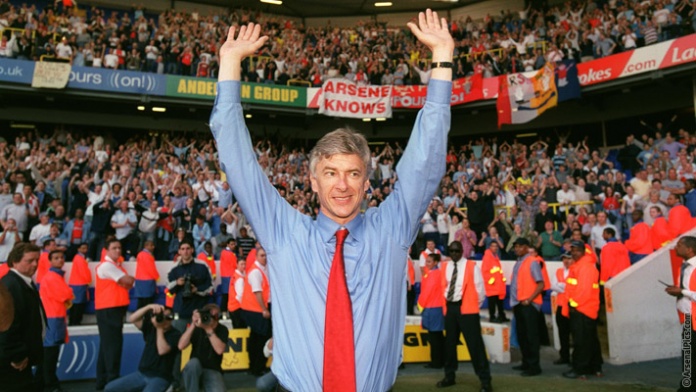
“Arsène Knows” – a celebration of 999 games.

March 20, 2014

AV1A

Arsène Wenger’s 1st game on Oct.12th 1996 – a 2-0 away victory over Blackburn Rovers

In August 1996, Arsenal dismissed manager Bruce Rioch and former Barcelona player and manager Johan Cruyff was the odds on favourite to take over; however Arsenal appointed a relative unknown named Arsène Wenger.

He officially took over the reigns on October 1st 1996. Arsène was a close friend of club vice-chairman David Dein, whom he first met during a match between Arsenal and Queens Park Rangers in 1988. The Evening Standard greeted his appointment with the headline “Arsène Who?” Arsenal finished third in his first season and missed out on a Champions League qualification place to Newcastle United who was in second place based on goal difference.

In his second season, Arsenal won the Premier League and FA Cup to complete the second league and cup double in the club’s history. Arsenal had to overcome a 12-point deficit on league leaders Manchester United in the final few weeks of the season. Arsenal’s success was built on an already stalwart defence which consisted of Tony Adams, Steve Bould, Nigel Winterburn, Lee Dixon and Martin Keown with David Seaman in goal. The defenders contributed to a run of eight consecutive clean sheets between January and March 1998.

Arsène thought of striker Dennis Bergkamp as the catalyst of the team plus the new signings of Petit and Vieira along with winger Marc Overmars and striker Nicolas Anelka all provided the core and benefited from Arsene’s attack-minded principles. The beginnings of “Wenger Ball” had officially arrived at Highbury!

The following seasons were a series of close calls, in 1998–99 the club finished second behind Manchester United who also defeated Arsenal in a FA Cup semi-final replay.

One year later, Arsenal lost the 2000 UEFA Cup Final to Galatasaray on penalties and in 2001, was beaten by Liverpool in the 2001 FA Cup Final, even though they dominated the match. During this period both Overmars and Petit left to join Barcelona.

Arsène then surprised everyone by signing a new four-year contract in July 2001.

Arsenal made several signings in the summer, including the controversial arrival of defender Sol Campbell, on a free transfer, from Tottenham Hotspur and midfielder Giovanni van Bronckhorst from Rangers – they along with Fredrik Ljungberg, Thierry Henry and Robert Pirès who were brought in during previous transfer windows, now created the bedrock of the first team.

2001- 2002 was another double season and, for Arsenal fans, the ultimate moment arrived when Sylvain Wiltord scored the winning goal against Manchester United at Old Trafford in the penultimate game of the season to secure the club’s 12th league championship and third double; four days earlier Arsenal had beaten Chelsea 2–0 in the 2002 FA Cup Final.

That same season Arsenal scored in every single league fixture and was unbeaten away from home. Arsenal extended their good form into the 2002–03 season; they overhauled Nottingham Forest’s top-flight record of 22 away league matches without defeat and surpassed Manchester United’s Premier League total of 29 matches unbeaten. They ended up second to Manchester United in the league after giving up an eight point lead, however they gained some consolation by winning their ninth FA Cup defeating Southampton 1-0.

In the 2003–04 season, Arsenal made history by winning the Premier League without a single defeat – an accomplishment last achieved by Preston North End over 115 years earlier. The team became known as “The Invincibles” and they clinched the League Championship in front of Tottenham’s supporters at White Hart Lane with a 2-2 draw on April 25th 2004 – eventually their undefeated run ended at 49 league games.

AV2

“We won the league at White Hart Lane”

That Arsenal chant must gnaw away at Tottenham fans who have suffered the indignity of watching our Gunners clinch the title on their ground not once, but twice.

Arsenal enjoyed another comparatively strong campaign in 2004–05, but finished second to Chelsea. Consolation again came in the 2005 FA Cup; Arsenal defeated Manchester United on penalties, after a goalless final with Patrick Vieira scoring the winning penalty with his last kick as an Arsenal player.

In the 2005–06 and 2006–07 seasons Arsenal finished fourth in the Premier League on both occasions and outside of the top two for the first time in Arsene’s tenure. The club reached their first Champions League final in May 2006, but ended the competition as runners-up to Barcelona in a 2-1 loss.

In the summer of 2006, Arsenal relocated to the Emirates Stadium; Wenger believed the increased capacity was “vital” to the club’s financial future. Arsenal has not won any trophies since the 2005 FA Cup but has continued to win qualification to the Champions League and under Arsene’s guidance they have qualified in the last seventeen seasons.

This brings us to the current season where with nine games left to play we look to be assured of another CL qualification spot and have a shot at winning the EPL Championship and we play Wigan in the semi final of the FA Cup.

Saturday March 22nd will be an epic day in Arsène Wenger’s tenure as the Arsenal Manager will take his Arsenal side to Stamford Bridge to play against Chelsea in his 1,000th game in charge of the club.

Arsenal accomplishments for Arsene Wenger

• FA Premier League: 1997–98, 2001–02, 2003–04

• FA Cup: 1997–98, 2001–02, 2002–03, 2004–05

• FA Community Shield: 1998, 1999, 2002, 2004

Individual accomplishments for Arsene Wenger

• French Manager of the Year: 2008

• J. League Manager of the Year: 1995

• Officer of the British Empire: 2003[206]

• Onze d’Or Coach of The Year: 2000, 2002, 2003, 2004

• Premier League Manager of the Season: 1998, 2002, 2004

• LMA Manager of the Year: 2001–02, 2003–04

• BBC Sports Personality of the Year Coach Award: 2002, 2004

• Freedom of Islington: 2004

• FWA Tribute Award: 2005

• English Football Hall of Fame: 2006[207]

• Premier League Manager of the Month:

March 1998, April 1998, October 2000, April 2002, September 2002, August 2003, February 2004, August 2004, September 2007, December 2007, February 2011, February 2012, September 2013

• World Coach of the Decade: 2001–2010

Top ten Arsenal Managers with the longest tenure.

AW1

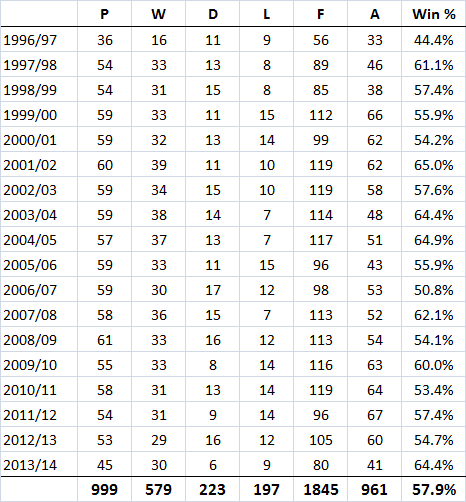
Arsene Wenger’s Record at Arsenal

AV4

Written by GunnerN5


An Arsenal Blast from the Past No.6 …… 1947/48 League Division 1 Championship

March 14, 2014

One night during WWII I was lying in bed when the room was suddenly lit up with a nearby searchlight coming on. Thinking it was a raid coming, I jumped out of bed and I started to get dressed. Looking out of the window, I saw dozens of searchlights sweeping the sky and waving backwards and forwards. I went into the front room where Mum and Dad had the radio on and they were just announcing the end of the war in Europe. Our next-door neighbour rushed in and everybody sat talking until the early hours of the morning. The next day nobody went to work and we had an impromptu party down at the corner of the road. People took cakes and sandwiches down to be shared out and a radiogram was fixed up to provide music for people to dance to.

Germany had officially surrendered and Londoners could now try to rebuild their damaged City and lives. Life was still very difficult, good jobs were scarce, food was still rationed, we still used Cow and Gate powered milk, and bomb sites were scattered all over town. But gradually life was returning to the streets and the daily fear of bombing raids, and having to dash to air raid shelters for safety, was now just a horrible memory.

The Arsenal ground in North London was not spared from war damage as the North Stand was extensively damaged by fire and the roof had collapsed, the South Stand terracing was also badly damaged and in need of repair. The debts from the construction of Highbury and the costs of repairing the war damage were a heavy financial burden, and Arsenal struggled when competitive football resumed. The war had cut short the careers of many of the club’s star players, including Bastin and Drake and nine of the pre-WW11 had been lost during the war.. They lost 6-1 on aggregate to West Ham United in the third round of the 1945-46 FA Cup, and upon the league’s resumption in 1946-47 the club finished a disappointing 13th.

allison_georgeAfter close to forty years with the Arsenal George Allison decided to retire from football at the end of that season, and was replaced by his assistant Tom Whittaker, who had been the clubs trainer under Herbert Chapman. So Tom Whittaker took over the reigns at Highbury with Joe Shaw joining him from Chelsea. Arsenal kicked off the1947/48 season with a 3-1 victory over Sunderland at Highbury, an ideal start for the new management team. Leslie Compton, the previous club Captain who had been playing cricket for Middlesex Cricket club, returned to Arsenal and they won the next six games. Joe Mercer had been Arsenal’s Captain in Compton’s absence but Whittaker felt that now Compton was back he should, once again, lead the team but Compton felt differently and persuaded him to keep Joe on as the clubs Captain.

1947 was a milestone year in the life of GunnerN5, I was nine years old and, for as long as I could remember I’d spent endless hour’s playing football on Avenell Road with my mates and kicking a rag football (made by my Mum) about and using the main gate into Highbury as our goal. We were in awe of all the grown ups as they streamed in and out of Highbury on Saturday afternoon’s and wished we had the few pennies it cost to get inside. The different noises coming from the ground always left us wondering what was happening inside but we always knew when the Gunners had scored as that caused the biggest roar of all.

My maternal Grandfather then changed my life and gave me the best present I have ever received, for my 10th birthday he took me to my very first Arsenal game it was November 22nd 1947 Arsenal vs Huddersfield Town and we won 2-0. My memories of the game are somewhat of a blur but we stood, in what was our family section under the Clock, (you see nobody ever told my Grandfather to move – he was a 6”5” local coalman and made of steel). I often feel that the young Paul Ashworth, in the movie “Fever Pitch”, was none other than a young GunnerN5 because after being inside Highbury for the first time there was nothing that was going to keep me out, lack of money, broken glass topped brick walls, turnstiles, stewards, were just mere obstacles to be overcome – I was hooked for life.

arsenal_champions_1947_1948

Tom Whittaker enjoyed immediate success with the club, winning the League in 1947-48; led by Captain Joe Mercer and with goals from the attacking front two of Reg Lewis and Ronnie Rooke, Arsenal topped the table from October and never looked back beating second place Manchester United by seven points. Given the age of the Arsenal side at the time (Rooke and Mercer were both over thirty, as were Denis and Leslie Compton), it was a remarkable achievement however long-term success was never on the cards. In response, Whittaker started to rebuild the team with younger players and brought in Doug Lishman, Alex Forbes and Cliff Holton.

In a remarkable family double Denis and Leslie Compton played alongside each other at football in Arsenal’s League Championship of 1947/48 and at cricket in Middlesex’s County Championship title in 1947.

The highest ever Football League attendance was on Saturday January 17th 1948 when a crowd of 83,260 watched Manchester United play Arsenal at Maine Road the game ended in a 1-1 draw.

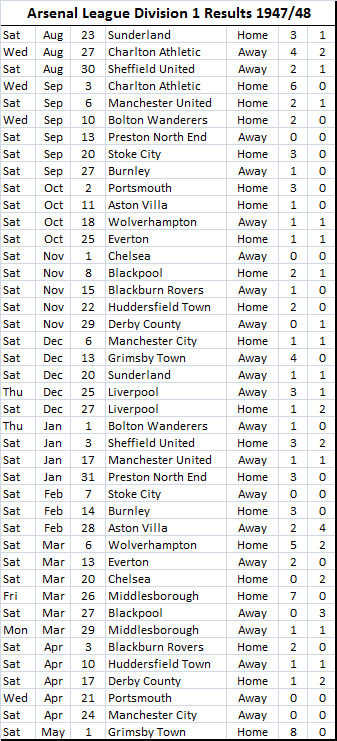
gn5 table 2

gn5 table

GunnerN5


The Last Good Friday ….. Good Luck to Norfolk Gooner

February 28, 2014

Last Friday:

Gradually the furore over Olligate is dying down, only for criticism of Ozil over the penalty miss to be given more impetus. Surprisingly, at least to me, Wenger admitted that Ozil was not “over” the penalty miss, which seemed an odd way to restore the players confidence. The consensus among the pundits is that Le Boss will drop our record signing for the Sunderland game.

Saturday:

So for once the pundits were right, Mesut Ozil was left out of the squad with a thigh injury. Yes, Arsene, of course we all accept your explanation for his absence.

The chosen line-up showed a number of changes with Szczesny coming in for Fabianski, Monreal for the injured Gibbs, Arteta for Flamini, Podolski for Ozil, Giroud for Sanogo and, surprisingly, Rosicky for Oxlade-Chamberlain.

giroud scores againnst sunderland

Olly didn’t quite get the hat-trick that I had asked for but to score on two occasions was certainly acceptable, redemption? I think so! What a master stroke by Le Boss, Rosicky’s goal must be the best of the season so far, even outstripping Jack’s early season wonder strike. Koscielny wrapped up the scoring with a free header from a corner, before joining Monreal in the treatment room.

The missus wants him to stay

The missus wants him to stay

Sagna was my Man of the Match for the outstanding effort he put in, playing right-back, before swapping to left, when Monreal failed to come out for the second half, and then centre-back when Koscielny went off.

All this after running himself into the ground in the Bayern game.

Please Monsieur Wenger give him a new contract, give him three years and a pay rise if that’s what it takes to keep him at Arsenal.

We can’t afford to lose players of Bacary’s calibre.

Sunday:

The press just can’t let go can they? The Telegraph’s headline…. Giroud puts poor visitors to bed! Ho! Ho! Ho! It’s surely time to put that one to bed.

Monreal and Koscielny are expected to be fit for Stoke next Saturday, Wilshere may have a hamstring problem and Ozil should be back…shouldn’t he?

Monday:

No change at the top of the table, all four of the top four won at the weekend, The Chavs managed a home win over Everton with the only goal coming in injury time, City scraped a one nil home win against Stoke, Liverpool scrambled to a four three home win over struggling Swansea, while Arsenal took all three points with a handsome four one win over Sunderland.

The race for Europa League qualification hotted up as Manure won and the Spuds lost to brave little Norwich City.

Rosicky to stay for another year!

Le Boss confirmed that Tomas is ready to sign a one year extension to his current contract; “Tomas Rosicky will stay” said Wenger. “We have an agreement with him and it will come out soon. I am absolutely adamant that he has to stay at the club.” Well done Arsene, now get to work on Sagna and Vermaelen.

Tuesday:

Mesut Ozil was given special permission to return to Germany for an extended break after the Bayern game. He is due to return to training today and expects to be fit to face Stoke on Saturday.

Aaron Ramsey is hoping to be fit in time for the game against Spurs on 16th March.

Apparently, and this is tabloid news, 31 year old Bacary Sagna wants a three year contract and £100,000 per week. Go on Arsene, split the difference, £100k and two years. You know it makes sense!

Wednesday:

Johan Djourou, has hinted that he does not wish to return to Arsenal but would like to make his loan at Hamburg permanent in the summer.

Arsenal target Julian Draxler has refused to rule out a summer move to Bayern Munich.

‘I am ready to play for Arsenal’ – Olympiakos hero Joel Campbell desperate for chance at Gunners.

Fresh from scoring a brilliant goal for Olympiakos against Man U on Tuesday, our young Costa Rican striker said “I believe I am ready to play for Arsenal next season,” “I have the capacity to play there and I am only waiting for the opportunity. With hard work I can get there.” Only a couple of weeks ago his agent said…‘Going back to Arsenal? He would not be happy sitting on the bench – even in a top league.’

As a transfer fee of around £7 million had been mooted, the agent would be in danger of missing out on a sizeable chunk of that if Campbell returned to The Gunners. So some mixed messages there. The decision will be made in the summer, and it will be Wenger’s to make.

Thursday:

In spite of a trawl through all my usual sources I’ve been unable to come up with much that could be called news. One headline caught my eye, but the actual article was ambiguous to say the least.

Arsenal get transfer boost as Julian Draxler admits he’s ready to quit Schalke “Julian Draxler has cleared the way for a move to Arsenal at the end of the season after telling Schalke he is ready for a new challenge.

Draxler, who was subject of a failed bid from the Gunners in January, remains a top target for Arsene Wenger ahead of the summer transfer window.

And amid speculation that Arsenal are working on a new bid for the midfielder, Draxler has left the door open to a switch to the Emirates by revealing that he wants a new challenge.

‘I can make my own decision about my future and I want a new challenge,’ he told the German press.

‘It’s no secret that I have a buyout clause in my contract and so from year-to-year I think about what is best for my development.

‘It leaves room for a lot of speculation, but I am calm and it’s also good for all sides.’

The 20-year-old’s release clause is set at £37.5million but it’s thought that Schalke would consider doing business for less at the end of the season.

Arsenal’s offer in the January window was about £20million, but that is expected to be increased when the club make a new push for the player.

Now I may be a bit of a cynic, but where does it say that Draxler is interested in a move to Arsenal?

Ahead of Saturday’s clash Stoke-on-Trent newspaper The Sentinel carried an interview with City’s chairman headlined…

Ryan Shawcross treatment after Aaron Ramsey incident still rankles Potters, admits Peter Coates

The chairman admitted: “Yes, we have got this thing with Arsenal.

We were very disappointed with how the Shawcross incident was treated because we thought there was never any intent whatsoever on Ryan’s part.

angle devil

We thought he was very badly treated over that incident in various quarters and it was wholly unfair on him. “Players get bad injuries all the time in professional football and in the vast majority of cases there is no blame to be attached, but Ryan seemed to be unfairly singled out over this one, in my opinion.” Watch out Arsenal, The Orcs are stirring, and so is Mr. Coates.

Much of the “news” that I have summarised over recent months has inevitably been speculative in nature, written by journalists striving to keep their jobs in a very competitive market place. They come in for an awful lot of criticism and abuse, some of it deserved, some not so. Occasionally they do get something right as this headline about Olympiakos vs. Man U demonstrates.

Clueless, Aimless and Hopeless

I regret to say that this is my final round-up, at least for a while. I have cataracts developing in both eyes and as a consequence I must cut down on the time spent peering at a computer screen. I’ve both enjoyed writing the posts and reading your comments, which have been almost entirely complimentary. I’m sure I shall look in on Arsenal Arsenal from time to time.

Keep the Faith

Norfolk Gooner

A note from ed:

Many thanks to Norfolk Gooner for his wonderful Friday Newsrounds. They have transformed a traditionally dull day in football terms into a joy that we all looked forward to. We hope his problems improve and that we can enjoy his company in the comments section whenever he is able.