The previous season had seen the Gunners win the league for the second successive time despite the untimely death of the great Herbert Chapman in January 1934. The Club appointed the club’s press officer, George Allison, as Chapman’s successor. In some ways, Allison moved from publicity expert to Club figurehead rather than manager itself and he wisely chose to use the existing coaching and playing resources to their fullest potential.
Although not officially in charge until the start of the 1934/35 season, George Allison had already procured Ted Drake from Southampton in March 1934 for £6,500. (Chapman had tried to lure Drake from The Saints two seasons earlier).
The signing of Drake was key to Arsenal’s success in the 34/5 season, with the tough, skilful centre forward scoring 42 goals in 41 games including 3 hat-tricks and four 4-goal hauls.

Arsenal began the season rampant at home but struggling a little on our travels. It wasn’t until late November (at Chelsea) that the team secured our first away victory, though managed to end the campaign with the league’s best travelling record.
Sunderland and Manchester City made the early season running with the Wearsiders inflicting Arsenal’s second defeat of the season in October, proving to be The Gunners main Championship rivals. By Christmas, the North-East side were top of the table with Arsenal in third position, albeit only a point behind.
The Club made some personnel changes in mid-season to bolster and reinvigorate our title bid. In January 1935, Taffy Rogers arrived from Wrexham, a few weeks later, Bobby Davidson joined from St. Johnstone, and in March, Alf Kirchen was signed from Norwich City. All would make a contribution in the run-in.
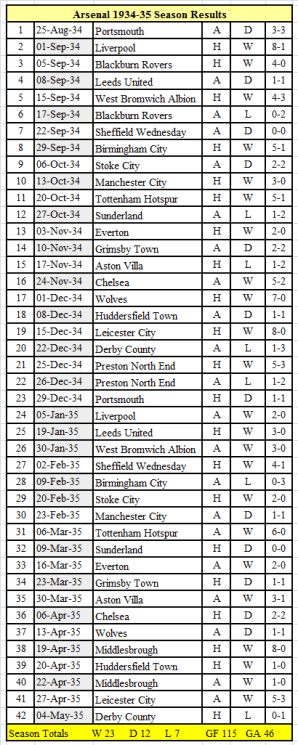
When Arsenal and Sunderland met at Highbury on March 9 1935, a crowd of 73,295 (the record Highbury attendance) saw a tight 0-0 stalemate. Arsenal remained on top by two points, but with both Sunderland and Manchester City snapping at their heels.
The next game in the League was away at Everton on March 16th and aside from the 8,7 and 6 nil thumpings, proved to be a remarkable match indeed. Frank Moss, the Arsenal keeper was injured after half an hour and had to be replaced by Eddie Hapgood in goal. He left the field of play and received treatment in the dressing room from Tom Whittaker. Ted Drake scored with a long range pile-driver just six minutes after Moss had left the field and Arsenal went in one up at the break.
In front of an astonished Goodison crowd, Moss came out on to the pitch at the start of the second half wearing a red outfield player’s shirt and took his place on the left wing with an injured arm strapped to his side. At that time there were no substitutes allowed in English football, not even for severely injured players.
Who knows how much persuasion was required for him to allow the title-chasing Arsenal side to take the field with their full complement of 11 players?
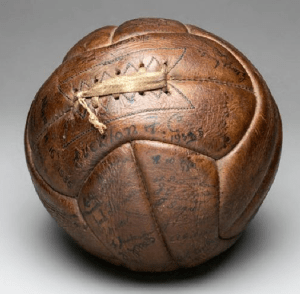
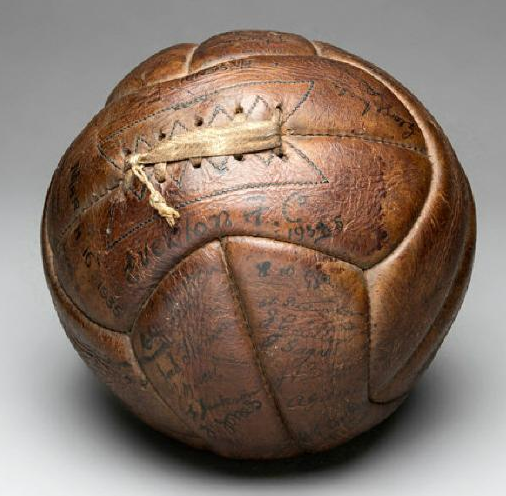
Arsenal’s makeshift defence held firm with Hapgood making a number of decent saves. Then bizarrely, Frank Moss, showing a touch of the Jesse Owenses, latched onto a pass from Ted Drake and buried the ball into the Everton net in the 70th minute. Reportedly, even the Toffees’ fans applauded his goal as he was mobbed by his excited team mates. Shortly after the goal, he left the field in agony as the injury flared up again (perhaps Herbie Roberts threw him over his shoulder in the goal celebration!). He was taken to hospital after the game to reset what turned out to be a double dislocation of the shoulder. The match ball signed by both sets of players was possibly scant consolation for what, in the long run, was to be a career-threatening injury.
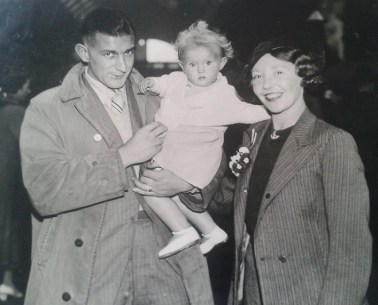
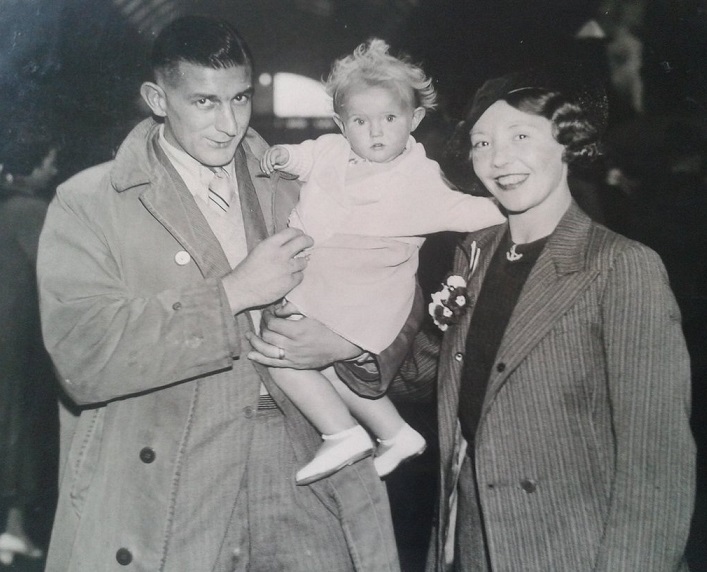
Frank Moss and family
With five games to go, Arsenal demolished Middlesbrough 8-0 (including another four by Ted Drake) to lead the First Division by three points. Four days later the Gunners played the same opposition away from home, this time winning by a single goal (Drake again the match-winner), opening up a five point gap with two games remaining and thus securing the title.
The Highbury faithful were treated to a magnificent 74 goals in the 21 home games of the 1934/5 season while conceding only 17 (even Micky would have been happy to attend!). To put the cherry quite firmly on top of the cake, Tottenham Hotspur were relegated, bottom of the table.


 Posted by Jeremy Bongo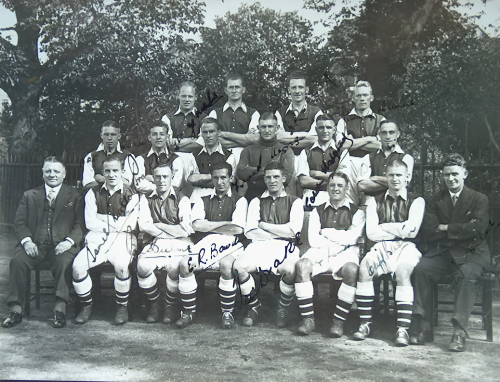





 Arsenal News 24/7


 arsenalarsenal.net