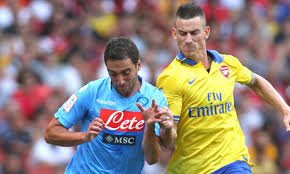
Emirates Cup – Arsenal 2 – Napoli 2

August 3, 2013

Yesterday saw the return of the Emirates Cup after a years absence to accommodate the Olympics, due to the pessimism amongst fans this was seen as a cop out, because:

A) they know no one will turn up
B) we can’t even win our own pre season tournament anymore
C) some other conspiracy theory

star man kozzer

Anyway the club has re introduced the tournament this season and it was our first chance to look at the progress of the team and more importantly for me the progress of the youth team against slightly more robust opposition than the Indonesian Dream Team.

The Emirates Cup has introduced us to many of our youngsters in the past, having watched Jack conduct the FA Youth Cup final the following season he was electrifying those watching at the Emirates Cup, capping it with a wrong foot (hit with his left peg on the right side of the goal and the ball coming from his left) half volleyed goal.

Yesterday we got to see more of Serge Gnabry while the highly rated Gedion Zelalem sat waiting on the bench alongside Chuba Akpom.

Joining Gnabry on the right flank was the eager Jenkinson, playing alongside the more experienced Mertesacker, Koscielny and Gibbs in front of Fabianski. In midfield the untested combination of Wilshere and Ramsey as the two deeper players with Rosicky in front. Podolski and Giroud completed the line up.

To be honest we started very slowly, either heavy legged from our trips to Asia or had it too easy whilst in Asia and therefore not ready for the sterner test provided by Napoli.

It has been known for some time that we are susceptible to counter attacks as we commit too many men forward, Napoli are probably the best European exponents of counterattacking football, they defend in numbers as all good Italian teams do, but they are very quick on the break, and know how to use the ball in those situations.

Having said that the first goal went to Napoli but not from a counter attack, we were pretty well set Jenkinson showed his inexperience by following his runner beyond the defensive line this gave the Napoli defender with the ball the opportunity to lift the ball over the rest of the defence and create a 50:50 between Jenkinson and the winger, Jenkinson won the header but the contact was unconvincing, Fabianski realised the danger too late and was not out quickly enough to collect whilst airborne leaving the young Napoli winger the relatively simple task of tapping home for the goal. Most goals are a result of a series of errors, the first one is most crucial, and the first error was not pressuring the defender with the ball, which was then compounded by the following errors and misjudgements.

The second goal conceded was more like what we are used to, too many men committed forward, Mertesacker’s man appeared to have him beat for pace but that said he was heading wide of goal and we had enough numbers tracking back, however Fabianski made it so much easier for Napoli by coming off his line which then forced other defenders to back away. I hope in a PL game we would have seen a little more commitment to blocking the shot but in a pre season friendly unnecessary risks such as throwing yourself full length at a shot should not be taken for fear of injury.

Arsenal struggled to find a shape that worked and Wilshere and Ramsey struggled to find a way to control the midfield they are both still too young to do it together. Although in time with guidance they showed enough understanding and ball movement to feel that they could become quite a force together….however they are both still learning the ropes when it comes to experienced opponents.

Gnabry failed to offer the required width on the right and most of our good work came from Gibbs and Podolski linking on the left, unfortunately their crosses did not result in meaningful shooting opportunities.

Gibbs did win a very soft penalty only for Podolski to use his left foot hammer as a feather duster and tickle the ball harmlessly at Reina.

We created other opportunities but a combination of the linesman, errant shooting and altruism (Podolski) we went in 2-0 down to unfortunately a few boos from the Emirates crowd.

One of those missed opportunities was perhaps indicative of why we were two goals down, Jack lifting a ball from the edge of the area to Ramsey in an offside position. Whilst the bit of play between the two was good, one has to question who they were expecting to be providing cover if the attack broke down.

The other problem in our attacks as well as a lack of width was the fact that all our attacking players appeared to be bunched on their eighteen yard box when attacking, so there was only one passing option and it was very congested, we had no depth to our attack.

From the start of the second half we appeared to have a better shape. Soon the substitutions were made, Jenkinson and Gnabry off, Sagna and Theo on. Later came the more telling substitution, Ramsey and Wilshere replaced by Oxlade-Chamberlain and Arteta. Immediately our shape seemed better, we retained possession in their half better and were not as susceptible to counter attacks. With a more solid presence in midfield in Arteta, Mertesacker and Koscielny began to make lighter work of dealing with Napoli attacks.

Rosicky was still the man providing most inspiration going forward, helped by Oxlade-Chamberlain, and the outlet Sagna and Theo provided.

giroud over-head

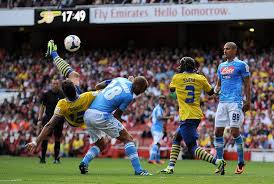
The start of the comeback came from a corner, Theo floated the ball onto the penalty spot, Giroud held off his marker and performed a bicycle kick which was heading wide, but clipped Bacary Sagna and went in the bottom corner.

We were pretty much camped in their half for the remainder of the game, but without providing the finishing touch to equalise.

It eventually came from a free kick in the final third, Arteta put a great delivery into the box which Mertesacker rose to meet, Reina could only party the ball upwards and Koscielny was first to react and raced to bundle the ball in at the far post.

As pre season friendlies go I think it was a very helpful game, some harsh lessons learned for the younger players in the squad, and a step up in quality opposition with only two weeks to go to the season opener.

For me the standout performer was Koscielny, the way he dealt with Higuain you would think that he had a personal vendetta against him. It’s almost like he couldn’t let the Emirates crowd see what they might be missing out on so he wouldn’t give them a sniff.

Arteta showed once again why he is so crucial to our chances of competing, the knowledge and calmness his presence brings to the side are invaluable. Rosicky continued from where he left off at the end of last season, as did Ramsey, although the latter was hampered by being partnered with Wilshere.

Jack will prevent a real problem this season, the English media will be happy to see him rested, the Arsenal crowd will want him to play, Jack himself will be desperate to make up for lost time. For me he is about moving with the ball from somewhere in the opponents half and attacking from there, but with Santi and Rosicky in the squad is that where he can be used?

All in all more questions than answers yesterday, lets hope for a few more answers today.

Written by Gooner in Exile


Top 50 Gunners – Poll Results

July 31, 2013

Following on from our Greatest Squad yesterday we can now reveal the 50 Greatest according to ArsenalArsenal bloggers and the votes cast throughout the summer.

GN5 the stats man has also added their total appearances, goals and their placing on the Arsenal.com Top 50 (if they featured at all). One of the aims of this exercise (as well as filling the void of the footballing desert of summer) was to bring to life some of those players from yesteryear that we had heard of but not necessarily know much more about than era and that they played for us.

Thanks to GN5’s efforts some detail has been added to so many of the names of the past, my thanks again to GN5 for making this summer of articles so much more than I envisaged when first floating the idea.

No. Player Votes Position Joined Left Games Goals A.Com
1 Thierry Henry 408 Striker 1999 2012 337 228 1
2 Patrick Vieira 250 Midfielder 1996 2005 406 33 5
3 Tony Adams 231 Defender 1983 2002 669 48 3
4 Denis Bergkamp 229 Striker 1995 2006 423 120 2
5 David Seaman 184 Goalkeeper 1990 2003 298 0 7
6 Cesc Fabregas 180 Midfielder 2003 2011 303 57
7 Robert Pires 133 Midfielder 2000 2006 284 84 6
8 Ian Wright 132 Striker 1991 1998 279 185 4
9 Liam Brady 93 Midfielder 1971 1980 307 59 8
10 Cliff Bastin 72 Striker 1929 1946 396 178 18
11 Ted Drake 66 Striker 1934 1945 184 139 31
12 Martin Keown 65 Defender 1981 2004 449 8 20
13 George Graham 61 Midfielder 1966 1972 308 77 42
14 Frank McLintock 60 Midfielder 1964 1973 403 32 30
15 Alex James 46 Striker 1929 1937 261 27 46
15 Peter Storey 46 Defender 1961 1977 501 17 50
17 Bob Wilson 45 Goalkeeper 1963 1974 308 0 39
18 Lee Dixon 44 Defender 1988 2002 619 28 21
19 Pat Jennings 43 Goalkeeper 1977 1985 327 0 10
20 Jens Lehmann 42 Goalkeeper 2003 2011 199 0
21 David O’Leary 40 Defender 1973 1993 722 14 14
22 Eddie Hapgood 37 Defender 1927 1945 440 2
23 Joe Mercer 33 Midfielder 1946 1954 275 2
24 George Eastham 31 Midfielder 1960 1966 223 41 41
24 Jack Kelsey 31 Goalkeeper 1949 1962 352 0
26 Kenny Sansom 30 Defender 1980 1988 394 6 36
27 Steve Bould 26 Defender 1988 1999 372 8
27 Pat Rice 26 Defender 1964 1980 528 13 17
29 Bob MacNab 24 Defender 1966 1975 365 6
29 Ray Parlour 24 Midfielder 1988 2004 466 32 19
31 Freddie Ljungberg 23 Midfielder 1998 2007 328 72 11
32 Gilberto Silva 21 Midfielder 2002 2008 244 24
32 Robin van-Persie 21 Striker 2004 2012 278 132
34 David Rocastle 20 Midfielder 1982 1992 277 34 16
34 Peter Simpson 20 Defender 1960 1978 477 15
36 Nigel Winterburn 16 Defender 1987 2000 584 12 32
37 David Jack 15 Striker 1928 1934 208 124 49
38 Herbie Roberts 13 Defender 1926 1937 335 5
38 Jon Sammels 13 Midfielder 1961 1971 270 52
40 Walley Barnes 12 Defender 1943 1955 294 12
41 Alex Forbes 11 Midfielder 1948 1956 240 20
41 John Radford 11 Striker 1962 1976 481 149 24
41 Joe Shaw 11 Defender 1907 1923 326 0
44 Doug Lishman 10 Striker 1948 1956 244 137
44 George Male 10 Defender 1929 1948 318 0
44 Alan Smith 10 Striker 1987 1995 347 115 27
47 Alf Baker 9 Midfielder 1919 1931 351 26
47 Jack Butler 9 Defender 1914 1930 296 8
47 Jack Lambert 9 Striker 1926 1933 161 109
50 Bob John 8 Defender 1922 1937 470 13

So there you have it our 50 Greatest Players according to the AA Readers, thanks again for joining us on this trip down memory lane.

GunnerN5 and Gooner in Exile


Our Greatest Ever Team – The Results

July 30, 2013

Finally, after nearly 3 months of reviewing and voting we can now reveal the Greatest All time Arsenal Squad as selected exclusively by Arsenal Arsenal bloggers.

We received close to 3,500 votes broken down between 6 Managers, 12 Goalkeepers, 20 Defensemen, 20 Mid-fielders and 20 Strikers. Those with the most votes within the 5 categories have been selected to form our Greatest all time Squad. Remember the 25 man squad is based on those receiving the most votes in the 4 general player categories and not by their specific position.

The squad is broken out as follows –

I First team Manager, I Director of Football, and 1 Coach.

3 Goalkeepers.

8 Defenders

8 Midfielders

6 Forwards

The Greatest All time Arsenal Squad:

The management team is probably unsurprising, Arsene received the most votes, followed by Herbert and the George, we thought this worked quite well in the modern setups so this is the roles we have given them:

Manager – Arsene Wenger

Director of Football – Herbert Chapman

Coach – George Graham

We doubt we would get many complaints from current fanbase to see Herbert helping out on acquiring players and George helping out on the tactics.

Then we have have the squad, the first eleven decided by those who acquired the most votes in their category.

David Seaman

Lee Dixon              Tony Adams           Martin Keown             Peter Storey

Robert Pires           Patrick Vieira     Cesc Fabregas                Liam Brady

Dennis Bergkamp

Thierry Henry

Substitutes:

Bob Wilson, David O’Leary, Eddie Hapgood, George Graham, Frank McLintock, Ian Wright, Cliff Bastin

Squad:

Pat Jennings, Kenny Sansom, Steve Bould, Pat Rice, Joe Mercer, George Eastham, Ted Drake, Alex James

Oh dear, we managed to break the FA rules as we have a 26 man squad, the fact is that Steve Bould and Pat Rice were tied on votes and we could not see a way to leave either player off of our team.

Thank you for your participation in the Summer voting, if you disagree with any of the above…….well you should have voted!

Come back tomorrow and we will review the top 50 all time greatest as voted by the ArsenalArsenal regulars.

GunnerN5 and Gooner in Exile


Another book about the summer…….

July 27, 2013

Arsene Wenger’s comments on Arsenal.com suggest that we may be heading for another one of those Transfer Window that Arsene could write a book about.

It is very unedifying to see us linked with so many players but not to have actually managed to sign one.

Gazidis was quoted at the end of last season that we would be looking to spend money, that the wage structure had to change, and that the club was ambitious to win trophies. He also went on to say that Arsene could effectively stay as long as he liked.

I have a problem with the quotes because I believe that if the club were that keen to spend money and change wage structure they would not allow Arsene to stay if it is him that is blocking the spending. This seems to be the general story when looking at blogs and the redtops.

I think Arsene is perhaps too loyal to his employers, if Mourinho was treated as Arsene has been treated by the board he would be negotiating his settlement within hours, Arsene has been covering the Boards backs for a number of years now and still they do not help him.

Early signs in the summer were good, a number of players were being released and sold on, this we believed to be about freeing wage bill for a big signing or two, however I fear it was more to do with freeing squad spaces due to EPL rules on homegrown/non homegrown etc.

Now Arsene comes out and is quoted as saying the following:

We are ready to do quick deals but all the transfers do not depend only on us, but we are prepared to wait. It looks unlikely before the Emirates Cup.

We still have a strong squad but we are there on the market to try to strengthen our team. With or without additions we can be title challengers next season.

When asked about Rodgers comments on Suarez he said the following

He must explain that, I don’t know. We are not close to signing Suarez or anybody else so there’s no reason why I should talk about it.

There is nothing to say. I have been away now for two or the weeks and it’s hard to see how things are advanced because everyone is on tour at the moment and it’s very difficult to get in touch with people.

I believe that everybody competes on a very high level. What has changed recently is that in Europe, countries like France have bought some very talented players who would two or three years ago all have come to England. That makes the chase for talent very difficult.

What we want is not a name but a good player. The name is less important. What is important is the quality of the player. We want as many top players as we can but we have to focus on the players and develop them as well.

In midfield you have plenty of candidates – there’s a big fight in midfield. Sagna has settled in well as a centre back. We have a strong squad. We are there on the market trying to strengthen our team.

It would appear from the above that Arsene is already starting to be a disbeliever when it comes to the Board helping him sign his targets. Maybe it also indicates that the whole Suarez thing is balderdash of the highest order, but with Liverpool being so open about the offers it is hard to ignore.

Whether Suarez is the right man for Arsenal or not is irrelevant at this point, what is relevant is that yet again Arsene in my view appears to have more content for his Transfer Window Opus, apparently it will be entitled, Arsene loves our club and the job too much to walk away, but sometimes for his own reputation’s sake I wish he would.

Written by Gooner in Exile


When does firewood become deadwood (and vice versa)?

July 24, 2013

I have never been a massive fan of the word so many fans have taken to using as a way of describing players they think are surplus to requirements or wasting wages.

We have had many players labelled as dead wood by Arsenal fans, some may be correct, but there are also instances where players deemed to be deadwood have actually come back to prove their doubters wrong.

After the League Cup Final Koscielny was in that category, after many injury hit seasons Rosicky was in it too, Aaron Ramsey had the temerity not to play like Messi on his return from a horrendous injury and then there was Diaby, Arshavin, Squillacci, Fabianski, Gibbs and even new signings like Gervinho who have all been tarred with the same brush.

Arshavin started off life as a fan favourite and then ended up in the deadwood pile, could Vermaelen be going the same way? Last seasons performances certainly put him at risk of being mentioned in the same breath as Squillacci. But is it fair to do so? He is a player not on form, but surely that doesn’t mean we want to bin him and forget all he has achieved before.

Before we go sticking more names in the recycle bin can we just look back at the deadwood players from the last two seasons:

Koscielny – so important during the run in, became undroppable

Fabianski – came in when Szczesny was having a blip and kept clean sheets and was a calm presence in between the sticks

Ramsey – perhaps the most criticised player on blogs, twitter and anywhere else you care to look for the last two years, well the two years before the last two months of the season when his detractors could not keep up their set in stone view on the lad any longer

Rosicky – another big part to play in the run in and generally seen to give us an added dimension.

What’s the point of this post? To make you think before you start labelling players, criticise someone for their play by all means, criticise work rate but please stop using a cheap throwaway label for an out of favour/form player. You never know when they will spark back into life again.

Perish the thought if Jack doesn’t start well or Ox or Ryo, or Cazorla looks tired after his summer excursions.

Football is about squads and not everyone in your squad can be a world class player, but you need cover and you need options when someone is out of form, everyone in the squad may have a role to play, and when they do their inclusion in a matchday squad should not be met by groans because some one on a blog has decided this player is deadwood and that opinion has circulated around the wonderweb.

By Gooner in Exile


Arsenal’s Greatest Forwards – Vote (like we need one)

July 20, 2013

There won’t be too much doubt about the winner of this poll but you have three votes …… so the second and third places will be interesting. If you’ve missed reading the posts this weeks profiling all of these forwards have a look in the side-bar and click on Greatest Forwards 4,5,6 and 7.

Thank you to GunnerN5 for all his hard work in writing the profiles for the players we have given you during the past weeks and to Gooner in Exile for compiling the posts for us.

All the posts are available if you click on ‘Recent Posts’ in the side-bar.

As a point of admin we are leaving the votes open until 24th July, so if you haven’t voted yet….what are you waiting for.

After the votes are counted GN5 will be compiling our greatest squad of 20 or so players, and also a top 50 players result.


Arsenal’s Greatest Forwards – Day 7

July 19, 2013

Continuing our Summer series of articles in search of Arsenal’s greatest ever team, this week we will end our quest for the greatest forwards to include in our team.  Don’t forget to take the opportunity to choose your personal favourite striker, this weeks posts will bring us bang up to date and there will be a vote on Saturday.

19. Thierry Henry: 1999-2012.

Thierry appeared in 377 games over a 13 year period and scored 228 goals.

Thierry was born and raised in Les Ulis suburb of Paris which, despite sometimes being seen as a tough neighbourhood, provided good football facilities. As a seven-year-old, he showed great potential, and was recruited by the local club CO Les Ulis. He joined US Palaiseau in 1989, but after a year his father fell out with the club, so Henry moved to ES Viry-Châtillon and played there for two years.

In 1990, Monaco sent scout Arnold Catalano to watch Thierry, when he was just 13 years old, he scored all six goals in a 6–0 win. Catalano asked him to join Monaco without even having a trial first, later he joined Arsène Wenger’s Monaco as a youth player. Subsequently, he signed professional forms and made his professional debut in August 1994. Although Wenger suspected that Thierry should be deployed as a striker, he put him on the left wing because he believed that his pace, natural ball control and skill would be more effective against full-backs than centre-backs. He was named the French Young Footballer of the Year in 1996, and in the 1996–97 season when Monaco won the Ligue 1 title. By his third season, he had received his first cap for the national team, and was part of the winning team in the 1998 FIFA World Cup. He continued to impress during his tenure with Monaco, and in his five seasons he scored 20 league goals in 105 appearances.henry arsenal

Thierry left Monaco in January 1999 and moved to Italian Serie A club Juventus for £10.5 million. He played on the wing, but found it difficult playing in an unfamiliar position against the Serie A defensive discipline, and scored just three goals in 16 appearances. Unsettled in Italy, he transferred from Juventus in August 1999 to Arsenal for an estimated fee of £11 million, reuniting with his former manager Arsène Wenger.  It was at Arsenal that he made his name as a world-class footballer. Brought in as a replacement for fellow French forward Nicolas Anelka, Thierry was immediately moulded into a striker by Wenger, a move that would pay rich dividends in years to come. However, doubts were raised about his ability to adapt to the quick and physical English game when he failed to score in his first eight games. After several difficult months in England he conceded that he had to “be re-taught everything about the art of striking”. These doubts were dispelled when he ended his first season at Arsenal with an impressive goal tally of 26. Arsenal finished second in the league behind Manchester United, and lost in the UEFA Cup Final against Turkish side Galatasaray. Despite recording fewer goals and assists than his first season, his second season with Arsenal proved to be a breakthrough, as he became the club’s top goal scorer. Armed with one of the league’s best attacks, Arsenal closed in quickly on perennial rivals Manchester United for the league title.

Success finally arrived during the 2001–02 season. Arsenal finished seven points above Liverpool to win the league title, and defeated Chelsea 2–0 in the FA Cup Final. Thierry became the league’s top goal-scorer and netted 32 goals in all competitions as he led Arsenal to a double and his first silverware with the club. 2002–03 proved to be another productive season for him, as he scored 32 goals in all competitions while contributing 23 assists, remarkable returns for a striker. In doing so, he led Arsenal to another FA Cup triumph, where he was man-of-the-match in the Final.  Even though Arsenal failed to retain their Premier League crown, he was named both the PFA Players’ Player of the Year and FWA Footballer of the Year. His rising status as one of the world’s best footballers was affirmed when he emerged runner-up for the 2003 FIFA World Player of the Year award

In the 2003–04 season Thierry was again instrumental in Arsenal’s exceptionally successful campaign; together with team mates the likes of Dennis Bergkamp, Patrick Vieira and Robert Pirès, he ensured that the Gunners became the first team in more than a century to go through the entire domestic league season unbeaten, claiming the league title in the process. He was named as the PFA Players’ Player of the Year and FWA Footballer of the Year, for the second year running. With 39 goals scored in all competitions, he led the league in goals scored and won the European Golden Boot.

In the 2004–05 season he maintained his reputation as one of Europe’s most feared strikers as he led the league in scoring, and with 31 goals in all competitions, he was the co-recipient (with Diego Forlán) of the European Golden Boot. In mid-2005 Thierry became the Arsenal Captain. The 2005–06 season proved to be one of remarkable personal achievements for Thierry on 17 October 2005, he became the club’s top goal-scorer of all time; two goals against Sparta Prague in the Champions League meant he broke Ian Wright’s record of 185 goals. On 1 February 2006, he scored a goal against West Ham United, bringing his league goal tally up to 151, breaking Arsenal legend Cliff Bastin’s league goals record. He scored his 100th league goal at Highbury, a feat unparalleled in the history of the club, and a unique achievement in the Premier League. He completed the season as the league’s top goal-scorer, and for the third time in his career, he was voted the FWA Footballer of the Year.

In a surprise move Arsenal sold Thierry to Barcelona on 25 June 2007, for €24 million.

Henry left Arsenal as the club’s leading all-time league goal-scorer with 174 goals and leading all-time goal-scorer in Europe with 42 goals; in July 2008, Arsenal fans voted him as Arsenal’s greatest player ever in Arsenal.com’s Gunners’ Greatest 50 Players poll.

Following his time with Barcelona, he signed a four-year deal for a reported €6.8 (£4.6) million per season, with the Red Bulls of the MLS.

After training with Arsenal during the MLS off-season, Thierry re-signed for the club on a two-month loan deal on 6 January 2012. This was to provide cover for players participating in the 2012 Africa Cup of Nations. He made his second Arsenal debut as a substitute against Leeds United in the FA Cup third round and scored the only goal. In his last league game on loan, he scored the winning goal in stoppage time in a 2–1 win against Sunderland. 

Awards and honours:

Monaco:

Ligue 1 (1): 1996–97

Trophée des champions (1): 1997

Arsenal:

Premier League titles: 2001–02, 2003–04

FA Cup: 2002, 2003, 2005

FA Community Shield: 2002, 2004

Barcelona:

La Liga: 2008–09, 2009–10

Copa del Rey: 2008–09

Supercopa de España: 2009

UEFA Champions League: 2008–09

UEFA Super Cup: 2009

FIFA Club World Cup: 2009

New York Red Bulls:

MLS Eastern Conference: 2010

National:

1998 FIFA World Cup

UEFA Euro 2000

FIFA Confederations Cup2003

Individual:

UNFP Ligue 1 Young Player of the Year (1): 1996–97

PFA Players’ Player of the Year (2): 2002–03, 2003–04

PFA Team of the Year (6): 2000–01, 2001–02, 2002–03, 2003–04, 2004–05, 2005–06

FWA Footballer of the Year (3): 2002–03, 2003–04, 2005–06

Premier League Golden Boot (4): 2001–02, 2003–04, 2004–05, 2005–06.

Golden Boot Landmark Award 10 (1): 2004–05

Golden Boot Landmark Award 20 (1): 2004–05

Premier League Player of the Month (4): April 2000, September 2002, January 2004, April 2004

Goal of the Season (1): 2002–03

UEFA Team of the Year (5): 2001, 2002, 2003, 2004, 2006

MLS Best XI (2): 2011, 2012

MLS Player of the Month (1): March 2012

Onze d’Or (2): 2003, 2006

European Golden Boot (2): 2003–04, 2004–05

French Player of the Year (5): 2000, 2003, 2004, 2005, 2006

IFFHS World’s Top Goal Scorer of the Year (1): 2003

FIFA FIF Pro World XI (1): 2006

FIFA World Cup All-Star Team (1): Germany 2006

FIFA Confederations Cup Golden Ball (1): France 2003

FIFA Confederations Cup Golden Shoe (1): France 2003

UEFA European Football Championship Team of the Tournament (1): 2000

FIFA 100: 2004

English Football Hall of Fame: 2008

A statue of Thierry statue stands outside the Emirates Stadium honouring him as one of Arsenal’s all time greatest legends.

20. Robin van-Persie: 2004-2012 

Robin played in 278 games over an 8 year period and scored 132 goals.

Robin was born in Rotterdam, Netherlands. The son of two artists, he was encouraged to follow in his parents’ footsteps, but he preferred football.

He joined Dutch side SBV Excelsior’s youth squad at the age of 14 years, but left at the age of 15 and signed for Feyenoord. He was quickly promoted into the first team due to injury problems among the squad, and made his debut for the club at 17, which was the first of 15 total starts. He received the KNVB Best Young Talent award at the end of the 2001–02 season and then signed a professional three-and-a-half-year contract the following season. Clashes with his manager Bert van Marwijk saw him demoted to the reserve squad, he finished his tumultuous debut season on the first team, making a total of 28 appearances and scoring eight goals, in addition to finishing runner-up in the KNVB Cup. Feyenoord unsuccessfully attempted to extend his contract during the off-season. His deteriorating relationship with van Marwijk led to his spending most of the 2003–04 season on the bench. He again played 28 matches, but finished with two fewer goals than the previous season.

On 17 May 2004, Robin signed a four-year deal with Arsenal for £2.75 million, just over half of Feyenoord’s original asking price of £5 million. Arsenal manager Arsène Wenger, who planned to convert him from a left winger to a centre forward, said of his new acquisition, “He can play on the left side of midfield, as a creative player behind the main strikers or as a target man. Robin spent most of his time on the bench during earlier parts of the 2004–05 season, and made his competitive debut on 27 October by scoring Arsenal’s opening goal in a 2–1 League Cup win over Manchester City. He was sent off for the first time, in an Arsenal shirt, on 26 February against Southampton, following a lunge at left back Graeme Le Saux, for which Wenger was seen yelling an obscenity at him from the sidelines. He then later lambasted him in the press stating “I do not support Van Persie today” Telegraph sportswriter Clive White described Van Persie in his match report as “21 going on nine.” He was consequently benched for a number of games, starting with Arsenal’s FA Cup replay against Sheffield United, and he was reintroduced into the squad only after Henry was out with a calf injury, his return to the first team saw him score twice in a FA Cup semi-final win over Blackburn Rovers. The rest of his season was cut short by injury, and he finished with ten goals in 41 appearances in all competitions. Robin’s good form at the start of the 2005–06 season earned him the Player of the Month award for November 2005 after eight goals in eight starts, and he was rewarded with a five-year contract extension until 2011. Two days after signing the contract, however, he was once again hit by injury when an opponent stepped on his foot and broke his toe during an FA Cup match.

The beginning of the 2006–07 season included an airborne volley against Charlton Athletic that Arsene called “the goal of a lifetime” and he was later named BBC Sport’s Goal of the Month for September, and he capped off the calendar year by being named the 2006 Rotterdam Sportsman of the Year. His season, however, ended early for the second time in his career on 21 January, when he fractured the fifth metatarsal in his right foot. After the departure of Thierry Henry he assumed the role as Arsenal’s main striker. Following a streak of seven goals in ten regular-season games, he was sidelined for two months with a knee injury suffered on international duty. He made his comeback in Arsenal’s Champions League group stage on 12 December and made his Premier League return in the win against Chelsea over the weekend. However, he picked up a recurrent injury that kept him sidelined until January when he played 45 minutes in a League Cup game against Tottenham Hotspur. He was withdrawn at half-time following another injury scare and featured sporadically throughout the rest of the campaign. The following season (2008–09) he was named as the Arsenal.com Player of the Season. With only one year remaining of his contract, it was announced in July that he had signed a new long-term contract with his club, stating, “My heart is with Arsenal and I just can’t picture myself in a different shirt.”

On 14 November 2009, he injured his ankle in an international friendly and was initially expected to be out for six weeks, but further tests showed that he would be out for five months. Before the start of the 2010–11 season, his squad number was changed to number 10. He made his 200th appearance in August but an ankle injury suffered in the game placed him on the sidelines once again. He returned as a substitute for Arsenal’s

0–1 defeat to Newcastle United on 7 November.

BSROn 1 January 2011, he scored his first goal of the season in a 3–0 away win over Birmingham City. On 15 January, he added two more goals to his tally in a comfortable 3–0 win over West Ham. This made him only the fourth Dutchman to reach 50 goals in England’s top division. Robin scored his first career hat-trick in a 3–0 win over Wigan Athletic on 22 January and two goals against Newcastle United in a 4–4 draw on 5 February. Continuing his fine form, he hit a brace the following week against Wolverhampton Wanderers scoring both Arsenal goals in a 2–0 win including a volley from inside the box. The ten goals he scored between 1 January and 12 February set a new Premier League record for most goals scored in the first two months of a calendar year.

He set the Emirates alight with a goal from an almost impossible angle in Arsenal’s fight back against Barcelona in the UEFA Champions League Round of 16 which ended 2–1 in favour of the Gunners. On 27 February 2011, Van Persie captained Arsenal at Wembley Stadium in the League Cup final, scoring the first half equalizer for the Gunners. It was his first goal at Wembley and his first in a cup final for Arsenal. However, he was later taken off in the second half with a knee injury he picked up while scoring the goal. He was voted as the second best player of the 2010–11 season on Arsenal’s official website and also received the team’s Goal of the Season award for his audacious strike in the 2–1 victory over Barcelona in the Champions League.

Having been appointed vice-captain for the 2010–11 season, he was promoted to club captain at the start of the 2011–12 season. He finished the season as the top goal-scorer in the Premier League with 30 goals, and became Arsenal’s 8th all-time top scorer with 132 goals.

On 4 July 2012, he announced that he would not be signing a new contract with Arsenal.

Finally after a series of rumours he was transferred to Manchester United for a reported £22.5 million. Supporters of Manchester United voted Van Persie as the Sir Matt Busby Player of the Year for the 2012–13 season.

Written by GunnerN5 and complied by Gooner in Exile

Arsenal’s Greatest Forwards – Day 6

July 18, 2013

Continuing our Summer series of articles in search of Arsenal’s greatest ever team, this week we will end our quest for the greatest forwards to include in our team.  Don’t forget to take the opportunity to choose your personal favourite striker, this weeks posts will bring us bang up to date and there will be a vote on Saturday.

17. Ian Wright: 1991-1998.

Ian appeared in 288 games over a 7 year period and scored 185 goals.

Ian was born in Woolwich, London. He came to professional football relatively late in life and despite having had trials at Southend United and Brighton during his teens, he was unable to attract sufficient interest to win a professional contract offer. Reverting to playing for amateur and non-league teams, he was left disillusioned about his chances of a career as a professional footballer.

A Crystal Palace talent scout, Peter Prentice, happened to see Wright playing for Dulwich Hamlet and invited him to have a trial at Selhurst Park. Having impressed then-manager Steve Coppell, he signed professional terms for Crystal Palace in August 1985, just three months short of his 22nd birthday. He quickly made his mark in his first season, scoring nine goals to finish as Palace’s second-highest scorer. When Mark Bright arrived on the Palace scene the following year the duo soon established a successful striking partnership and it was largely their goals which took the club to top flight via the playoffs in 1989. Ian was particularly instrumental that season, scoring 24 goals in the Second Division and a grand total of 33 in all competitions.

WrightA twice-cracked shin bone reduced his initial impact in the First Division. However, after recovering from the injury he made a dramatic appearance as a ‘super-sub’, in the 1990 FA Cup Final against Manchester United. He equalised for Palace a few minutes after coming onto the field forcing extra time, then putting them ahead in extra time. The eventual score was 3–3, but Palace lost the replay 1–0. The next season he gained full international honours, and reached a hundred goals for Crystal Palace.  Ian became renowned for his deadly striking ability, as shown when he scored a hat-trick in just eighteen minutes in Palace’s penultimate game of the 1990–91 season away to Wimbledon. He scored 117 goals in 253 starts and 24 substitute appearances over six seasons for The Eagles in all competitions.

Ian signed for Arsenal in September 1991 for £2.50m, which was at the time a club record fee. He scored on his debut against Leicester City in a League Cup tie, and then scored a hat-trick on his League debut against Southampton. He won the Golden Boot in his first season by scoring 29 league goals, five of which were for Palace, and 31 in all competitions. He scored a hat-trick in the final game of the season against Southampton; his third goal being the last ever scored in the old First Division. He went on to be Arsenal’s top scorer for six seasons in a row. He played a major part in the club’s success during the 1990s, winning an FA Cup and League Cup double in 1993; he scored in both the FA Cup Final and the replay against Sheffield Wednesday. Ian also helped Arsenal reach the 1994 UEFA Cup Winners’ Cup Final, although he was suspended for the final in which Arsenal beat Parma 1–0.

The period that followed proved to be a difficult time for both Ian and Arsenal, manager George Graham was dismissed over illegal payments, and under caretaker Stewart Houston they could only manage a 12th place finish in the league. The arrival of Bruce Rioch heralded a bleaker time; the two did not get on and eventually Wright handed in a transfer request, which he later retracted. The arrival of Dennis Bergkamp heralded a brief but fruitful striking partnership, and in their first season playing together they helped Arsenal finish fifth in the league and qualify for the UEFA Cup. They also reached the Coca-Cola Cup semi-finals, where they went out on away goals to eventual winners Aston Villa.

By the time Arsène Wenger had arrived at Arsenal in September 1996, Ian was nearly 33. Despite his age, he continued to score regularly (being the second highest Premier League scorer in 1996–97 with 23 goals), and on 13 September 1997 he broke Cliff Bastin’s Arsenal goal scoring record with a hat-trick against Bolton Wanderers. A couple of months later he suffered a bad hamstring injury which ruled him out of the club’s run-in to a League and Cup Double; he was named as a substitute in the cup final against Newcastle United but did not play. His final goal at Highbury came on 4 October 1997 against Barnsley and was his 300th career goal for both Crystal Palace and Arsenal. He scored his final goal for Arsenal on 6 January 1998 in a League Cup quarter-final victory against West Ham United.

On 15 July 2008, he finished 4th in 50 Greatest Gunners listed on the Arsenal website.

In July 1998, he moved to West Ham United for £500,000. He spent fifteen months as a West Ham player, scoring the winner on his debut against Sheffield Wednesday. During his spell there he made the headlines for all the wrong reasons when he vandalised the referee’s dressing room at Upton Park after being sent off during a match against Leeds United. He had subsequent short spells at Nottingham Forest, Celtic, and Burnley before retiring in 2000. He finished his club career with 313 goals in all competitions.

He made his for England under manager Graham Taylor in February 1991. He started in the 2–0 victory against Cameroon at Wembley and helped England reach the finals of Euro 1992 in Sweden. Despite the fact that his international career spanned eight years, 87 matches and three different full-time managers, he only started 17 times and was a used substitute in 16 matches.

While he was still a professional footballer at Arsenal, he published his autobiography, Mr Wright. In 1993, he wrote and released a single called “Do The Right Thing”. The song was co-written and produced by Chris Lowe (of Pet Shop Boys) and reached #43 the UK Singles Chart.

Shortly after his retirement from playing in 2000, Ian was awarded the MBE for his services to football.

18. Denis Bergkamp: 1995-2006.

Denis appeared in 423 games over an 11 year period and scored 120 goals.

Born in Amsterdam, Denis was the fourth of four sons. He was brought up in a working-class suburb; his father who was an electrician played amateur footballer in the lower leagues. He was named in honour of Scottish striker Denis Law but in order to comply with Dutch given name customs, an extra “n” was inserted into his first name, by his father, after it was not accepted by the registrar.

DB10He was spotted by Ajax and was brought up through their famous youth system, joining the club at age 11 and making his professional debut on 14 December 1986. He scored his first senior goal for the club against HFC Haarlem on 22 February 1987 in a match Ajax won 6–0. He went on to make 23 appearances in the 1986–87 season, including a European debut against Malmö FF in the 1986–87 European Cup Winners’ Cup, Ajax won the competition, beating Lokomotive Leipzig 1–0. In later seasons he established himself as a first-team player for Ajax. This culminated in a period of success for the club, which won the Eredivisie title in the 1989–90 season for the first time in five years. Denis scored 29 goals in 36 games the following season and became the joint top goal scorer in the league. Ajax won the 1992 UEFA Cup Final, beating Torino through the away goals ruling. He was the top scorer in the Eredivisie from 1991 to 1993, and was voted Dutch Footballer of the Year in 1992 and 1993. In total, he scored 122 goals in 239 games for his hometown club.

Denis attracted the attention of several European clubs as a result of his performances for Ajax. He was insistent on playing in Italy. as he considered Serie A “the biggest league at the time” and preferred a move to either Juventus or Internazionale, on 16 February 1993, he agreed a £7.1 million move to Internazionale and made his debut against Reggiana on 29 August 1993.  In his first two seasons at Internazionale, the club changed managers twice and Denis had a difficult time, troubled with stress injuries and fatigue from the 1994 World Cup, he only scored five goals in 26 appearances. Off the field, his relationship with the Italian press and fans became uncomfortable. His shy persona and his propensity to go home after matches was interpreted as apathy. Because of his poor performance on the pitch, one Italian publication renamed their award given to the worst performance of the week, L’asino della settimana (Donkey of the Week) to Bergkamp della settimana.

Denis left Internazionale and signed with Arsenal in June 1995 for a transfer fee estimated at £7.5 million. He became manager Bruce Rioch’s first signing at Arsenal and broke the club’s transfer fee record of £2.5 million. On the opening day of the 1995–96 league season, he made his full debut against Middlesbrough. He struggled to adapt to the English game and failed to score in the club’s next six league matches, prompting ridicule by the national press, he ended his first season with 33 appearances and a goal tally of 11.

The appointment of Arsène Wenger as Arsenal manager in September 1996 marked a turning point in his career. Wenger, who had moderate success coaching in France and Japan, recognised his talent and wanted to use him as a fulcrum of the team’s forward play. Both were advocates of a continental style of attacking football, and Denis was happy with Arsene’s decision to impose a strict fitness and health regime. Despite making fewer appearances in the 1996–97 season, he was more influential in the first team, creating 13 assists. The following season he was instrumental in helping Arsenal complete a domestic league and cup double. He became the club’s top scorer with 22 goals and recorded a strike rate of 0.57.  In 1997/8 he was the recipient of the PFA Players’ Player of the Year award, becoming only the second foreign player to be recognised by his fellow professionals as the outstanding performer in English football.

After 3 seasons of finishing second more success finally came in the 2001–02 season. Arsenal regained the league, beating Manchester United at Old Trafford in the penultimate game of the season to complete the club’s second double under Wenger; Arsenal defeated Chelsea 2–0 to win the FA Cup four days prior. Denis played in 33 league matches, setting up 15 goals. After a 3 game red card suspension he made his return against Newcastle United on 3 March 2002. Early in the match, Arsenal midfielder Robert Pirès played a low pass from the left flank to Denis in the edge of the opponent area with his back to goal. Under pressure from his marker Nikos Dabizas, he controlled the ball with one flick and went around the other side before placing the ball precisely into the bottom right-hand corner to score. Arsene described the goal as “unbelievable”, adding “It was not only a magnificent goal but a very important one – I enjoyed it a lot”

Denis reached a personal landmark during the 2002–03 season, scoring his 100th goal for Arsenal against Oxford United in a FA Cup third-round tie. On 20 July 2003, he signed a one-year extension at the club. The 2003–04 season ended on a high point as Arsenal reclaimed the league title, becoming the first English team in more than a century to go through the entire domestic league season unbeaten Champions League over two legs. He committed himself to Arsenal at the end of the season, signing a further extension to his contract.

The team finished fourth in the league in his final season at Arsenal. After much campaigning from Arsenal supporters, the club designated one of its Highbury match day themes, organised to commemorate the stadium’s final season as home of Arsenal, to Dennis Bergkamp. “Bergkamp Day” took place on 15 April 2006 It celebrated his contribution to Arsenal; fans were given commemorative orange ‘DB10′ T-shirts – the colour of his national team, his initials and his squad number. Denis came on as a second-half substitute and set up the winning Pirès goal moments after Nigel Quashie had levelled the score. Fittingly, his 89th-minute goal proved to be his last for Arsenal in competitive football.

He was the focus of the first match at Arsenal’s new ground, the Emirates Stadium. On 22 July 2006, a testimonial was played in his honour at the new stadium as Arsenal played his old club Ajax.

Denis made his international debut for the Netherlands national team against Italy on 26 September 1990. He was selected for Euro 1992, where his national team were the defending champions. Although he impressed, scoring three goals in the tournament, the team lost on penalties to eventual champions Denmark. In the qualification for the 1994 FIFA World Cup, hep scored five goals and was selected for the finals, staged in the United States. He featured in every game for the national team, getting goals against Morocco in the group stages and the Republic of Ireland in the round of 16.

Against Wales in the 1998 FIFA World Cup qualification on 9 November 1996, he scored his first hat-trick for the national team. The Netherlands finished first in their group and qualified for the 1998 FIFA World Cup, held in France. Denis scored three times in the competition, including a memorable winning goal in the final minute of the quarterfinal against Argentina. He took one touch to control a long 60-yard aerial pass from Frank de Boer, brought the ball down through Argentine defender Roberto Ayala’s legs, and finally finished by firing a volley with the outside of his right foot, past the keeper at a tight angle from the right, he described the goal as his personal favourite in his career.  His international career ended with 37 goals in 77 appearances.

In April of 2007, he was inducted into the English Football Hall of Fame by viewers of BBC’s Football Focus. A year later, he was voted second by Arsenal fans behind Thierry Henry in a list of the 50 Gunners Greatest Players.

This is a summary of his achievements in chronological order:

Dutch Football Talent of the Year (1): 1990

Dutch Footballer of the Year (2): 1991, 1992

Eredivisie Top Scorer (3): 1990–91, 1991–92, 1992–93

UEFA European Football Championship Top Scorer (1): 1992

UEFA European Football Championship Team of the Tournament (1): 1992

World’s Top Goal Scorer of the Year (1): 1992

UEFA Cup Top Scorer (1): 1994

Premier League Player of the Month (4): August 1997, September 1997, March 2002, February 2004

PFA Team of the Year (1): 1997–98

FWA Footballer of the Year (1): 1997–98

PFA Players’ Player of the Year (1): 1997–98

Premier League Goal of the Season (2): 1997–98, 2001–02

FIFA World Cup All-Star Team (1): 1998

FIFA 100

English Football Hall of Fame

His statue now stands outside Emirates Stadium honouring him as one of Arsenal’s legends. 

GunnerN5


Arsenal’s Greatest Forwards Day 4

July 16, 2013

Continuing our Summer series of articles in search of Arsenal’s greatest ever team, this week we will end our quest for the greatest forwards to include in our team.  Don’t forget to take the opportunity to choose your personal favourite striker, this weeks posts will bring us bang up to date and there will be a vote on Saturday.

11. David Herd: 1954-1961.

David made 180 appearances over a 7 year period and scored 107 goals.

David was born in Hamilton but grew up in Manchester. He started his career at Stockport County and Soccer - League Division One - Arsenal New Signing - Highburymade his debut on the final day of the season, but his appearances  were limited by his national service duties. He scored five goals in 12 games in 1953–54 and he attracted the attentions of First Division clubs.

He did well enough to attract the attention of Arsenal, who signed him for £10,000 in 1954, and he made his debut on 19 February 1955 against Leicester City. David continued to be a bit part player, playing just eight games in his first two seasons at Arsenal, before making his breakthrough in 1956–57, scoring 18 goals in 28 games that season. From then on he was an established goal scorer, being the club’s top goal scorer for four season’s straight, from 1956–57 through to 1960–61 – when he scored 29 goals, the most by an Arsenal player since Ronnie Rooke. Despite being top scorer in 1960–61, he was unsettled at Arsenal due to their lack of success, and he moved to Manchester United in July 1961 for £35,000. Manchester United.

His first game for United came against West Ham United on 19 August 1961. He helped the club to the 1962–63 FA Cup, scoring two goals in the final itself against Leicester City. He also helped them to the 1965 and 1967 league championships and the 1967–68 European Cup. However, after he broke his leg in March 1967, his first-team appearances were limited, and he was not selected for the 1968 European Cup Final on 29 May 1968. In all, he scored 145 career goals in 265 appearances, an average of 0.54 goals per game. He also once scored past three different goalkeepers in one match on 26 November 1966 against Sunderland, as United won the game 5–0.

He left Manchester United in July 1968 for Stoke City on a free transfer. He played 39 games for Stoke in 1968–69 scoring nine goals as Stoke had a poor season narrowly avoiding relegation. In 1969–70 He made nine appearances scoring twice and was released at the end of the season. He then spent a short spell with Irish club Waterford.

He won his first cap for Scotland, on 18 October 1958 against Wales at Ninian Park; Scotland won 3–0. He won five caps in total for Scotland between 1958 and 1961, scoring three goals, his last cap coming in a 4–0 defeat by Czechoslovakia on 14 May 1961.

After retiring from playing, he had a stint managing Lincoln City between 1971 and 1972.

His 107 goals for Arsenal place he 16th on the all time list 

12. John Radford: 1962-1976.

John made 481 appearances over a 14 year period and scored 149 goals.

John was born in Hemsworth, Yorkshire. He joined Arsenal as an apprentice in 1962, turning professional in February 1964. He was a prolific goal scorer in the youth and reserve teams, before making his first-team debut against on 21 March 1964, his only appearance of the 1964-65 season. He played a little more the next season, playing 15 times, and became Arsenal’s youngest ever hat-trick scorer, against Wolves on 2 January 1965, at the age of 17 years and 315 days, a record that remains to this day. He played mostly as an inside forward or centre forward, and occasionally as a right-winger.

radfordBy the start of 1965-66 he was an Arsenal regular, and blossomed under the management of Bertie Mee; in 1968-69, although he had been moved out to the right wing, he scored nineteen goals and reached the 1969 League Cup final. As he peaked, so did Arsenal; in 1969-70 he again scored nineteen goals, and helped Arsenal win the 1970 Inter-Cities Fairs Cup, their first trophy in seventeen years; John scored the second goal in Arsenal’s 3-0 win in the second leg of the final, which they won 4-3 on aggregate. By now, John had been moved up front again and continued to score regularly. The following season (1970-71) he scored 21 goals, his best single tally in a season, forming a partnership with Ray Kennedy that between them recorded 47 goals. With his goals, John was an instrumental part of Arsenal’s FA Cup and League Championship double-winning side, and his assists played an important role too; he set up Kennedy for the winning goal in Arsenal’s FA Cup semi-final replay win against Stoke City, and set up both Eddie Kelly and Charlie George for their goals in the Final against Liverpool.

John was now an England international, having already won four caps for the under-23 side. He made his full England debut in a friendly against Romania on 15 January 1969. However, he was not a favourite of England manager Sir Alf Ramsey and won only one further cap, against Switzerland on 13 October 1971; he scored in neither match. He continued to play for Arsenal through the early 1970s, scoring another 19 goals in 1972-73. However, his goal rate gradually reduced (only achieving single figures in 1973-74 and 1974-75) and he was injured in 1975-76, further restricting his appearances. By now, the partnership of Malcolm Macdonald and Frank Stapleton had become Arsenal’s first-choice attacking duo and John only played twice in the first four months of 1976-77.

Unable to keep a regular place in the side, he moved on to West Ham United in December 1976 for £80,000. After a year and 28 league appearances and no goals with the Hammers, Radford joined Blackburn Rovers in 1977. He was moderately successful with the Second Division side, scoring ten times in 38 league appearances. He left Rovers in 1978 and played for non-league Bishop’s Stortford before retiring. After retiring, he became a pub landlord, and enjoyed several spells as manager of Bishop’s Stortford in the late 1980s and early 1990s.

His 149 goals make him Arsenal’s fourth all-time top scorer.

13. George Armstrong: 1961-1977.

George made 621 appearances over a 16 year period scoring 68 goals.

Born in Hebburn, County Durham, George had trained as an electrician while playing in youth football, he was rejected by both Newcastle United and Grimsby Town, but nevertheless, he succeeded in joining Arsenal as a youth player in August 1961. He made his debut not long after joining the club; while still only 17, he started against Blackpool on 24 February 1962 in a match that Arsenal won 1-0 and by the 1963-64 season he had become a regular in the side, and in 1964-65 he missed only two matches.

Over his long career with the Gunners, George became one of Arsenal’s most consistent players, and was noted for the quality and accuracy of his crossing and corner kicks, as well as for his tireless running up and down the wing; he primarily played on the left, but was also effective on the right. As he matured, he became one of the few players of the Billy Wright era (along with Jon Sammels and Peter Storey) to become an integral part of Wright’s successor Bertie Mee’s Arsenal side, which ended the club’s long trophy drought.

After losing two successive League Cup finals in 1967-68 and 1968-69, George helped the Gunners win the 1969-70 Inter-Cities Fairs Cup and the 1970-71 League and FA Cup double; he was a regular in the Double-winning team that season, setting up a number of goals for his team-mates, which included teeing up Ray Kennedy’s winning header against Tottenham Hotspur, in the match that won Arsenal the League title. He was also voted Arsenal’s Player of the Year in 1970.

George remained with the club through the 1970s, as Arsenal failed to win any further trophies after their Double win; he played at least thirty matches in each season he was at the club during that decade. However, after falling out with Mee’s successor, Terry Neill, he moved to Leicester City in the summer of 1977 for £15,000. He played only 14 League matches in his single season with the Foxes, and finished his career with Stockport County before retiring in 1979. After retiring from playing, he moved into coaching, and worked for a variety of clubs, including Fulham, Aston Villa, Middlesbrough, QPR and Enderby Town (as manager), as well as FK Mjølner in Norway and was manager of the Kuwaiti national team between 1988 and 1989.

ArmstrongIn 1990, before the Iraqi invasion, he returned to England and joined Arsenal as reserve team coach, a post he remained at for the remainder of his life, despite the many managerial upheavals the club underwent. During his time at Arsenal he was responsible for bringing many young players through the Arsenal ranks, including Steve Morrow, Ray Parlour and Paul Dickov

Surprisingly for such a high-standing player, he was never capped for the full England side, despite plenty of youth and U23 caps; this was primarily because of England manager Sir Alf Ramsey’s policy of not using wingers.

He played in sixteen full seasons at Arsenal, most of them as an ever-present, at one time he held the club’s all-time record for appearances – 621 competitive first-team appearances, including exactly 500 in the league; his record has since been overtaken only by David O’Leary and Tony Adams. He also scored 68 goals for Arsenal.

On 31 October 2000, while conducting a club training session he collapsed after an unexpected brain haemorrhage; he died in Hemel Hempstead Hospital in the early hours of the following morning.

George had a pitch named after him at the Arsenal F.C. training ground, in London Colney

GunnerN5


Arsenal’s Greatest Forwards – Day 3

July 11, 2013

Continuing our Summer series of articles in search of Arsenal’s greatest ever team, this week we begin our quest for the greatest forwards to include in our team.  Don’t forget to take the opportunity to choose your personal favourite striker from an earlier era by voting in the poll on Saturday.

7. Cliff Bastin: 1929-1946.

Cliff appeared in 396 games over a 17 year period and scored 178 goals.

cliff bastinBorn in Heavitree near Exeter, Cliff started his career at Exeter City, making his début for the club in 1928, at the age of 16. Despite only playing 17 games and scoring 6 goals in his time at Exeter, he was spotted by Arsenal manager Herbert Chapman in a match against Watford; Chapman was attending to keep tabs on a Watford player, but the 17-year-old Bastin’s ability was so evident that Chapman decided to sign him at the end of the 1928-29 season.

He made his début against Everton on 5 October 1929 and was immediately a first team regular, making 21 appearances that season. He went on to become an integral player in the side over the next decade, playing over 35 matches for every season up to and including 1937-38. His play was characterised by a remarkable coolness, and deadly precision in front of goal; he also became Arsenal’s regular penalty taker. Cliff’s scoring feats are all the more remarkable considering he played on the left wing rather than as centre forward; at the time Arsenal’s strategy depended heavily on their wingers cutting into the penalty box, and the supply of passes from Alex James was the source of many of his goals.

Cliff won the FA Cup twice, in 1929-30 and 1935-36, and the First Division title five times, in 1930-31, 1932-33, 1933-34, 1934-35 and 1937-38 and by the age of nineteen he had won a League title, FA Cup and been capped for England, making him the youngest player ever to do all three. Cliff also finished as Arsenal top scorer twice (1932–33 and 1933–34, though after centre-forward Ted Drake arrived in March 1934, Cliff was no longer Arsenal’s number one target man. With Drake scoring the lion’s share of the goals and Alex James increasingly unavailable due to injury and age, Cliff was moved to inside-forward to replace James for much of the 1935-36 season but he still scored 17 goals, including six in Arsenal’s run to the 1936 FA Cup Final, which they won 1-0. After a stint at right half to cover for Jack Crayston, he was eventually restored to the left wing and scored 17 goals in the 1937-38 title-winning season.

Cliff formed an integral part of the side that dominated English football in the 1930s. He scored 178 goals in 396 games, which made him Arsenal’s all-time top goal scorer from 1939 until 1997, when his total was surpassed by Ian Wright. In 2005 Thierry Henry passed both Bastin and Wright’s totals, thus meaning Bastin is currently Arsenal’s third-top goal scorer of all time. His record of 150 league goals for Arsenal stood for slightly longer, until it was equalled by Thierry Henry on 14 January 2006 and surpassed on 1 February.

During his career Cliff also played for England between 1931 and 1938, winning 21 caps and scoring 12 goals.  Highlights of his England career included the famous “Battle of Highbury”, where England defeated 1934 World Cup winners Italy 3-2, and a notorious

match against Germany in Berlin in 1938, when the England team was ordered to give the Nazi salute before the match.

His career was cut short at its peak when WW11 started; he was excused military service as he failed the army hearing test owing to his increasing deafness. Thus, during the war, he served as an ARP Warden, being stationed on top of Highbury stadium. After the war was over, Cliff, by now in his thirties, would only play seven more times before retiring in January 1947.

After retirement, he returned to his native Exeter and ran a pub.  A stand at St James Park, Exeter’s home ground, is named in his honour and in 2009 he was inducted into the English Football Hall of Fame.

He died in 1991 at the age of 79

8. Reg Lewis: 1935-1953

Reg appeared in 176 games over an 18 year period and scored 118 goals.

Reg LewisBorn in Bilston, Staffordshire, Reg spent his entire career at Arsenal. He joined the club as a schoolboy in 1935, and scored on his debut against Everton on January 1, 1938. He made only four appearances in 1937-38, however, and as a result missed out on a League Championship winners’ medal. He broke into the first-team more in 1938-39, making 16 appearances in league and cup, scoring 7 goals, but the advent of the WW11 interrupted his career.

During the war he continued to play for Arsenal and shone as a natural goal scorer; although wartime appearances and goals are not officially counted, he scored 143 goals in 130 games, including four in the 1943 War Cup Southern Final, in a 7-1 demolition of Charlton Athletic. Towards the end of the war he served in the British Army of the Rhine in Occupied Germany, but returned to play for Arsenal once first-class football resumed in 1946. Although most of the Arsenal side of the 1930s were past their best by this time, Reg was still only 26 and he continued to be a regular in the first team throughout the remainder of the 1940s. He was the club’s top scorer in 1946-47 with 29 goals, and the following season (1947-48), he partnered new signing Ronnie Rooke and between them they scored 47 goals as Arsenal won the First Division title.

He continued to be a regular for the rest of the decade and he enjoyed arguably his best season in 1949-50; he scored 19 goals in 31 league games, played twice for the England B team. However, during the early 1950s, Reg became constantly afflicted with injuries, and he made only 12 appearances in 1951-52 and none at all in 1952-53.

His tally of 118 in 176 first-team games puts him 13th in the all-time list but his total figure from 1935 to 1953 was a staggering 392 in 451 matches. His finest hour came in the 1950 FA Cup final, when he scored both goals in a 2-0 win over Liverpool.

In the close season of 1953, he retired from the game at the age of 33. After retiring, Reg first ran a pub, and then worked in insurance.

Reg passed away in 1997 aged 77 years.

9. Jimmy Logie: 1939-1955 

Jimmy appeared in 328 games over a 16 year period and scored 76 goals.

Born in Edinburgh and raised in the city’s Grassmarket, Jimmy first played for Scottish junior side Lochore Welfare, before being signed by Arsenal in June 1939. Soon afterwards World War II broke out, and he was called up; he served in the Royal Navy for the entire duration of the conflict.

JImmy LogieAfter being demobbed he rejoined Arsenal, playing several wartime matches, before making his full first-team debut against Wolves on 31 August 1946. Jimmy was a talented and creative player (many observers likened him to his fellow countryman Alex James, who had played for Arsenal in the 1930s), and for the next eight seasons he was a regular in the Arsenal side, playing at inside forward.

He took part in all of Arsenal’s early post-war successes; winning two First Division titles in 1947-48 and 1952-53.  He also lifted the 1950 FA Cup (setting up both goals in the 2-0 win over Liverpool) and played in the 1952 final when the Gunners were beaten 1-0 by Newcastle after playing 55 minutes with just 10 men. In the latter stages of his career he also served as Arsenal vice-captain, behind Joe Mercer.

In all he played 328 matches for Arsenal, scoring 76 goals and after a distinguished career with Arsenal, he was transferred to Gravesend and Northfleet for £2,000 in February 1955.

Despite his success at Arsenal, Jimmy only ever won a single a cap for Scotland, playing against Northern Ireland on 5 November 1952.

After retirement Jimmy fell on hard times; football was not the lucrative profession it is currently, and he was a keen gambler. He eventually ended up working for a newsagent in Piccadilly Circus.

Jimmy Logie dedicated almost 16 years of his life to Arsenal.

He died in 1984, aged 64.

10. Doug Lishman: 1948-1956.

Doug appeared in 244 games over an 8 year period and scored 137 goals.

Born in Birmingham, Doug first played as a centre forward for non-league Paget Rangers, before signing as a professional for Third Division South Walsall in August 1946. In two seasons with the Saddlers, Lishman scored 26 goals in 59 league appearances.

Doug LishmanHe was signed by Arsenal in the summer of 1948 for £10,500, as backup for Reg Lewis, who was only 28 but was injured frequently, Doug made his debut against Sheffield United on September 4, 1948, but after a promising first season (scoring 13 goals in 25 appearances), and his 1949-50 and 1950-51 seasons were marred by injuries. He was passed over for the 1950 FA Cup final (which Arsenal won 2-0), in favour of Lewis and Peter Goring, and then just as he came back into the Arsenal first team, he broke his leg playing against Stoke City in December 1950.

However, he recovered to become Arsenal’s top scorer in 1950-51, and the next season hit 30 goals, including three hat-tricks in three successive home matches; Arsenal finished third that season. The following season (1951-52) they reached the FA Cup final, only to lose to Newcastle United; a series of injuries meant only eight fit players finished the match (no substitutes were allowed in those days). Doug came close for Arsenal with a header, which clipped the crossbar, but Arsenal lost 1-0.

His disappointment was soon forgotten, as Arsenal won the League Championship in 1952-53. He was again Arsenal’s top scorer, this time with 26, and with every goal proving vital, Arsenal won the title on goal average above Preston North End. His form was good enough for him to be picked for an England B match against Scotland B in March 1953, although he was never capped for the full national side.

Doug was top scorer for another two seasons after that, making it five successive seasons as the club’s top scorer in total. He scored 137 goals in 244 appearances, making him the club’s tenth-highest goal scorer of all time. However with younger men like Derek Tapscott and David Herd taking over goal scoring duties for Arsenal, Doug was dropped from the first team in 1955-56.

In March 1956 he was sold to Second Division Nottingham Forest. He scored a hat-trick in the match that got Forest promoted (a 4-0 win over Sheffield United) to Division One in 1956-57, but decided to retire in the summer of 1957. He left the game entirely after retiring. He joined his father-in law in business (furniture retail) in Stoke on Trent, later taking over the business himself.

He continued to live in Stoke on Trent until his death in 1994.

Written by GunnerN5 and compiled by Gooner in Exile