After yesterday’s glorious thrust and counter thrust of the Iberian derby, what delights will 4 game Saturday hold for us on day 3 of the 2018 World Cup?
Saturday June 16
Hors D’Ouevres
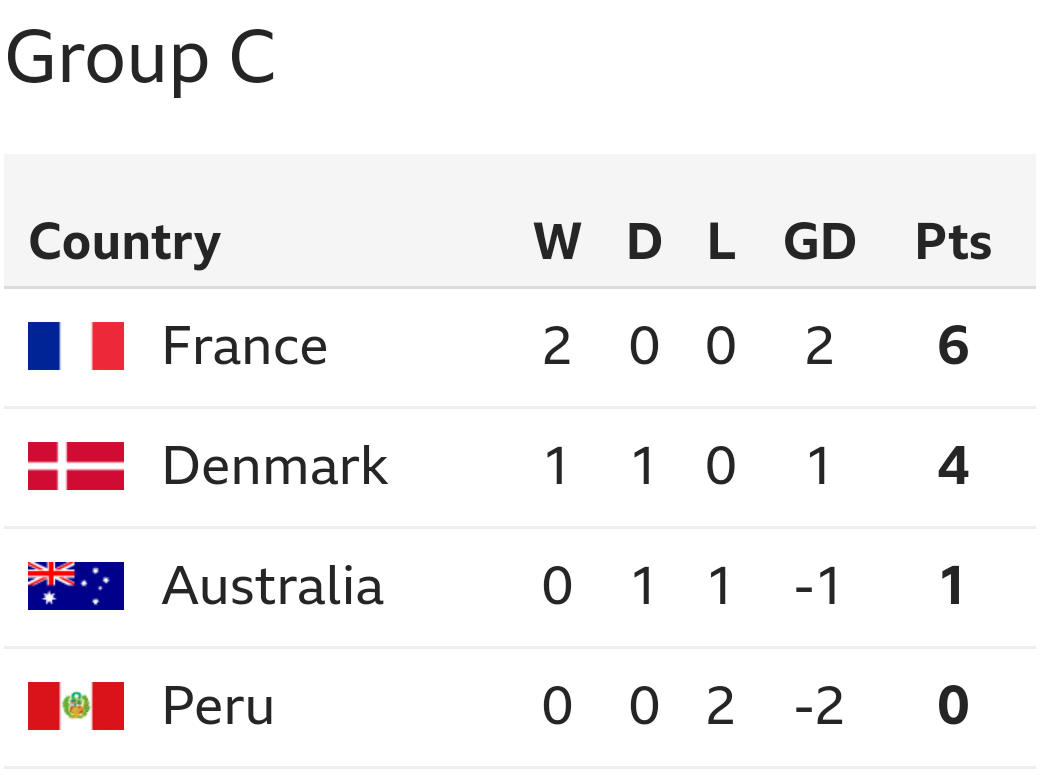
France v Australia Group C
Kazan 11am (UK) BBC
Fish Course
Argentina v Iceland Group D
Moscow 2pm (UK) ITV
Main (Seal Flipper Pie)
Peru v Denmark Group C
Saransk 5pm (UK) BBC
Dessert
Croatia v Nigeria (D)
Kaliningrad 8pm (UK) ITV
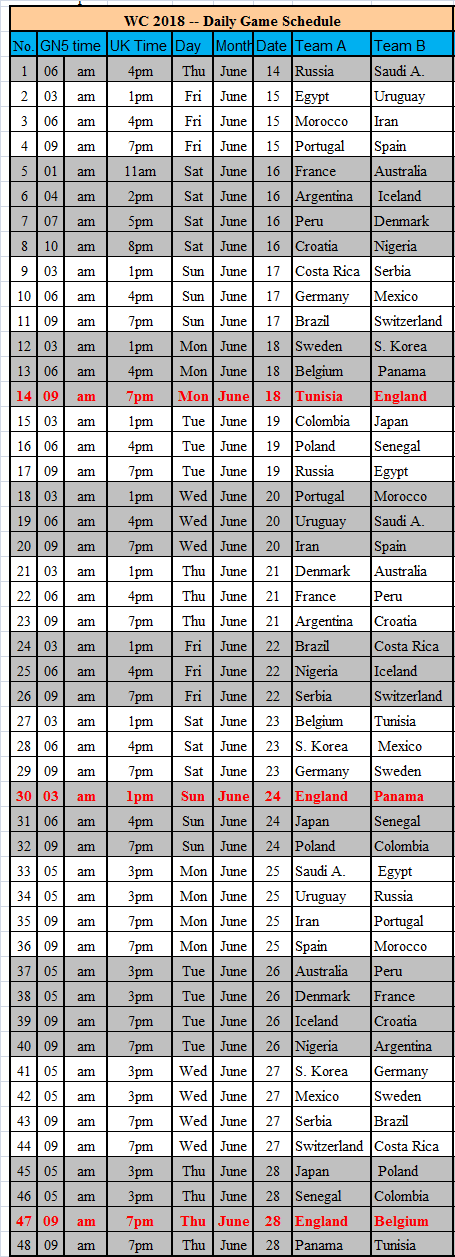
The 2018 World Cup in Russia is now upon us with the first game between Russia and Saudi Arabia kicking off at 6:00am on Thursday June 18th. With so many games to watch I created my own WC timetable for the group games.
Here is a copy.
My personal level of excitement is very low but I love watching football and given that in Canada and the -5 hour time difference with the UK it will make it a little easier to watch.
The group games are usually the dullest with so many having next to zero chance of advancing to the knock out games.
England should advance with little trouble but as yet I have not bothered to see who in the final 16 teams they will potentially face.
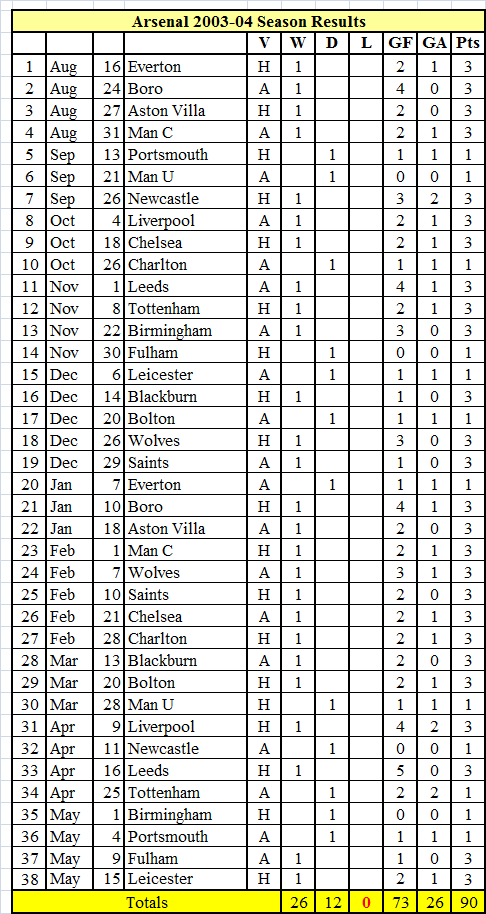
They are the only team to go unbeaten for a complete season since Preston North End went unbeaten in the inaugural season of the Football League in 1889 with a record of P22, W18, D4, L0, GF74, GA15, Pts58.
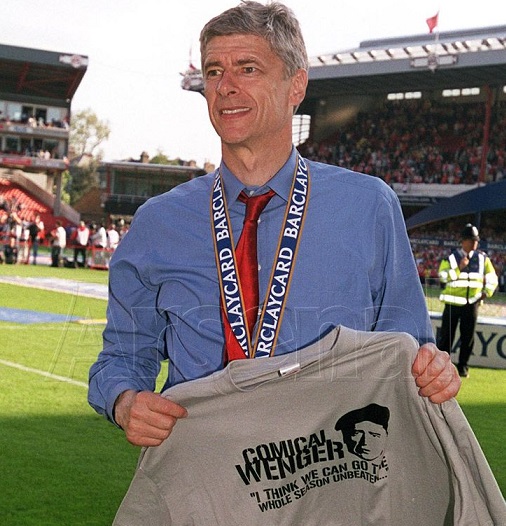
In retaining the Premier League Championship in 2001/02, Arsenal had earlier equalled Preston North End’s record of going unbeaten away for the entire season by beating Manchester United 0-1 at Old Trafford in our final away game. Perhaps it was this outstanding achievement which prompted Arsene Wenger’s outrageous prediction in September 2002 that his side could go a whole season unbeaten – the journos and footballing establishment mocked such a claim.
The ‘Comical’ jibe plus beret were a reference to an Iraqi Information minister at the time
Arsene only used 22 players in the whole season with Jens Lehmann playing in all 38 games – which included 15 shut outs.
Although he performed well throughout the 2002/03 season, long-serving keeper David Seaman was released at the end of the campaign. Arsenal brought in Jens Lehmann from Borussia Dortmund for a mere £1.5 million – a steal, considering just how important he would be for Arsenal over the next 12 months. Due to building the Emirates there were no big-name signings; club captain Patrick Vieira signed a new contract in the face of strong interest from Manchester United, Chelsea, and Real Madrid. With Arsene not make any big changes to the squad, and with no major departures, Arsenal started the season with the same group of players as the previous season.
The season kicked off with Arsenal in inspired form. A 2-1 home victory over Everton on the opening day was followed up with 4-0 win over Middlesbrough, a 2-0 win over Aston Villa and a 2-1 away victory over David Seaman and Manchester City. With just four games played, Arsenal had already put three points between them and fellow title-chasers Manchester United, leaving them sitting comfortably in first place, having scored ten and conceded just two.
Our unbeaten run came close to ending at Old Trafford in the sixth game of the season when United were awarded a penalty in injury time (no surprise there) but (our leastliked player) Ruud van Nistelrooy stepped up and missed the penalty and the match ended tied at 0–0. Tempers boiled over in the game dubbed the ‘Battle of Old Trafford’ following Vieira being given a red card.
October presented a tough schedule with a trip to Anfield and a home game against Chelsea. Despite falling behind against Liverpool we recovered to win 2-1. Going into the Chelsea game, both sides were level at the top of the table and were also undefeated in the league. The game appeared to be heading for a draw until a Carlo Cudicini blunder saw Thierry Henry give Arsenal the win, bringing an end to Chelsea’s unbeaten run. Despite the fact we had still not lost a poor 0-0 draw against Fulham on Nov 30th gave Chelsea the chance to take over at the top of the table.
At the turn of the year Arsenal had made it half way through the season without tasting defeat in the Premier League and the unbeaten season began to take place: but despite this feat, Arsenal entered 2004 in second place, one point behind leaders Manchester United.
The Gunners’ first game of the year once again ended with a lacklustre draw against Everton, while United secured a victory to increase their lead to three points. Although, things picked up with a dominant 4-1 win over Middlesbrough, which saw us draw level with United on points, goal difference and goals scored. Henry then began a goal scoring run which would see him net in each of the club’s next six games, the second and third of which came against Aston Villa a week later giving Arsenal all three points. Despite a trip to title chasers Chelsea and a visit to Manchester City, February would prove to be one of the best months in the campaign, with five wins in five games.
After 30 games Arsenal had officially beaten the Premier League record of consecutive game without defeat.
The 31st game saw perhaps the game of the season with Thierry Henry scoring a blistering hat trick to beat Liverpool after being 2-1 down at halftime.
Henry beats Dudek having left a trail of prostrate Scouse defenders in his wake
On April 25th we went to White Hart Lane knowing knew that a single point would be enough to end any chance of a late Chelsea comeback. Goals from Vieira and Pirés were enough to secure a 2-2 draw that handed Arsenal the trophy at the home of the North London pretenders with four games to spare.
We saw out the final month of Premier League action comfortably, with a bore draw against Birmingham City followed up with a 1-1 draw at Portsmouth and a 1-0 victory over Fulham. Despite going behind in their final game against Leicester City, Arsenal bossed the second-half, claiming victory thanks to goals from Henry and Vieira.
After Arsenal completed the only 38-match season unbeaten, the Premier League commissioned a unique gold trophy to commemorate the achievement. Arsène Wenger was presented the trophy as a parting gift from the club after his last home game as manager on 6 May 2018.
Brace yourselves as I’m in new territory here as far as post writing is concerned. Two reasons: yesterday I finished a book which is relevant, and unbelievably, I’ve just done seven minutes of research.
The book: Art of Learning. This is about an American fella called Josh Waitzkin. From being a chess prodigy, he quit the game at twenty three, took up a form of Tai Chi, and went on to become world champion. It is a highly illuminating and in depth analysis of the competitive psyche, and I recommend it.
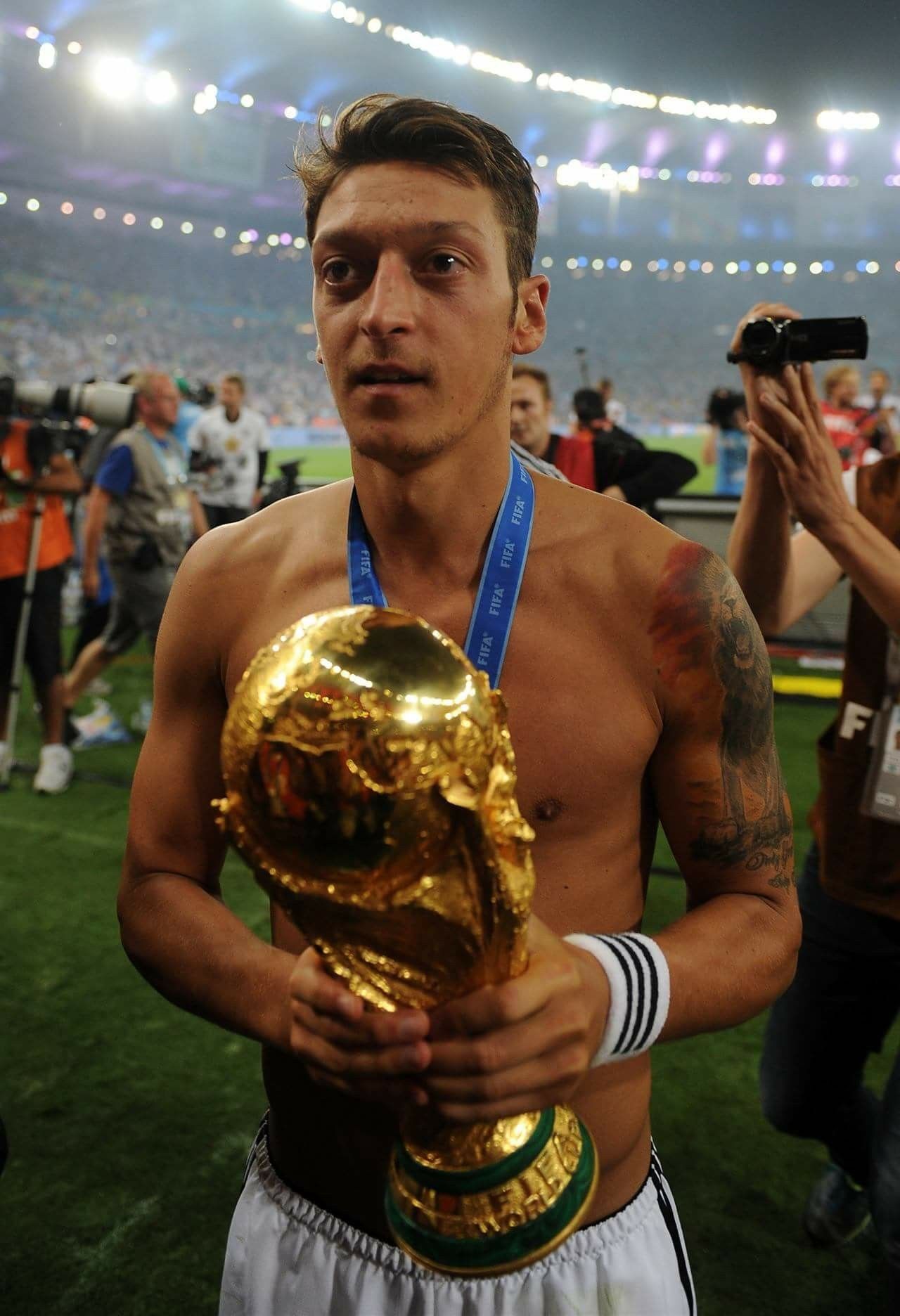
While reading, it made me think about Mesut Ozil.
Waitzkin talks about the fine margins that define the difference between competitors at the very highest levels of any discipline/sport. Part of that difference is the recognition that you cannot operate at peak performance at all times, and true champions know how to operate at a higher level for most of the time and elevate to peak level for short but decisive moments. This is Mesut Ozil.
Now the research bit. This morning I googled the Low German World Cup team formations and then did ditto for the Unai PSG sides, as I wanted to understand how and where Mesut was likely to fit in.
For Germany Mesut plays central of a three behind a lone striker. These three operate in front of the rock steady pair of Khedira and Kroos.
Next up, Unai’s PSG. Here we see a temptation to play a deeper anchor midfielder with two in front. Can’t do this as you end up with the awful box to box headless chicken runners stuff. Happily, many google images of the Emery PSG line ups show the more Germanic set up with the two, which of course, is what any sensible manager would do to optimise The Mesut Ozil.
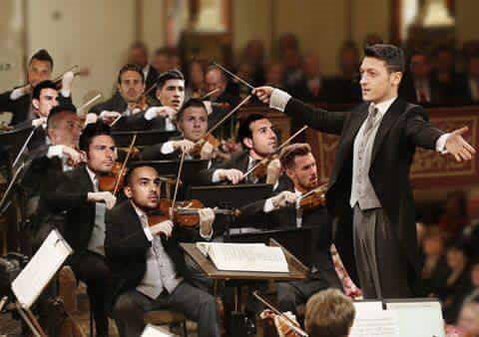
Arsene understood that creative genius is an essential component to the art of football, and even the more pragmatic Germans realise that a Mozart needs someone to build the concert hall.




 Posted by Jeremy Bongo








 Arsenal News 24/7


 arsenalarsenal.net