Arsenal’s Greatest Defenders – Day One

June 11, 2013

Continuing our Summer series of articles in search of Arsenal’s greatest ever team, this week we highlight the defenders. The daily posts will list the players in chronological order so many of you will never have heard of today’s crop of Arsenal heroes from yesteryear. Read on and appreciate what fantastic players these ‘Brylcreem Boys’ were and take the opportunity to choose your personal favourite by voting in the poll at the end of the week.

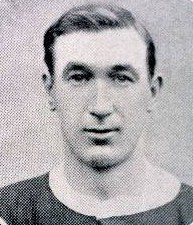
1. Percy Sands: 1902 – 1919

He played in 350 games over a 17 year period.

Percy was born in Norwood, London in 1881; he trained as a teacher in Cheltenham and also played football for Cheltenham Town.
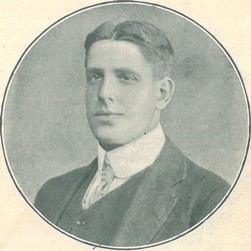
Percy_Robert_SandsHe joined Woolwich Arsenal in 1902 as an amateur, and while still an amateur he made the first team as centre half, he did not turn professional until three years later, while still working as a part time teacher. When Arsenal was promoted to the First Division in 1904 Percy was an ever present member of the first team who reached the FA Cup semi-final in both 1905-6 and 1906-7.

Known as “Mr. Reliable” he stayed with the club through thick and thin which included the leaner years and the club’s financial problems, and then relegation in 1912-13. During this time he was promoted to club captain and still remained captain when Arsenal moved to Highbury and the club was renamed “Arsenal”.

Football was suspended with the outbreak of WW1, but despite being 33 years of age he still played for Arsenal in unofficial war time games. He later joined the Royal Army Medical Corps and served as a sergeant on the Western Front.

In all he played in 350 games for Arsenal a record that stood for the next 15 years until it was broken by Bob John.

He passed away in December of 1965 aged 84 years.

2. Joe Shaw: 1907 – 1923

He played in 326 games over a 16 year period.

Joe was born in Bury, Lancashire in 1883 he first played for his home club, Bury, and then Accrington Stanley, helping them win the Lancashire Combination, before moving moved south to London, where in 1907 he joined Woolwich Arsenal.

Joseph_Ebenezer_ShawHe made his debut with Woolwich Arsenal against Preston North End on September 28, 1907, soon becoming a regular in the Arsenal side where he was first-choice left back. Despite Arsenal’s relegation in 1912-13 he stayed with the club as they moved across London to Highbury, and was an ever-present in the final season of 1914-15 before first-class football was suspended for WW1. He continued to play during this period in unofficial wartime matches, and by the time competitive football had resumed, he had made the switch to right back. After the departure of Percy sands in 1919 he was made Arsenal captain, by this time Arsenal were back in the First Division, and he continued to play until the age of 38 and in 1922 he made his 300th first-class appearance.

In all he played 326 matches for the club, after retiring from playing he became first a coach, and then manager of the Arsenal reserve side. After the unexpected death of Herbert Chapman in January 1934, he was made caretaker manager of the first team and carried on Chapman’s good work, for the rest of the season, as Arsenal won the 1933-34 League title. When George Allison was appointed permanent first-team manager in the summer he went back to his previous post as manager of the reserve team.

Joe remained with Arsenal through the 1930’s and after WW11 he went to Chelsea as a coach, returning to Arsenal in 1947 to become assistant manager under Tom Whittaker. He later served as a club ambassador before retiring from football in 1956, after 49 years’ service for Arsenal.

He passed away in 1963 at the age of 80 years.

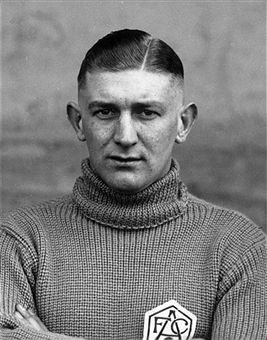
3. Jack Butler: 1914 – 1930

He played in 296 games over a 16 year period.

Born in, Colombo to English parents. He played for Dartford and Fulham Wednesday as a youth, before signing for Fulham in 1913. He became an Arsenal player in 1914 playing for the reserve side in his first season.

Soccer - FA Cup - Final - Cardiff City v Arsenal - Arsenal TrainingWith the outbreak of WW1 he signed up for the Royal Artillery and served in France, returning to Arsenal at the end of the war, with the resumption of first-class football, he  made his first-team debut for the Gunners on 15 November 1919.

Playing as a traditional “centre half” he was in competition with the Gunner’s regular centre halves, Chris Buckley and Alex Graham but by the 1924-25 season he was the undisputed first-choice centre half. He also won his first and only cap for England against Belguim in 1924. The following season he missed only one game as the Gunners finished second behind Huddersfield.

He was a regular first team player for the next four four seasons, playing in every match of the FA Cup run in 1927, reaching the final, but losing 1–0 to Cardiff City. Taking advantage of a relaxation in the offside law, Herbert Chapman introduced the new “WM” system. Although Jack experienced some success in the new system Chapman thought the side could do better, and in 1929-30 replaced Butler with Herbie Roberts.

He left Arsenal in the summer of 1930 and joined Torquay United for two seasons before becoming the coach of Royal Daring, a Belgian club. Later on he took over as coach of the Belgian National team at the 1938 FIFA World Cup. He went on to manage Torquay United, Crystal Palace and Colchester United.

Jack passed away in 1961 at the age of 66 years.

Written by GunnerN5 and compiled by Gooner In Exile


In Praise Of Ivan The Not-So-Terrible

June 10, 2013

There is an unbridgeable divide between supporters who feel we have overachieved since the stadium move and those who feel we have underachieved.

I am in the first camp. The arguments for and against have seen more daylight than Ashley Cole’s wayward todger so there’s no need to go into them in too much depth again.

But in summary, the case for us having overachieved is this:

  • We moved stadium at great expense, leaving us with a mighty debt.
  • To pay for the stadium we had to enter into long-term commercial deals which, while just about OK at the time, became less and less competitive as the years went by. Unfortunately we were locked in for the long haul as it was the only way we could finance the new stadium.
  • The world entered the biggest financial crash for 75 years.
  • Rich oilygarchs started taking over English football clubs and completely skewed the economics of the game. In this rich man’s game we were suddenly the paupers at the table.
  • Somehow, despite all these adverse trends, we managed to qualify for the Champions League every single year while showing a net profit on transfers. During this period we were massively outspent not just by the oilers, but also by such footballing titans as Stoke City, Aston Villa, QPR, West Ham, Sunderland, Wigan, Reading and Norwich.
  • All the above constitutes a minor footballing miracle. That any club could be steered through such stormy seas and still find its way to harbour safely year after year is simply incredible. One day this achievement will be understood and appreciated more widely than it is now.

Now if you, like me, accept this case as being self-evident, then it naturally follows that some people have been doing an extraordinarily good job at Arsenal.

First and foremost the credit for this overachievement is rightly given to Arsene Wenger.

We now know that his “project youth” experiment (while undoubtedly appealing somewhat to his philosophy and vanity) was actually a policy of financial necessity.

And while many are angry that he failed to bring us any silverware in the years since we left Highbury, with the financial resources we had available it’s remarkable that we did not slide into mid table mediocrity.

But enough has been said and written about Arsene.

I want to dole out some credit to another man – one who has been pilloried and vilified by huge swathes of the fan base for many years: Ivan Gazidis.

The reason I feel he deserves praise is because if Arsene was the captain of our ship during the stormy years, Ivan was the chief engineer. It was his job to keep HMS Arsenal seaworthy (financially sound) during some very difficult years – and he has succeeded brilliantly.

To be honest, I have never understood the vitriol – hate, even – that has been directed at him. Most of the critics have not the faintest idea of what he actually does (not that it stops them hating him).

When he became Chief Executive in 2008 the challenges before him were many and complex but the main ones were: retain the services of Arsene Wenger; pay down the high-interest elements of our stadium debt; ensure stability in the boardroom during a period of intense struggle between shareholders; improve on the commercial deals when possible.

Well, you can put a tick against every one of those aims.

His recent interview, in which he spoke with great optimism about the future of Arsenal, has received mixed reactions entirely depending on the prejudices of the listener/reader.

If you are part of the Angry Brigade, his talk of being now able to compete financially with the best in the world was a cynical ploy related to season ticket renewal and in advance of the meeting with supporters this week. Or it was a way of passing the blame on to Arsene if we fail to make any significant signings this summer.

I am a much less complicated listener. I took his words to mean what they said. In fact, they sounded to me like self-evident truth: we know that our new commercial deals are bringing in vast sums of money; we know that the new Premier League broadcasting deal is doing likewise; we know that the remaining “mortgage” on The Emirates Stadium is at low interest rates and is entirely manageable.

If you want to understand what our club has achieved in the last seven or eight years, just think about what COULD have happened during that period.

  • The stadium move could have spiraled out of control, running over time and over budget, but it didn’t, which says a great deal for the oversight from the club’s hierarchy (before and after Gazidis’s arrival).
  • Without Wenger’s genius and with no “net” money to spend on transfers, the team could have really struggled to stay competitive and could have slid down the Premier League table.
  • This might then have prompted desperate, panic buying to try and prop up the playing side even though we couldn’t afford it.
  • In the worst case, we could have found ourselves in a vicious spiral of debt off the pitch and failure on the pitch, which might ultimately have led to flirting with relegation, bankruptcy or both.
  • St Totteringham’s bones would have stayed in their casket for year after miserable year.

None of these bad things happened and we are now better placed than all but the “financially doped” teams to succeed in the years ahead.

And as Ivan has pointed out, the two teams in the Champions League final this year – Munich and Dortmund – both got there on the back of sustainable financial models and without the help of rich sugar-daddies.

So, Ivan Gazidis, you have taken many barbs since you arrived at Arsenal. Just for once, it’s time you took a bow…

Footnote

I have seen Ivan referred to as an American, as a South African, as someone who knows nothing about football. Well, here are some facts that you may not know about our Chief Exec:

Born in Johannesburg, South Africa.

Moved to England (Manchester) at age four because he father, a prominent anti-apartheid activist, was being persecuted by the then South African government.

Was considered a very talented footballer at school in Manchester.

Went to Oxford University where he earned a “blue” at football (which means he represented the University which also means he was a better player than 99% of the people reading this Post).

Graduated in law.

Moved to the US in 1992.

Was a founding member of Major League Soccer in the US in 1994.

RockyLives

DON’T FORGET: TOMORROW WE RESUME OUR SEARCH TO FIND THE ALL-TIME GREATEST ARSENAL SQUAD. THIS WEEK WE MOVE ONTO THE DEFENCE.


Week 2 – Goalkeepers Vote

June 7, 2013

So over the last few days you have seen the goalkeepers in contention for a place in the Greatest Ever Arsenal Squad, but me and GN5 both feel that there are too many Johnny Come Lately types who only ever vote for players in their most recent memory (or only memory). So to stop our squad being made up of 11 Invincibles and friends we are forcing you to vote by era.

4 goalkeepers 2 from each era are going in our squad, it’s up to you to decide…….

Has anything you have read over the last few days changed your mind? Hopefully you’ve been in search of Pathe news reels to see some of them in action, or maybe you’ve now realised why your Dad was so respectful to the old guy selling you your first scarf.

Today’s poll will allow multiple answers (up to 3 in total) for those of you who are in two minds or just wish to acknowledge more than one keeper.

1900-1970

George Swindin
Dan Lewis
Frank Moss
James Ashcroft
Jack Kelsey
Jim Furnell
Bob Wilson

1970-2013

Jimmy Rimmer
John Lukic
Pat Jennings
David Seaman
Jens Lehmann

I expect this to be a fiercely contested category, we have had some fine keepers over the years, and may have one more in the making, time will tell.

Written by GN5, compiled by Gooner in Exile


Goalkeepers – Day 3

June 6, 2013

9. Pat Jennings 1977 – 1985

Pat was our keeper for 8 years and played 327 games.

Pat was born in in Newry, County Down, after playing for Shamrock Rovers under-18 side at the age of 11, he concentrated on Gaelic football until the age of sixteen, when he made his soccer comeback with his hometown side Newry Town. After impressing with Newry he moved to English Third Division side Watford.

He was signed by Tottenham Hotspur for £27,000 in 1964. Pat spent thirteen years with Tottenham where he played in 472 league games, and 591 in all competitions. He won the FA Cup in 1967, the League Cup in 1971 and 1973, and the UEFA Cup in 1972.

He played an unsuspecting role in Arsenal’s League and Cup double in 1971 as he was in goal for Tottenham when Ray Kennedy’s header flew past him as Arsenal famously wrapped up the title at White Hart Lane.

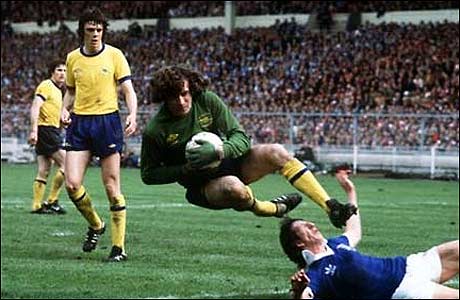
jenningsIn August 1977, he was transferred to Arsenal, the fact that Arsenal enjoyed some of his finest years was largely thanks to a miscalculation by Spurs manager Keith Burkinshaw who incorrectly suspected that Pat was approaching the end of his career when he let him leave for Highbury. He found himself out of favour at Arsenal in 1982 as Scottish keeper George Wood assumed the No 1 spot, but he bounced back and regained his starting place until his retirement from club football in 1985. His long career ended in style with an appearance, at the age of 40, at the 1986 World Cup Finals in Mexico. It was a fitting finale for one of our greatest goalkeepers. In total, Jennings participated in the qualifying stages of six World Cups between 1966 and 1986.

After his retirement, he returned to Tottenham Hotspur, playing in their reserve side to maintain his match sharpness for Northern Ireland’s 1986 World Cup campaign. He was also briefly on Everton’s books, having been signed as goalkeeping cover for the 1986 FA Cup Final against Liverpool, Neville Southall having been injured playing for Wales.

In 1973 the Football Writers association named him as its footballer of the year Three years later he won PFA’s version of the award – he was the first goalkeeper to receive this accolade, he also received an MBE and an OBE.

In 2003 Pat was inducted into the English Football Hall of Fame in recognition of the skills he demonstrated in English football

10. John Lukic 1983 -1990

John played for 7 years and appeared in 298 games.

John was born in Chesterfield, he signed for Leeds United as a schoolboy. He made his debut for them in 1979 and went on to play 165 games. After making a transfer request, he moved to Arsenal in July 1983 for £75,000, as a long-term replacement for Pat Jennings.

gun__1322669536_lukic_johnBy the middle of the 1984-85 season he was the club’s No. 1, and won the League Cup in 1987 and the Division One title in 1989. He was ever present in Arsenal’s first team throughout seasons 1987-88, 1988-89 and 1989-90. He played in the final game of the 1989 season where Arsenal won the title in the last minute of the game against Liverpool, with John starting the move which led to Michael Thomas’ famous goal.

In the summer of 1990 Arsenal manager George Graham signed David Seaman from Queens Park Rangers – Seaman had ironically been his understudy at Leeds. This outraged many Arsenal fans at the time, especially as John was a fan favourite. On his departure, Graham commented “I still think John Lukic is one of the best keepers in the country; I just think David Seaman is the best”

Having played 277 times for the Gunners, he rejoined Leeds for £1million, playing a further 265 times and winning a second League title in 1991-92 and a runners up medal in the League Cup in 1995-96

His career took another twist when he rejoined Arsenal in 1996 as understudy to Seaman and four years later was on the bench for Arsenal’s UEFA Cup final defeat to Galatasaray. John became the oldest player to feature in a Champions League match when, in October 2000, he played against Lazio at the age of 39 years and 311 days.

In 2000, after a series of injuries to the club’s other ‘keepers, he made a brief return to the first team, playing four times. The last of these four games, against Derby County, was a month shy of his 40th birthday – he is also one of several players to have played in the top flight of English football in four separate decades.

11. David Seaman 1990 – 2003

David played for 13 years and appeared in 564 games.

David was born in Rotherham, South Yorkshire; he began his career at Leeds United, the club he supported as a boy. However (much to his disappointment), he was not wanted by then-manager Eddie Gray, who had been his favourite player. David went to Division 4 club Peterborough United for a £4,000 fee in August 1982, where he began to make a name for himself.

Just over two years later, in October 1984, Second Division club Birmingham City paid £100,000 for his services. They ended up winning promotion at the end of that season, but were relegated again at the end of the following season. Seaman was not to follow them back to Division Two, however as in August 1986, David moved to Queens Park Rangers for £225,000. He earned his first England cap, which came under Bobby Robson in a friendly against Saudi Arabia in November 1988. Whilst at Q.P.R.,he was coached by Arsenal1971 double-winner Bob Wilson, who was to work with him for more than a decade.

Arsenal manager George Graham paid Leeds United £1.3 million for him which, at the time was a British record for a goalkeeper with John Lukic leaving to rejoin Leeds. Seaman became the cornerstone of an Arsenal back five which kept 23 clean sheets and conceded just 18 goals en route to the 1990/91 League title. His qualities were manifold – he had sharp reflexes, excellent positional sense, great judgement from crosses and bags of courage.

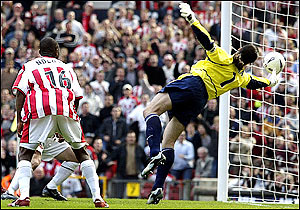
seaman1504_176880aOne of his most memorable moments came in April 2003 when Arsenal was defending a 1-0 lead in the FA Cup Semi-Final against Sheffield United at Old Trafford. In the closing minutes he was stranded when Paul Peschisolido headed towards goal but somehow he threw himself across goal and reached back to claw the ball away from under the crossbar. What made the save even more remarkable was that it was made in his 1,000th professional game. A month later, as Arsenal’s captain, he lifted the FA Cup at Cardiff’s Millennium Stadium following a 1-0 win against Southampton. After 564 appearances and eight major trophies, it was his final act as an Arsenal player and a fitting climax to his Arsenal career.

He retired from the game on 13 January 2004, following a recurring shoulder injury.

He was appointed an MBE in 1997 for services to the sport.

12. Jens Lehmann 2003-2011.

Jens played for 11 years and appeared in 200 games.

Jens was born in Essen, Germany.

The German international signed for Arsenal from Bundesliga side Borussia Dortmund in July 2003. During his first spell with Arsenal he played in every match of the Club’s unbeaten league campaign in 2003/04, when he was awarded the Premier League Golden Glove Award for his integral part in the ‘Invincibles’ season. He also won the Premier League title in 2003/04, the Community Shield in 2004 and an FA Cup winner’s medal in 2005, when he famously saved from Paul Scholes in the victorious penalty shoot-out

However, his style of play, often coming out of his goal to intercept passes occasionally led to mistakes, as it did in the title-winning match against Spurs when he pushed Tottenham striker Robbie Keane as they both waited for a Tottenham corner, he also made a mistake that led to the equalising goal in Arsenal’s Champions League defeat at home to Chelsea the same season.

Before joining Arsenal he was a Bundesliga title winner with Borussia Dortmund in 2002, and UEFA Cup winner with Schalke in 1997. He also had a brief spell with AC Milan in 1998.

He was a regular fixture for the Germany national team making 61 appearances before retiring from international football in 2008, Jens was a member of the Germany World Cup squads in 1998, 2002 and 2006, in addition to their squads for the European Championship Finals in 2000, 2004 and 2008.

soc_g_jens_576He was voted UEFA Club Goalkeeper of the Year for the 1996–97 and 2005–06 seasons, and he has been selected for three World Cup squads and also holds the UEFA Champions League record for the most consecutive clean sheets – not having conceded a goal in 10 matches while playing for Arsenal.

After leaving Arsenal he joined German club Stuttgart, where he spent two years before announcing his retirement from football at the end of last season. He rejoined Arsenal on a short-term basis in March 2011 during the time when, Wojciech Szczesny, Lukasz Fabianski and Vito Mannone were out through injury. He only made one appearance during his three-month spell back, helping Arsenal to victory at Blackpool.

Jens set a national team record of not conceding a goal for 681 minutes in a friendly against Switzerland on 26 March 2008


Goalkeepers – Day 2

June 5, 2013

Continuing our search for the goalkeeper of our Greatest Ever Arsenal team ……………………

5. Jack Kelsey: 1949 – 1962

Jack played for 13 years appearing in 352 games.

He was born in the Llansamlet area of Swansea. Les Morris, an ex-Arsenal player, spotted Kelsey whilst he was playing for his local side, Winch Wen. Morris recommended Kelsey to Arsenal, who upon watching the goalkeeper for a few games decided to sign him. Arsenal already had an established first-choice goalkeeper at this time, in Geroge Swindin, so Kelsey could do nothing but wait for his chance to play for the first team.

kelsey_greatThe legendary shot-stopper made his Arsenal debut in a 5-2 home defeat to Charlton Athletic in 1951 and was a world-class goalkeeper during the Gunners’ barren spell in the late 1950s and early 1960s.

With a rugged build and consistently solid catching, Kelsey managed to fully oust Swindin from the side (Swindin making only two appearances in 1953-54) and went on to be Arsenal’s first-choice goalkeeper for the next eight seasons; only a broken arm sustained in an FA Cup tie against Sheffield United in 1959 put him out of the Arsenal side for any considerable amount of time, with Jim Standen taking over in the meantime.

Jack was a true one-club man. He began and finished his career at Highbury after eventually ousting George Swindin as Arsenal’s No 1 in the 1952/53 campaign.

Dubbed “the cat with magnetic paws” by the Brazilian national side, he won 41 caps for Wales – then a British record for a keeper. He was their goalkeeper at the 1958 World Cup, which remains their only appearance at the finals to date.

He also played for Great Britain v Rest of Europe in 1955.

Jack displaced two vertebrae at the base of his spine while playing for Wales in 1962 and was forced to retire. He later took up the post of commercial manager at Arsenal, retiring in 1989.

He passed away in London in March 1992.

In September 2010 Jack was inducted into the Welsh Sports Hall of Fame.

6. Jim Furnell: 1963-1968

Jim played for 5 years and made 167 appearances.

Born in Clitheroe, Lancashire, Jim started his career at his local club Burnley, signing at the age of 17. As third-choice keeper he only played twice in eight seasons at Turf Moor, before being signed by Liverpool in 1962 where he immediately took the No. 1 jersey, playing all the club’s remaining matches that season, as they won the Second Division title and promotion to the First Division. Due to an accident early in the 1962-63 season, he lost his place and only played two matches in 1963-64.

titleBilly Wright brought Jim to Arsenal in 1963 paying £15,000. The manager was vindicated as Jim slotted straight in to the Gunners’ first XI, making his debut the day after he signed against Blackpool; the match finished 5-3 to Arsenal. He went on to become the long-term successor to Jack Kelsey playing as Arsenal’s No. 1 for the majority of the next five seasons. He was in goal for the Gunners’ League Cup Final defeat against Leeds United in 1968. But in the very next match, an FA Cup tie against Birmingham City, Jim’s mistake led to an unlikely Blues’ equaliser. He was duly dropped and never played for Arsenal’s first team again with young understudy Bob Wilson taking over the mantle.

He was sold in September 1968 for £8,000 to Rotherham United, after two years with Rotherham he moved to Plymouth Argyle and became a fans’ favourite at the club, playing there for five and a half years before his retirement in the summer of 1976. As part of the club’s centenary in 2003, he was named as goalkeeper in the Pilgrims’ all-time greatest XI by the club’s fans.

After retiring as a player, he was a coach at Plymouth before joining Blackburn Rovers in 1981; he served as a coach there until his retirement in 1998.

In a 2007 web poll, Jim was named Plymouth’s best goalkeeper of all time.

7. Bob Wilson: 1963 – 1974

Bob played for 11 years appearing in 308 games.

Bob was born in Chesterfield, he was the youngest child of six and had much older brothers (and an elder sister); two of his brothers were killed in the Second World War, one as a Spitfire pilot and the other as a rear- gunner in a Lancaster.

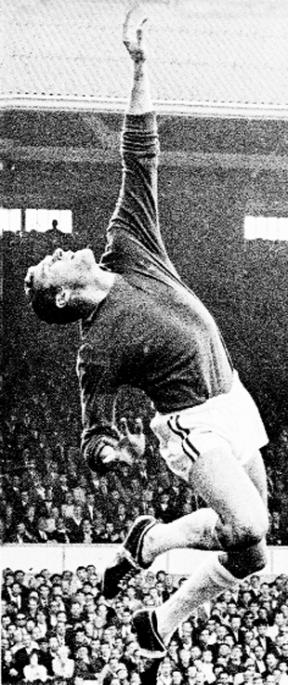
bob_wilsonHe was a late starter as a professional player, as his father would not let him sign papers with Manchester United as he thought it wasn’t a reasonable job whilst he was a youth. He played in reserve games for Wolves as an amateur and made his debut for Arsenal as an amateur, and was the first amateur to have a transfer fee paid (around £6,500).

Bob was forced to bide his time as understudy to Jim Furnell, and his early appearances for the Club did little to suggest he would make the grade. But a combination of intelligence and sheer hard graft ensured that he seized his chance when it came in March 1968.

He gained his first honour in 1970, the Inter-Cities Fairs Cup. The following year Bob was an ever-present in Bertie Mee’s Double-winning side, gaining the Player of the Year honour. Two years later injury forced Wilson out of the Arsenal side but he recovered to claim back his No 1 jersey. He held it until his retirement at the age of 32.

Wilson was goalkeeping coach for 28 years, working with Pat Jennings, John Lukic and David Seaman. He also forged a successful broadcasting career with the BBC and later ITV. In 2007 Bob received the Order of the British Empire (OBE) as recognition for his work in the Willow Foundation which was set up in memory of his daughter Anna who passed away in 1968.

He made no bones about the deep-seated passion for the Arsenal having the N5 postcode on his car number plate.

8. Jimmy Rimmer: 1974 – 1977

Jimmy played for 3 seasons and appeared in 146 games.

Born in Southport Rimmer joined Manchester United as a schoolboy, turning professional two years later, he played 46 times for United. In October 1973 he was loaned to Swansea City where he impressed as first-team goalkeeper. Arsenal manager Bertie Mee brought him in April 1974 for £40,000 and gave him his first-team debut against Liverpool shortly afterwards.

rimmer2He made only one appearance in 1973-74 (keeping a clean sheet on his debut against Liverpool). After Bob Wilson announced his retirement at the end of that season, Jimmy became Arsenal’s No. 1 for the next three seasons, and was a near ever-present for the Gunners. During his time at Arsenal he also won his one and only England Cap

After Tottenham Hotspur manager Terry Neill took over at Arsenal, he signed Pat Jennings from his old club and he was sold to Aston Villa. At Villa, Jimmy was No. 1 for the next six seasons, winning a First Division winners’ medal in 1981. The following year Villa reached the European Cup Final, but he was injured after only nine minutes, Villa nevertheless beat Bayern Munich 1-0 they then went on to win the European Super Cup.

Jimmy left Villa in 1983 to rejoin old club Swansea City. After retiring from playing, he became Swansea’s goalkeeping coach, having a brief spell as manager. He then spent several years in China working as the goalkeeping coach for the Chinese National team.

Written by Gunner N5 and compiled by Gooner in Exile


Goalkeepers – Day 1

June 4, 2013

Continuing our series of looking to create the Greatest Ever Arsenal team we move onto Goalkeepers this week. There will be information about various keepers during the week and a vote on Saturday to determine Arsenal Arsenal’s number 1.

1. James Ashcroft: 1900–1908

James was our keeper for 8 seasons and played in 303 games.

Ashcroft, JimmyBorn in Liverpool he played his youth football with Wilbyn’s United FC, Anfield Recreation Club and Garston Copper Works, all in Liverpool. He began with Everton FC Amateurs in 1897 and joined Gravesend United FC in the 1899 close season.

In June, 1900 he was signed for the Gunners by Harry Bradshaw, our manager from 1899 to 1904. He was the first Gunner to keep goal for Arsenal in the top flight, the first to play international football for England, winning 3 caps, the first to play in over 300 games and the first to play in 8 consecutive seasons while starting in over 30 games each season.

He made his first-team debut in the third game of the 1900/1 season at Burton Swifts after which he didn’t miss a game for more than four years, playing in 154 consecutive games, before sitting out the trip to Blackburn in October 1904. From his first game on he only let in 26 goals in the next 34 games, including 17 clean sheets and six consecutive games without conceding a goal. In 1903/4 he let in 22 goals in 34 games including 20 clean sheets.

The 1904/05 season was the Club’s first in Division One after they had won promotion the previous May and Jimmy remained the regular No 1 as Arsenal secured a top -10 finish in the top flight.

He secured another Arsenal goalkeeping first in 1906 after starting the Club’s maiden FA Cup Semi-Final against Newcastle. Arsenal lost that game and suffered the same fate a year later when Sheffield Wednesday beat them at the same stage of the competition with Ashcroft again between the posts.

He passed away in 1943 aged 64.

2. Dan Lewis 1924-1931

Dan was our keeper for 7 years and played in 167 games

Dan was born in Maery, Glamorgan, and after playing for clubs in his area moved to Clapton Orient before joining Arsenal in 1924 he made his debut in a 3-2 victory over Everton in November that year.

Dan worked in the coal mines before taking up football and was a popular choice for Herbert Chapman; but was forced to fight for his place throughout. When Chapman arrived in 1925 he competed for the No. 1 shirt with Jock Robson and Bill Harper; eventually becoming the first choice keeper after they departed in 1926 and 1931 respectively.

gun__1341483330_lewis_danThe most infamous moment of Lewis’ Arsenal career was the 1927 FA Cup Final against Cardiff City at Wembley it was the Gunners’ first Cup final, which we lost 1-0 due to an error by Lewis. In the 74th minute, Cardiff striker Hughie Ferguson hit a tame shot straight at Lewis, who dived down to make what should have been a comfortable save. However, Lewis fumbled the ball as he gathered it, and it slipped between his body and the crook of his elbow; Lewis turned around and tried in vain to reclaim the ball but only succeeded in knocking it with his elbow into the back of the net.

Flickering Pathe newsreel footage shows Lewis, a hapless Chaplinesque figure in baggy shorts, go down on his knees to gather Ferguson’s shot, only for the ball to slip between his body and the crook of his elbow. As his calamity unfolds, in slow motion, the greasy leather ball appears to wriggle through his grasp like a slippery salmon.

On receiving his losers’ medal from King George V, a disgusted Lewis reportedly cried “This is not for me,” before flinging it as far as he could into the Wembley crowd. “According to legend, the entire Arsenal team went back out on to the pitch afterwards and got down on their hands and knees to look for it.” Years later Lewis’s Arsenal team-mate, Bob John, reflected: “Poor Dan. I don’t think he was ever the same again.”

Another version of the story is that Lewis’s son Dave, an Arsenal fan, has kept the solid gold artefact at his Hertfordshire home since his father’s death in 1965. “He said, it has a little dent in it possibly caused by my dad chucking it across the dressing room,” One wonders where the truth actually lies?

Lewis blamed his brand new jersey for the error, saying the wool was too greasy for him to grip the ball properly; since then, according to club legend, no Arsenal goalkeeper has played in a new jersey before it is washed first.

He remained the number one for another three seasons playing in 95 games. He missed out on playing in our 1930 FA Cup Final victory over Huddersfield (our first trophy) after getting injured in a game against Leicester City. He was transferred to Gillingham in 1927.

3. Frank Moss 1931-1937

Frank was our keeper for 6 years and played in 161 games.

He signed for Arsenal from Oldham Athletic in November 1931.

tumblr_lhh63woykd1qftoilo1_400Moss immediately took the first-team keeper’s jersey from Charlie Preedy and was a near regular for the Gunners for the next four seasons; he won a hat-trick of First Division titles 1932-33, 1933-34 and 1934-35 he also played in the 1932 FA Cup Final which Arsenal lost to Newcastle United after a controversial equaliser from Jack Allen where the ball went behind the goal-line and out of play before being crossed back in for Allen to score.

Moss also played five times for England, making his debut on 14 April 1934 against Scotland at Wembley keeping a clean sheet as England won 3-0. His final match for England was the “Battle of Highbury” match against World Champions Italy on November 14th 1935 at Highbury, in which seven Arsenal players started the match; England won 3-2.

Moss is the only Arsenal goalkeeper to score in a first-class match. On 16 March 1935, in a First Division match against Everton, Moss dislocated his left shoulder; with no substitutes allowed in those days, Moss was forced to play the rest of the game on the left wing and incredibly, he scored Arsenal’s first goal in a 2-0 win.

4. George Swindin: 1936– 1954

George played in 297 games over an 18 year career, which included WW11.

Swindin was born in Campsall, Doncastor, and Yorkshire. He played as an amateur for various local clubs, turning professional in 1934 with Bradford City where he played 26 times before being signed by Arsenal in 1936 for £4,000. He played seventeen games in 1937-38 the most of Arsenal’s three keepers, and won a First Division medal.

WW11 interrupted his career somewhat, but Swindin continued to play through the war for Arsenal, whilst acting as a PT instructor for the Army.

063-0009By the time first-class football had resumed after the war, he became Arsenal’s undisputed No. 1, and stayed there for the next six seasons. He was a commanding keeper who was especially known for his aerial ability and assured handling of crosses, as well as his strong physical resilience. He won his second League title in 1947-48 he also played in two FA Cup finals; winning against Liverpool in 1950 but losing to Newcastle in 1952.

By 1952-53 he was beginning to show his age, and another talented keeper, the Welshman Jack Kelsey took his first-team place. Nevertheless, George in played 14 matches that season as Arsenal won the title again, giving him his third Championship winner’s medal.

Despite his excellent form for Arsenal, he was never capped by England.

Written by GunnerN5 and compiled by Gooner in Exile


Greatest Manager – Herbert Chapman or George Allison

May 29, 2013

Today’s post is a collaborative effort between GunnerN5 and Gooner In Exile and is the first in a series that will be profiling the best managers and players ever to represent the Arsenal.  We will publish a poll at the end of each category to allow readers to choose who they deem to be the best of all time. The end result will establish (after 8 weeks of painstakingly researched articles) who readers believe comprises the best Arsenal team of all time.  

1. Herbert Chapman: 1925-1934

He was born in Kiveton Park, near Rotherham; his father was a coal miner. One of eleven children in a keen sporting family, two of his brothers played professional football. The most successful was Harry, who played for The Wednesday in the 1900s. His older brother Tom played for Grimsby Town and yet another brother, Matthew, became a director of the same club. Herbert’s own playing career was mostly as a journeyman amateur.

His managerial career began with Northampton Town after which he joined Leeds City.

Herbert_Chapman_1During the suspension of league football, during WW1, he decided to help the war effort by becoming manager of a munitions factory in Barnbow. Soon after the end of WW1 Leeds City was accused of making illegal payments to players and as they refused to open their books for examination the club was expelled from the football league. Five officials including Chapman were banned from football for life. However the ban was overturned in 1921, when Huddersfield Town gave him a character reference, he then joined them as assistant manager on February1st 1921 and was appointed secretary/manager the following month. He went on to win the FA Cup in 1924-25 and consecutive League Titles in 1923-24 & 1924-25.

In the 1925 close season, Arsenal chairman Sir Henry Norris placed the following advertisement in the Athletic News.

“Arsenal Football Club is open to receive applications for the position of Team Manager. He must possess the highest qualifications for the post, both as to ability and personal character. Gentlemen whose sole ability to build up a good side depends on the payment of heavy and exorbitant transfer fees need not apply.”

WMHerbert moved to Arsenal soon after, attracted both by Arsenal’s larger crowds and a salary of £2,000, double what he earned at Huddersfield Town. Arsenal’s league form was indifferent but in 1927 they reached the FA Cup Final losing 1–0 to Cardiff City. That same year, Arsenal became embroiled in a scandal over illegal footballers’ pay. Sir Henry Norris was indicted for his part and banned from football, but Chapman escaped punishment.

He showed his cunning during negotiations held in a hotel when looking to buy David Jack from Bolton. Chapman met with the barman and gave him two pounds and then said “This is my assistant Mr Wall; he will drink whiskey and dry ginger. I will drink gin and tonic. Our guests will drink whatever they choose but you will give them double of everything while Mr. Wall’s drinks and mine will contain no liquor.” His cunning worked as Arsenal paid 3,000 pounds less than Bolton had first asked.

He went on to establish Arsenal as English footballs dominate force and his football concepts and ideas served as a template for teams and managers all over the globe. He won the first trophy for the club winning the FA Cup in 1930. His 1930/31 team scored an incredible 127 goals – still a club record. He championed innovations such as floodlighting, European competitions and numbered shirts.

Tragically he passed away from pneumonia in 1934 aged 55 years.

A bronze bust of Chapman stood inside Highbury as a tribute to this outstanding manager.

Herbert Chapman’s league record –

Games 336, Won 157, Drawn 84, Lost 95,

Goals for 736, Goals against 541,

Goals for per game 2.19, Goals against per game 1.61

Points won 59.3%

Average League Position 6.25

Total # of trophies won – 2 League titles, 1 FA Cup, 3 Charity Shields.

2. George Allison: 1934-1947.

Born in Hurworth-on-Tees, County Durham, he played amateur football in Stockton-on-Tees and dabbled in writing as a sideline and eventually became a full time journalist.

During WW1 he worked for the War Office and the Admiralty, producing propaganda, and later joined the Royal Fling Corps (later renamed the Royal air Force). After the war he moved into broadcasting, joining the BBC and becoming the first person to commentate on the radio on events such as The Derby and the Grand National, as well as the annual England v.Scotland international, and the 1927 FA Cup Final. By this time, he had already formed a strong association with Arsenal and he became the club’s programme editor, becoming a member of the board of directors soon after the end of the WW1; he was first club secretary and then managing director.

-Images-a-allison_georgeAfter the sudden death of Herbert Chapman in January 1934, he was appointed Chapman’s full-time successor, in the summer of that year. Arsenal had already won the League Championship twice in a row (1932-33 and 1933-34), and he made it a hat-trick, winning a third successive title in 1934-35.

He famously appeared in a 1939 movie that was set at Highbury, “The Arsenal Stadium Mystery”, where he had a speaking part as himself. Amongst his lines included one uttered at half time: “It’s one-nil to the Arsenal. That’s the way we like It.”, a line which had resonance with the team’s penchant for 1-0 score lines many decades later.

Unlike Herbert Chapman he took a hands-off approach to managing and left Joe Shaw and Tom Whittaker to take care of the training and squad discipline, while he concentrated on transfer policy and the club’s relationship with the media. He was known as being tactful, friendly and good-hearted but it was felt that he fell short in his handling of the squad and lacked a professional’s deep knowledge of the game. However his proponents have cited the amount of trophies won in his reign, although by the end of the 1930s Arsenal were no longer the all-conquering team that they had once been and he was unable to replace many of the stars from the first half of the decade. With the start of WW11 football in England was suspended; after the war ended, many of the players that had made Arsenal great had retired from playing. Arsenal finished a disappointing 13th in 1946-47, by now he was in his mid-sixties and being tired of managerial life, he decided to step down and retire from the game.

He died in 1957 after several years of illness.

George Allison’s league record –

Games 294, Won 137, Drawn 80, Lost 77,

Goals for 552, Goals against 345,

Goals for per game 1.88, Goals against per game 1.17

Points won 60.2%.

Average League Position 4.29

Total # of trophies won – 3 League titles, 1 FA Cup, 2 Charity Shields.

Written by GunnerN5 and compiled by Gooner in Exile


Our Greatest Ever Squad

May 28, 2013

Anyone who has been to the Emirates has probably seen this picture.

SPIRIT OF HIGHBURY full image

I personally love it, it shows me what we as a football club are about, the years of traditions and the number of players and managers that have represented our club.

So this summer to keep our minds off arrivals and departures I thought it would be a good time to revisit some of the history of our club and to have a Greatest Ever Team Poll. GN5 however had other ideas……..here is his summation of what you lucky souls are in for the the summer:

Choose AA’s Greatest Ever Arsenal Squad

Over the next 8 weeks we will be profiling the very best players and managers in Arsenal’s history. They have been chosen based on various criteria which include, games played, goals scored, international careers and their overall importance to Arsenal. We apologise, in advance, if your personal favourites are not included.

The historic records do not always give us their precise positions, and in many cases players have changed positions during their careers. With this in mind we will be dividing the players into four groups, however even with this grouping there are still some that have played in more than one group – so keep an open mind.

Group 1 – 6 Managers

Group 2 – 12 Goalkeepers

Group 3 – 20 Defensemen

Group 4 – 20 Mid-Fielders

Group 5 – 20 Forwards

Each week we will have three days devoted to player profiles and one day for you to cast your vote for the week’s best players. You can vote two players as the end of the eight weeks there will be a final “AA Squad Reveal Day” when we will reveal your choices for both our “A” and “B” squads.

We hope you enjoy…….

Written and compiled by GunnerN5 and Gooner in Exile


Cesc: “Only Arsenal For Me”

May 27, 2013

We are used to reading rubbish in the silly season, but one story this summer really takes the biscuit.

I’m sure I wasn’t the only one to guffaw over my cornflakes when I read the “Fabregas to Manchester United” stories that are doing the rounds.

At this time of year most transfer-related stories smell of fabrication and are written purely to fill column inches or garner online hits. But even in such company, the Cesc-to-Manchester-United fantasy really does stink the place out.

Before I explain why, let’s just remind ourselves of this quote from Cesc himself, shortly after he departed for Barcelona: “Apart from Arsenal and Barcelona, I don’t see myself playing anywhere else. I will definitely be going back (to Arsenal) whenever I have time to watch games and to see the guys… and if there is one place to go back to (to play), it is Arsenal for sure.”

Cesc was abundantly clear then that he would only return to the Premier League if it was to play for Arsenal.

Of course you might say (and with some justification): “Why should we believe the words of footballers? They are always quick to spout loyalty to a club then equally quick to demonstrate loyalty only to their wallet.”

It was about 18 months ago when Cesc gave the interview from which I have quoted and yes, it’s possible he could have changed his mind since then.

But – unlike Brave Sir Robin and the Fat French Benchwarmer – he is not a player known to be driven by greed (he even took a pay cut to join Barcelona).

However, there are other good reasons why Cesc to ManUre will never happen:

Firstly, why would a world class player join a club that is quite clearly at the high point of its “arc of success” and is about to start slipping down the far side?

United have been good enough to run away with the English Premier League this year, but no-one believes they are a great team. Meanwhile, in Europe, they have fallen even further behind the Continent’s powerhouses than they were when humiliated by Barcelona in the CL final in 2011.

Most perceptive observers believe that United over-achieved in the season just past and were helped by mismanagement and upheaval at Manchester City and Chelsea.

Secondly, one of the reasons for a top player joining United has long been the draw of old Mr Scarlet Proboscis himself: Sir Alexander Chapman Ferguson (you didn’t know his parents gave him a middle name honouring a great Arsenal manager, did you?).

But Cyrano de Fergerac is no fool. He will always have wanted to bow out a champion and not a loser.

Having won the title this year, he undoubtedly surveyed the medium term prospects for his club and his playing staff and did not like what he saw.

He knows that, with their current squad, United will face a real struggle to hold on to their title next year and he also knows that without spending a hundred million pounds or more (which United cannot afford) they have no chance of competing with the likes of Real Madrid, Barcelona and Bayern Munich.

Quite sensibly, he celebrated the title win and exited stage left.

So now any superstar thinking of joining the red half of Manchester has to consider the fact that they will be playing not for the most decorated and successful EPL manager of the last half century. Instead they will be lining up under some bloke from The Simpsons.

The idea of Cesc Fabregas agreeing to play under David Moyes is simply laughable.

Thirdly, if Cesc does want to return to the EPL and if, for some reason, he reneges on his assurance that he would return only to Arsenal, his destination is far more likely to be Manchester City than Manchester United.

The Northern Oilers are likely to be entering the new season under the stewardship of the highly respected Manuel Pellegrini – a much more attractive proposition for international stars than David Moyes. And, of course, for City money is not an issue.

Finally, it was widely reported that we have first option on Cesc if he wants to leave Barca. Do you really think we would not snap him up again given the chance?

So, having (I hope) properly put to bed all the nonsense about Cesc-to-United, there is one Huddlestone in the Room that needs addressing: would we – the supporters – want Cesc to return to The Home of Football and step out again in the colours of the mighty Arsenal?

I have seen comments in Arsenal Arsenal recently with differing views on the subject.

For me it’s a no-brainer. Cesc Fabreagas is one of the greatest footballers ever to have played for us. If we can get him back he can only improve us. And his return at a time when we are leaving the period of austerity (during which, let’s remember, he was instrumental in helping keep us even vaguely competitive while the club spent NOTHING on net transfers) and about to enter a new era of competitiveness could be the spark that really pushes us to domestic and European glory.

Do you agree?

RockyLives


Happy 26th May

May 26, 2013

Football is all about the creation of heroes.

When we think about how a game was won or lost we search for the person/people that affected the outcome. Last night Arjen Robben became a hero scoring in the 88th minute of a game that looked destined for extra time and penalties.

Last weekend Laurent Koscielny became our hero for scoring against Newcastle and securing fourth place for us.

All teams have their heroes, some can do it on a consistent basis whereas others just manage one moment that gets them into the history books.

Some footballers can by their own actions drive their team to victory and others that shoulder the responsibilty are unable to do so. Sometimes it’s down to the gods to smile on the winning side ……. it was meant to be.

On the 26th May 1989 Arsenal went to Anfield for the final game of the season. A win by two clear goals would snatch the title away from Liverpool and on that night the footballing gods were on our side. We were victorious and that team of heroes earned their place in Arsenal folklore.

Many of you might recognise yourselves or others in the following clip ………. enjoy.

Which games stand out for you where a hero was born? Or which of your heroes always pulled all the stops? Feel free to add video clips in your comments for others to enjoy.

Have a nice day.

Written by peachesgooner