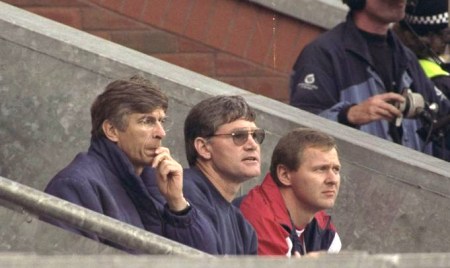
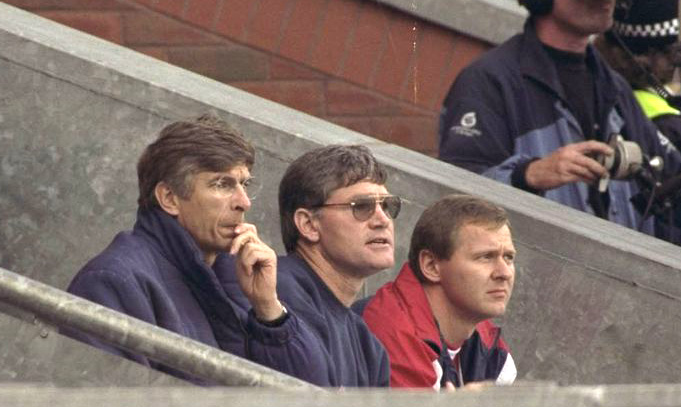
Arsène Wenger’s 1st game on Oct.12th 1996 – a 2-0 away victory over Blackburn Rovers
In August 1996, Arsenal dismissed manager Bruce Rioch and former Barcelona player and manager Johan Cruyff was the odds on favourite to take over; however Arsenal appointed a relative unknown named Arsène Wenger.
He officially took over the reigns on October 1st 1996. Arsène was a close friend of club vice-chairman David Dein, whom he first met during a match between Arsenal and Queens Park Rangers in 1988. The Evening Standard greeted his appointment with the headline “Arsène Who?” Arsenal finished third in his first season and missed out on a Champions League qualification place to Newcastle United who was in second place based on goal difference.
In his second season, Arsenal won the Premier League and FA Cup to complete the second league and cup double in the club’s history. Arsenal had to overcome a 12-point deficit on league leaders Manchester United in the final few weeks of the season. Arsenal’s success was built on an already stalwart defence which consisted of Tony Adams, Steve Bould, Nigel Winterburn, Lee Dixon and Martin Keown with David Seaman in goal. The defenders contributed to a run of eight consecutive clean sheets between January and March 1998.
Arsène thought of striker Dennis Bergkamp as the catalyst of the team plus the new signings of Petit and Vieira along with winger Marc Overmars and striker Nicolas Anelka all provided the core and benefited from Arsene’s attack-minded principles. The beginnings of “Wenger Ball” had officially arrived at Highbury!
The following seasons were a series of close calls, in 1998–99 the club finished second behind Manchester United who also defeated Arsenal in a FA Cup semi-final replay.
One year later, Arsenal lost the 2000 UEFA Cup Final to Galatasaray on penalties and in 2001, was beaten by Liverpool in the 2001 FA Cup Final, even though they dominated the match. During this period both Overmars and Petit left to join Barcelona.
Arsène then surprised everyone by signing a new four-year contract in July 2001.
Arsenal made several signings in the summer, including the controversial arrival of defender Sol Campbell, on a free transfer, from Tottenham Hotspur and midfielder Giovanni van Bronckhorst from Rangers – they along with Fredrik Ljungberg, Thierry Henry and Robert Pirès who were brought in during previous transfer windows, now created the bedrock of the first team.
2001- 2002 was another double season and, for Arsenal fans, the ultimate moment arrived when Sylvain Wiltord scored the winning goal against Manchester United at Old Trafford in the penultimate game of the season to secure the club’s 12th league championship and third double; four days earlier Arsenal had beaten Chelsea 2–0 in the 2002 FA Cup Final.
That same season Arsenal scored in every single league fixture and was unbeaten away from home. Arsenal extended their good form into the 2002–03 season; they overhauled Nottingham Forest’s top-flight record of 22 away league matches without defeat and surpassed Manchester United’s Premier League total of 29 matches unbeaten. They ended up second to Manchester United in the league after giving up an eight point lead, however they gained some consolation by winning their ninth FA Cup defeating Southampton 1-0.
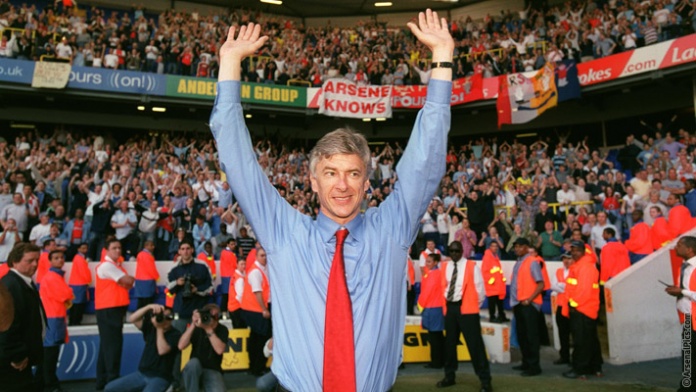
In the 2003–04 season, Arsenal made history by winning the Premier League without a single defeat – an accomplishment last achieved by Preston North End over 115 years earlier. The team became known as “The Invincibles” and they clinched the League Championship in front of Tottenham’s supporters at White Hart Lane with a 2-2 draw on April 25th 2004 – eventually their undefeated run ended at 49 league games.

“We won the league at White Hart Lane”
That Arsenal chant must gnaw away at Tottenham fans who have suffered the indignity of watching our Gunners clinch the title on their ground not once, but twice.
Arsenal enjoyed another comparatively strong campaign in 2004–05, but finished second to Chelsea. Consolation again came in the 2005 FA Cup; Arsenal defeated Manchester United on penalties, after a goalless final with Patrick Vieira scoring the winning penalty with his last kick as an Arsenal player.
In the 2005–06 and 2006–07 seasons Arsenal finished fourth in the Premier League on both occasions and outside of the top two for the first time in Arsene’s tenure. The club reached their first Champions League final in May 2006, but ended the competition as runners-up to Barcelona in a 2-1 loss.
In the summer of 2006, Arsenal relocated to the Emirates Stadium; Wenger believed the increased capacity was “vital” to the club’s financial future. Arsenal has not won any trophies since the 2005 FA Cup but has continued to win qualification to the Champions League and under Arsene’s guidance they have qualified in the last seventeen seasons.
This brings us to the current season where with nine games left to play we look to be assured of another CL qualification spot and have a shot at winning the EPL Championship and we play Wigan in the semi final of the FA Cup.
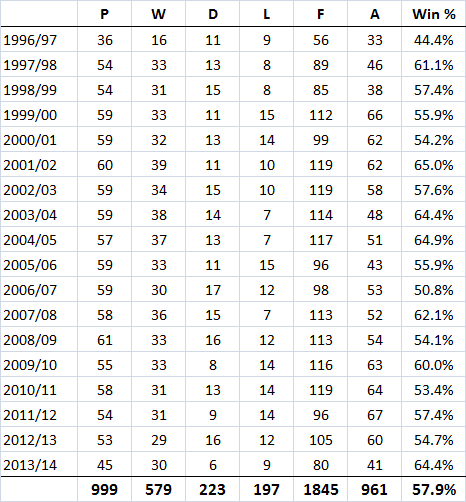
Saturday March 22nd will be an epic day in Arsène Wenger’s tenure as the Arsenal Manager will take his Arsenal side to Stamford Bridge to play against Chelsea in his 1,000th game in charge of the club.
Arsenal accomplishments for Arsene Wenger
• FA Premier League: 1997–98, 2001–02, 2003–04
• FA Cup: 1997–98, 2001–02, 2002–03, 2004–05
• FA Community Shield: 1998, 1999, 2002, 2004
Individual accomplishments for Arsene Wenger
• French Manager of the Year: 2008
• J. League Manager of the Year: 1995
• Officer of the British Empire: 2003[206]
• Onze d’Or Coach of The Year: 2000, 2002, 2003, 2004
• Premier League Manager of the Season: 1998, 2002, 2004
• LMA Manager of the Year: 2001–02, 2003–04
• BBC Sports Personality of the Year Coach Award: 2002, 2004
• Freedom of Islington: 2004
• FWA Tribute Award: 2005
• English Football Hall of Fame: 2006[207]
• Premier League Manager of the Month:
March 1998, April 1998, October 2000, April 2002, September 2002, August 2003, February 2004, August 2004, September 2007, December 2007, February 2011, February 2012, September 2013
• World Coach of the Decade: 2001–2010
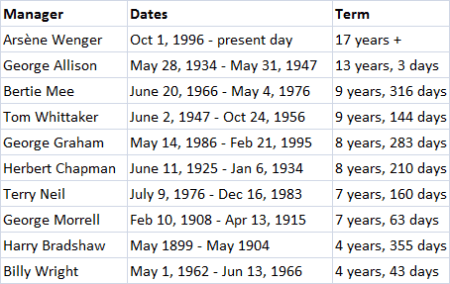
Top ten Arsenal Managers with the longest tenure.
Arsene Wenger’s Record at Arsenal

Written by GunnerN5


 Posted by Erik the Red







 Arsenal News 24/7


 arsenalarsenal.net