Arsenal’s Greatest Forwards Day 4

July 16, 2013

Continuing our Summer series of articles in search of Arsenal’s greatest ever team, this week we will end our quest for the greatest forwards to include in our team.  Don’t forget to take the opportunity to choose your personal favourite striker, this weeks posts will bring us bang up to date and there will be a vote on Saturday.

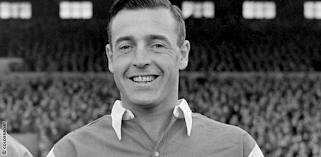
11. David Herd: 1954-1961.

David made 180 appearances over a 7 year period and scored 107 goals.

David was born in Hamilton but grew up in Manchester. He started his career at Stockport County and Soccer - League Division One - Arsenal New Signing - Highburymade his debut on the final day of the season, but his appearances  were limited by his national service duties. He scored five goals in 12 games in 1953–54 and he attracted the attentions of First Division clubs.

He did well enough to attract the attention of Arsenal, who signed him for £10,000 in 1954, and he made his debut on 19 February 1955 against Leicester City. David continued to be a bit part player, playing just eight games in his first two seasons at Arsenal, before making his breakthrough in 1956–57, scoring 18 goals in 28 games that season. From then on he was an established goal scorer, being the club’s top goal scorer for four season’s straight, from 1956–57 through to 1960–61 – when he scored 29 goals, the most by an Arsenal player since Ronnie Rooke. Despite being top scorer in 1960–61, he was unsettled at Arsenal due to their lack of success, and he moved to Manchester United in July 1961 for £35,000. Manchester United.

His first game for United came against West Ham United on 19 August 1961. He helped the club to the 1962–63 FA Cup, scoring two goals in the final itself against Leicester City. He also helped them to the 1965 and 1967 league championships and the 1967–68 European Cup. However, after he broke his leg in March 1967, his first-team appearances were limited, and he was not selected for the 1968 European Cup Final on 29 May 1968. In all, he scored 145 career goals in 265 appearances, an average of 0.54 goals per game. He also once scored past three different goalkeepers in one match on 26 November 1966 against Sunderland, as United won the game 5–0.

He left Manchester United in July 1968 for Stoke City on a free transfer. He played 39 games for Stoke in 1968–69 scoring nine goals as Stoke had a poor season narrowly avoiding relegation. In 1969–70 He made nine appearances scoring twice and was released at the end of the season. He then spent a short spell with Irish club Waterford.

He won his first cap for Scotland, on 18 October 1958 against Wales at Ninian Park; Scotland won 3–0. He won five caps in total for Scotland between 1958 and 1961, scoring three goals, his last cap coming in a 4–0 defeat by Czechoslovakia on 14 May 1961.

After retiring from playing, he had a stint managing Lincoln City between 1971 and 1972.

His 107 goals for Arsenal place he 16th on the all time list 

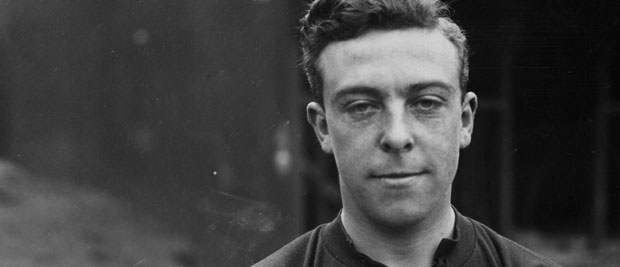
12. John Radford: 1962-1976.

John made 481 appearances over a 14 year period and scored 149 goals.

John was born in Hemsworth, Yorkshire. He joined Arsenal as an apprentice in 1962, turning professional in February 1964. He was a prolific goal scorer in the youth and reserve teams, before making his first-team debut against on 21 March 1964, his only appearance of the 1964-65 season. He played a little more the next season, playing 15 times, and became Arsenal’s youngest ever hat-trick scorer, against Wolves on 2 January 1965, at the age of 17 years and 315 days, a record that remains to this day. He played mostly as an inside forward or centre forward, and occasionally as a right-winger.

radfordBy the start of 1965-66 he was an Arsenal regular, and blossomed under the management of Bertie Mee; in 1968-69, although he had been moved out to the right wing, he scored nineteen goals and reached the 1969 League Cup final. As he peaked, so did Arsenal; in 1969-70 he again scored nineteen goals, and helped Arsenal win the 1970 Inter-Cities Fairs Cup, their first trophy in seventeen years; John scored the second goal in Arsenal’s 3-0 win in the second leg of the final, which they won 4-3 on aggregate. By now, John had been moved up front again and continued to score regularly. The following season (1970-71) he scored 21 goals, his best single tally in a season, forming a partnership with Ray Kennedy that between them recorded 47 goals. With his goals, John was an instrumental part of Arsenal’s FA Cup and League Championship double-winning side, and his assists played an important role too; he set up Kennedy for the winning goal in Arsenal’s FA Cup semi-final replay win against Stoke City, and set up both Eddie Kelly and Charlie George for their goals in the Final against Liverpool.

John was now an England international, having already won four caps for the under-23 side. He made his full England debut in a friendly against Romania on 15 January 1969. However, he was not a favourite of England manager Sir Alf Ramsey and won only one further cap, against Switzerland on 13 October 1971; he scored in neither match. He continued to play for Arsenal through the early 1970s, scoring another 19 goals in 1972-73. However, his goal rate gradually reduced (only achieving single figures in 1973-74 and 1974-75) and he was injured in 1975-76, further restricting his appearances. By now, the partnership of Malcolm Macdonald and Frank Stapleton had become Arsenal’s first-choice attacking duo and John only played twice in the first four months of 1976-77.

Unable to keep a regular place in the side, he moved on to West Ham United in December 1976 for £80,000. After a year and 28 league appearances and no goals with the Hammers, Radford joined Blackburn Rovers in 1977. He was moderately successful with the Second Division side, scoring ten times in 38 league appearances. He left Rovers in 1978 and played for non-league Bishop’s Stortford before retiring. After retiring, he became a pub landlord, and enjoyed several spells as manager of Bishop’s Stortford in the late 1980s and early 1990s.

His 149 goals make him Arsenal’s fourth all-time top scorer.

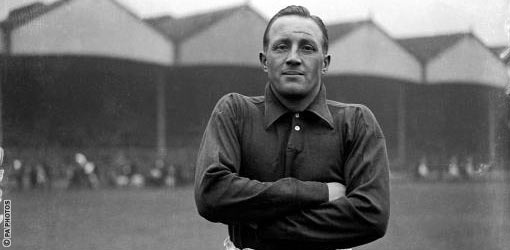
13. George Armstrong: 1961-1977.

George made 621 appearances over a 16 year period scoring 68 goals.

Born in Hebburn, County Durham, George had trained as an electrician while playing in youth football, he was rejected by both Newcastle United and Grimsby Town, but nevertheless, he succeeded in joining Arsenal as a youth player in August 1961. He made his debut not long after joining the club; while still only 17, he started against Blackpool on 24 February 1962 in a match that Arsenal won 1-0 and by the 1963-64 season he had become a regular in the side, and in 1964-65 he missed only two matches.

Over his long career with the Gunners, George became one of Arsenal’s most consistent players, and was noted for the quality and accuracy of his crossing and corner kicks, as well as for his tireless running up and down the wing; he primarily played on the left, but was also effective on the right. As he matured, he became one of the few players of the Billy Wright era (along with Jon Sammels and Peter Storey) to become an integral part of Wright’s successor Bertie Mee’s Arsenal side, which ended the club’s long trophy drought.

After losing two successive League Cup finals in 1967-68 and 1968-69, George helped the Gunners win the 1969-70 Inter-Cities Fairs Cup and the 1970-71 League and FA Cup double; he was a regular in the Double-winning team that season, setting up a number of goals for his team-mates, which included teeing up Ray Kennedy’s winning header against Tottenham Hotspur, in the match that won Arsenal the League title. He was also voted Arsenal’s Player of the Year in 1970.

George remained with the club through the 1970s, as Arsenal failed to win any further trophies after their Double win; he played at least thirty matches in each season he was at the club during that decade. However, after falling out with Mee’s successor, Terry Neill, he moved to Leicester City in the summer of 1977 for £15,000. He played only 14 League matches in his single season with the Foxes, and finished his career with Stockport County before retiring in 1979. After retiring from playing, he moved into coaching, and worked for a variety of clubs, including Fulham, Aston Villa, Middlesbrough, QPR and Enderby Town (as manager), as well as FK Mjølner in Norway and was manager of the Kuwaiti national team between 1988 and 1989.
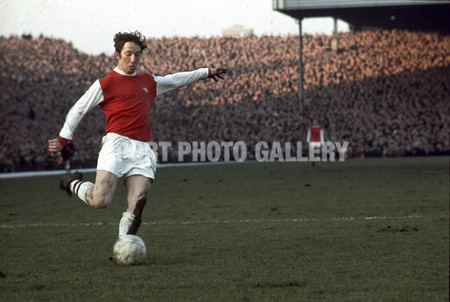
ArmstrongIn 1990, before the Iraqi invasion, he returned to England and joined Arsenal as reserve team coach, a post he remained at for the remainder of his life, despite the many managerial upheavals the club underwent. During his time at Arsenal he was responsible for bringing many young players through the Arsenal ranks, including Steve Morrow, Ray Parlour and Paul Dickov

Surprisingly for such a high-standing player, he was never capped for the full England side, despite plenty of youth and U23 caps; this was primarily because of England manager Sir Alf Ramsey’s policy of not using wingers.

He played in sixteen full seasons at Arsenal, most of them as an ever-present, at one time he held the club’s all-time record for appearances – 621 competitive first-team appearances, including exactly 500 in the league; his record has since been overtaken only by David O’Leary and Tony Adams. He also scored 68 goals for Arsenal.

On 31 October 2000, while conducting a club training session he collapsed after an unexpected brain haemorrhage; he died in Hemel Hempstead Hospital in the early hours of the following morning.

George had a pitch named after him at the Arsenal F.C. training ground, in London Colney

GunnerN5


Ramsey is Better Than Fellaini

July 15, 2013

It is probably wrong to give much (or any) credence to stories that emerge during this febrile period in the footballing year.

For example, the Higuain story has given birth to thousands of articles, comments, tweets and whatnot but – unless I have missed it – not a single word about the player had come from any official Arsenal source until Arsene Wenger responded to a journalist’s question during our Indonesia tour by accepting that the Argentine was the level of player for whom we could now realistically bid. Not that we were bidding for him, or even interested in him. Just that he was the kind of player we might be looking at.

One or two Arsenal players had earlier talked of “welcoming” the idea of  Higuain joining us – but what else are they supposed to say when asked by journalists about any world class player? “Sorry mate – not for me. He’s pants.”?

RamseySame applies to the Rooney and Suarez stories.
But, having said that, one piece I read recently did manage to particularly tickle my “irkometer” – it was the one that
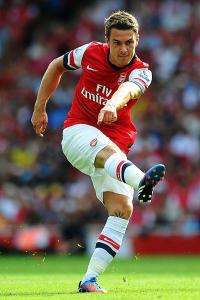
suggested we were preparing to offer cash plus Aaron Ramsey to get Everton to part with the human microphone, Marouane Fellaini.

I sincerely hope this notion is as false as the vast majority of the other cobblers that has been reported so far this summer.

Or, to be more precise, I am perfectly happy with the notion of us signing Fellaini – just not at the expense of losing Ramsey.

Fellaini is clearly an effective player who would enhance our squad – not least with his height, physical presence and combative nature.

But Ramsey is a better technical player and will, I believe, emerge as one of the finest midfielders in the country over the next few years.

We all know his Arsenal history: snatched from under the bulbous red nose of a frothing Ferguson; an immensely promising start at The Home of Football; a horrendous injury inflicted by a moronic Stoke City Orc; a difficult period or readjusting to first team football; abuse from some Arsenal so-called fans who should have known better; the beginnings of redemption during our run-in to the season just finished, when Aaron’s commitment, skill and work rate were instrumental in helping us clinch fourth place ahead of the Forces of Spudness.

In the last 10 or so games of last season he started to show what he can offer to this Arsenal team and I am convinced he will get better and better. Eventually I see him as having something of the likes of Steven Gerrard, Bryan Robson, Ray Parlour and Brian Talbot about his game.

He may not catch the eye like a Brady or Fabregas, but his contribution will allow others to do just that.

He is also part of a strong core of young British players that will be at the heart of our next title-winning team, alongside the likes of Wilshere, Gibbs and Walcott.

So – gods of the Summer Silly Season – please let this particular rumour turn out to be the nonsense that it deserves to be.

RockyLives


Is The Arsenal getting less popular?

July 14, 2013

Some years back I wrote an article on the comparative popularity and visibility of the Arsenal in Asia. At that time we were a strong second or third after Manchester United so how has 8 trophyless years affected us? I have been lucky enough to spend the last eleven weeks travelling around SE Asia and New Zealand so I was keeping my eye open on where we stood now.

What I noticed that this time around there are a much smaller selection of shirts seen. Before there were the big four [United, Liverpool, Arsenal and Chelsea] but you also did see shirts from other teams like Leeds, Everton and Villa or Spurs. This time around, with the exception of Singapore, it was the big four plus Barcalona and Real Madrid and very few other team’s shirts being worn. The Big get bigger!!!

This is what I found in the seven countries I visited, of course everything is subjective and this article reflects what I saw in the places that I visited, who knows what I missed! I also throw in a few travel tips for those of you fortunate enough to be able to visit the area.

New Zealand:

This is the land of Rugby! The EPL is readily available on TV but each night there are 2 or 3 channels at least showing Rugby at all levels. Most sports shirts being worn are Rugby shirts and I truly don’t remember seeing a football shirt even being sold. In some British or Irish pubs you will see adverts for broadcasted games but by and large rugby rules here! The good news of course is Arsenal are no better or worse than any other team. Travel tip: Drive up the west side of the South Island, Glaciers, Mountains and lonely beaches. A truly spectacular drive with wonderfully friendly people.

Malaysia:

The main paper has 4 columnists who each weekend write on Manchester United, Liverpool, Chelsea and Arsenal. Of course, as everywhere in Asia, Manchester United are the biggest club but Liverpool are a very strong second and we are roughly level with Chelsea in third. Barcelona have really improved their visibility since I last visited but the EPL is still the main game in town and in a Saturday paper you will get 3 or 4 pages of EPL coverage. We were much bigger 5 years ago and have definitely slipped but each day I saw at least one Arsenal shirt being worn, sometimes more. You see the occasional QPR shirt around as they are owned by a Malaysian and he sells the shirts in his airline shops, Air Asia. Travel Tip: Kuala Lumpur has a serious violent crime problem so go to Penang which is safer and also has the best food in Asia!

Thailand:

My favourite country in the region and one where Liverpool almost matches United, the residual support from the glory years is very strong and most football adverts on television will show one or both of the clubs. I have to credit the Liverpool supporters in Asia for their loyalty when you consider their relative lack of recent success. Chelsea is quite big here and are certainly third with us just behind them.

Bangkok airport used to have an Arsenal section where you could buy shirts and casual wear. We have been replaced by Leicester City as King Power, who run the Bangkok duty free, sponsor the shirts of that team. What did surprise me is that Everton, whose shirts are sponsored by a major Thai beer company have zero visibility. Travel Trip: Skip Bangkok and go to Chiang Mai, its cooler, cheaper and there is more to do like trekking.

Myanmar:

I did not see football shirts being worn here for any team but I did see the Arsenal v Wigan game on one of their four TV channels. There were adverts around the city showing Arsene Wenger and Arsenal promoting junior football so perhaps we have our foot in the door. Travel Tip: Bring crisp US dollars, ATMs are problematic at best and shops will not accept old US dollars or even a note that has been stapled.

Sri Lanka:

I saw a few shirts around Colombo and we had a good presence, second to United but cricket is the main sport here and the level of support for football appeared much less than in SE Asia.

Travel Tip: If you plan to travel outside Colombo allow lots of time or fly, roads are bad.

Indonesia:

I was in Bali so most shirts you see are for Australian Rugby or football as that’s where the tourists come from but EPL shirts are around and United, Arsenal and Manchester City were all spotted by your hard working correspondent! Travel Tip: Bali is spectacularly beautiful but if you go then avoid Kuta which is rightly called the armpit of Bali due to it being overrun by drunken Aussie youths on the lookout for women .

Singapore:

You will have noticed I have not mentioned Tottenham as I truly had never seen anyone wearing their shirt. Imagine my surprise when on a pub crawl with my nephew I saw a banner with Singapore Tottenham Hotspurs Supporters Club opposite a bar we were in. I couldn’t resist and I just had to go over and ask one of the guys at the stand… WHY??

Even more astonishing there was around 20 people there and Glen Hoddle was giving a talk. I asked him who was the best Arsenal player he faced and he said it was between Rix and Brady but felt on balance it was Brady. He seemed a decent enough guy and as the only Gooner there they treated me well. Kudos to Singapore Spurs fans but still… WHY? WHY Spurs???

Travel Tip:. Aa night on the town in Singapore is amazingly expensive, a small bottle of beer will cost a tenner or more!! If you are a beer drinker head for Thailand where It’s still reasonable!!

In conclusion it was a tough 11 weeks of travel and we have sadly fallen back in visibility in SE Asia. We have a loyal and large following in Malaysia and Thailand but the last 8 years have seen the casual fans move from us to United and Chelsea. If we don’t start winning soon then I fear that in another 5 years we will have fallen back even further!! I found Bali and New Zealand to be out of this world spectacular and no one can beat the friendliness of the Thgai people.

Written by neaman


Vote For Arsenal’s Greatest Forward pre 1956

July 13, 2013

Time to vote on this week’s strikers pre 1956 as we compile our own Arsenal’s Greatest Team.

If you’ve missed this weeks posts we have profiled 10 strikers from between 1923 and 1956. If you check the side-bar you can re-read them. Votes can be cast for up to three players.

This weeks profiles written by GunnerN5 and compiled by Gooner in Exile


Who should be Arsenal captain next season?

July 12, 2013

There seems to be a feeling amongst Arsenal fans that we haven’t had a truly great captain since Vieira. Henry, Gallas, Cesc. Some fine players there. But apparently not great captains. Two seasons ago we seemed to have solved that problem, but the manner of his* departure must also bring into doubt his leadership qualities. (* He who shall not be named)

TV captain

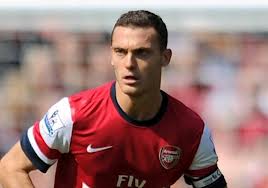
That left Thomas Vermaelen to take over the armband. He was a popular, and seemingly natural choice at the time. His steely eyed look of determination, his all action style, very visible fist pumping and gesturing to his teammates, seemed to suggest he was made of the same stuff as the stereotypically great captains that we remember. (Yes, I do have issues with typecasting a certain type of attitude as being the sign of a captain.)

But Vermaelen never recovered his form, and eventually lost his place in the starting 11 as well. Can anyone argue that he should start ahead of Koscielny and Mertesacker? Which actually begs the question, will he leave? Should Arsenal let him go?

Arteta captain

Assuming Vermaelen stays, should he retain the armband? Does a captain have to be a regular starter? If so, who is to be the new captain? The stories from last season suggest that Mikel Arteta was in fact the real leader of the group. Arteta had a fantastic season, changing his game tremendously to adapt to a new role, because that is what the team needed him to do. His statistics last season were brilliant, as was his attitude. So, should he just formally take over what he seemed to be doing informally anyway?(After all, you don’t need the armband to lead)

I would say yes, but there is a risk that Vermaelen will feel undermined. Also, if TV is precluded from being captain due to not being a starter, what about rumours of Arsenal bidding for Fellaini or Bender? What will that mean for Arteta, especially in light of his age?

Sagna captain

Who else could be captain? In my view Sagna could stake a real claim, despite his poor form last season. However, his contract having only one year to run might mean he should be overlooked. Another player who could get a shout as captain would be Per Mertesacker. He’s the organizer in defense, and seems to make his defensive partners better. He’s also already an authority figure of sorts at the club as he’s responsible for collecting fines from the players. A 2 metre tall defensive stalwart would suit many people’s idea of an Arsenal captain, even if he is German.

Mertesacker captain

Of course if it were to be down to popularity amongst the fans, then I think a certain Jack Wilshere would be installed as captain. As far as I’m concerned though, the only thing in his favour would be the (relatively assured) long term continuity in captain, which would be lacking in Arteta, Sagna, and maybe even Vermaelen’s case. For the rest, I think he’s still too young (and a little reckless). He should concentrate on getting his fitness, and then his place back. He has a long future ahead of him and there’s no need to rush to make him captain, especially when there are better candidates for the role.

Jack captain

So who would you vote for as Arsenal captain? (Bonus. Who should be vice captain?)

Written by Shard


Arsenal’s Greatest Forwards – Day 3

July 11, 2013

Continuing our Summer series of articles in search of Arsenal’s greatest ever team, this week we begin our quest for the greatest forwards to include in our team.  Don’t forget to take the opportunity to choose your personal favourite striker from an earlier era by voting in the poll on Saturday.

7. Cliff Bastin: 1929-1946.

Cliff appeared in 396 games over a 17 year period and scored 178 goals.

cliff bastinBorn in Heavitree near Exeter, Cliff started his career at Exeter City, making his début for the club in 1928, at the age of 16. Despite only playing 17 games and scoring 6 goals in his time at Exeter, he was spotted by Arsenal manager Herbert Chapman in a match against Watford; Chapman was attending to keep tabs on a Watford player, but the 17-year-old Bastin’s ability was so evident that Chapman decided to sign him at the end of the 1928-29 season.

He made his début against Everton on 5 October 1929 and was immediately a first team regular, making 21 appearances that season. He went on to become an integral player in the side over the next decade, playing over 35 matches for every season up to and including 1937-38. His play was characterised by a remarkable coolness, and deadly precision in front of goal; he also became Arsenal’s regular penalty taker. Cliff’s scoring feats are all the more remarkable considering he played on the left wing rather than as centre forward; at the time Arsenal’s strategy depended heavily on their wingers cutting into the penalty box, and the supply of passes from Alex James was the source of many of his goals.

Cliff won the FA Cup twice, in 1929-30 and 1935-36, and the First Division title five times, in 1930-31, 1932-33, 1933-34, 1934-35 and 1937-38 and by the age of nineteen he had won a League title, FA Cup and been capped for England, making him the youngest player ever to do all three. Cliff also finished as Arsenal top scorer twice (1932–33 and 1933–34, though after centre-forward Ted Drake arrived in March 1934, Cliff was no longer Arsenal’s number one target man. With Drake scoring the lion’s share of the goals and Alex James increasingly unavailable due to injury and age, Cliff was moved to inside-forward to replace James for much of the 1935-36 season but he still scored 17 goals, including six in Arsenal’s run to the 1936 FA Cup Final, which they won 1-0. After a stint at right half to cover for Jack Crayston, he was eventually restored to the left wing and scored 17 goals in the 1937-38 title-winning season.

Cliff formed an integral part of the side that dominated English football in the 1930s. He scored 178 goals in 396 games, which made him Arsenal’s all-time top goal scorer from 1939 until 1997, when his total was surpassed by Ian Wright. In 2005 Thierry Henry passed both Bastin and Wright’s totals, thus meaning Bastin is currently Arsenal’s third-top goal scorer of all time. His record of 150 league goals for Arsenal stood for slightly longer, until it was equalled by Thierry Henry on 14 January 2006 and surpassed on 1 February.

During his career Cliff also played for England between 1931 and 1938, winning 21 caps and scoring 12 goals.  Highlights of his England career included the famous “Battle of Highbury”, where England defeated 1934 World Cup winners Italy 3-2, and a notorious

match against Germany in Berlin in 1938, when the England team was ordered to give the Nazi salute before the match.

His career was cut short at its peak when WW11 started; he was excused military service as he failed the army hearing test owing to his increasing deafness. Thus, during the war, he served as an ARP Warden, being stationed on top of Highbury stadium. After the war was over, Cliff, by now in his thirties, would only play seven more times before retiring in January 1947.

After retirement, he returned to his native Exeter and ran a pub.  A stand at St James Park, Exeter’s home ground, is named in his honour and in 2009 he was inducted into the English Football Hall of Fame.

He died in 1991 at the age of 79

8. Reg Lewis: 1935-1953

Reg appeared in 176 games over an 18 year period and scored 118 goals.

Reg LewisBorn in Bilston, Staffordshire, Reg spent his entire career at Arsenal. He joined the club as a schoolboy in 1935, and scored on his debut against Everton on January 1, 1938. He made only four appearances in 1937-38, however, and as a result missed out on a League Championship winners’ medal. He broke into the first-team more in 1938-39, making 16 appearances in league and cup, scoring 7 goals, but the advent of the WW11 interrupted his career.

During the war he continued to play for Arsenal and shone as a natural goal scorer; although wartime appearances and goals are not officially counted, he scored 143 goals in 130 games, including four in the 1943 War Cup Southern Final, in a 7-1 demolition of Charlton Athletic. Towards the end of the war he served in the British Army of the Rhine in Occupied Germany, but returned to play for Arsenal once first-class football resumed in 1946. Although most of the Arsenal side of the 1930s were past their best by this time, Reg was still only 26 and he continued to be a regular in the first team throughout the remainder of the 1940s. He was the club’s top scorer in 1946-47 with 29 goals, and the following season (1947-48), he partnered new signing Ronnie Rooke and between them they scored 47 goals as Arsenal won the First Division title.

He continued to be a regular for the rest of the decade and he enjoyed arguably his best season in 1949-50; he scored 19 goals in 31 league games, played twice for the England B team. However, during the early 1950s, Reg became constantly afflicted with injuries, and he made only 12 appearances in 1951-52 and none at all in 1952-53.

His tally of 118 in 176 first-team games puts him 13th in the all-time list but his total figure from 1935 to 1953 was a staggering 392 in 451 matches. His finest hour came in the 1950 FA Cup final, when he scored both goals in a 2-0 win over Liverpool.

In the close season of 1953, he retired from the game at the age of 33. After retiring, Reg first ran a pub, and then worked in insurance.

Reg passed away in 1997 aged 77 years.

9. Jimmy Logie: 1939-1955 

Jimmy appeared in 328 games over a 16 year period and scored 76 goals.

Born in Edinburgh and raised in the city’s Grassmarket, Jimmy first played for Scottish junior side Lochore Welfare, before being signed by Arsenal in June 1939. Soon afterwards World War II broke out, and he was called up; he served in the Royal Navy for the entire duration of the conflict.

JImmy LogieAfter being demobbed he rejoined Arsenal, playing several wartime matches, before making his full first-team debut against Wolves on 31 August 1946. Jimmy was a talented and creative player (many observers likened him to his fellow countryman Alex James, who had played for Arsenal in the 1930s), and for the next eight seasons he was a regular in the Arsenal side, playing at inside forward.

He took part in all of Arsenal’s early post-war successes; winning two First Division titles in 1947-48 and 1952-53.  He also lifted the 1950 FA Cup (setting up both goals in the 2-0 win over Liverpool) and played in the 1952 final when the Gunners were beaten 1-0 by Newcastle after playing 55 minutes with just 10 men. In the latter stages of his career he also served as Arsenal vice-captain, behind Joe Mercer.

In all he played 328 matches for Arsenal, scoring 76 goals and after a distinguished career with Arsenal, he was transferred to Gravesend and Northfleet for £2,000 in February 1955.

Despite his success at Arsenal, Jimmy only ever won a single a cap for Scotland, playing against Northern Ireland on 5 November 1952.

After retirement Jimmy fell on hard times; football was not the lucrative profession it is currently, and he was a keen gambler. He eventually ended up working for a newsagent in Piccadilly Circus.

Jimmy Logie dedicated almost 16 years of his life to Arsenal.

He died in 1984, aged 64.

10. Doug Lishman: 1948-1956.

Doug appeared in 244 games over an 8 year period and scored 137 goals.

Born in Birmingham, Doug first played as a centre forward for non-league Paget Rangers, before signing as a professional for Third Division South Walsall in August 1946. In two seasons with the Saddlers, Lishman scored 26 goals in 59 league appearances.

Doug LishmanHe was signed by Arsenal in the summer of 1948 for £10,500, as backup for Reg Lewis, who was only 28 but was injured frequently, Doug made his debut against Sheffield United on September 4, 1948, but after a promising first season (scoring 13 goals in 25 appearances), and his 1949-50 and 1950-51 seasons were marred by injuries. He was passed over for the 1950 FA Cup final (which Arsenal won 2-0), in favour of Lewis and Peter Goring, and then just as he came back into the Arsenal first team, he broke his leg playing against Stoke City in December 1950.

However, he recovered to become Arsenal’s top scorer in 1950-51, and the next season hit 30 goals, including three hat-tricks in three successive home matches; Arsenal finished third that season. The following season (1951-52) they reached the FA Cup final, only to lose to Newcastle United; a series of injuries meant only eight fit players finished the match (no substitutes were allowed in those days). Doug came close for Arsenal with a header, which clipped the crossbar, but Arsenal lost 1-0.

His disappointment was soon forgotten, as Arsenal won the League Championship in 1952-53. He was again Arsenal’s top scorer, this time with 26, and with every goal proving vital, Arsenal won the title on goal average above Preston North End. His form was good enough for him to be picked for an England B match against Scotland B in March 1953, although he was never capped for the full national side.

Doug was top scorer for another two seasons after that, making it five successive seasons as the club’s top scorer in total. He scored 137 goals in 244 appearances, making him the club’s tenth-highest goal scorer of all time. However with younger men like Derek Tapscott and David Herd taking over goal scoring duties for Arsenal, Doug was dropped from the first team in 1955-56.

In March 1956 he was sold to Second Division Nottingham Forest. He scored a hat-trick in the match that got Forest promoted (a 4-0 win over Sheffield United) to Division One in 1956-57, but decided to retire in the summer of 1957. He left the game entirely after retiring. He joined his father-in law in business (furniture retail) in Stoke on Trent, later taking over the business himself.

He continued to live in Stoke on Trent until his death in 1994.

Written by GunnerN5 and compiled by Gooner in Exile


Arsenal’s Greatest Forwards – Day 2

July 10, 2013

Continuing our Summer series of articles in search of Arsenal’s greatest ever team, this week we begin our quest for the greatest forwards to include in our team.  Don’t forget to take the opportunity to choose your personal favourite striker from an earlier era by voting in the poll at the end of the week.

4. Alex James: 1929-1937.

Alex made 261 appearances over an 8 year period and scored 27 goals.

Born in Mossend, Lanarkshire, Alex started his career with local youth clubs.

Alex joined Raith Rovers in 1922, where he spent three seasons, recording nearly one hundred League appearances, before moving to Preston North End for £3,000 in 1925.

Alex JamesHe spent four years at the Second Division side, scoring 55 goals in 157 appearances; however towards the end of his stay there he fell into several disputes with the club’s management, partly over wages – at the time, the Football League operated a maximum wage of £8 a week – and also because Preston refused to release him for international duty with Scotland.

Alex left Preston and joined Arsenal in 1929 for £8,750, making his debut against Leeds United on 31 August 1929. In order to circumvent the maximum wage rules, Arsenal arranged it so that his employment at the club was supplemented by a £250-a-year “sports demonstrator” job at Selfridges, the London department store. James had an unremarkable first season at Arsenal, in part due to the recovery from injuries he had accrued playing in the Second Division; however, he played in Arsenal’s 1930 FA Cup Final win against Huddersfield Town, scoring the first in a 2-0 win to give Arsenal their first major trophy.

Over time he settled into his role and became part of the dominant side of English football in 1930s. Playing deep as a supporting player, he scored relatively few goals for Arsenal – only 27 in 261 appearances – but created many times that number. Alex’s passing and vision supplied the ammunition that David Jack, Cliff Bastin, Ted Drake and Jack Lambert all put into the net.

He helped Arsenal to their first ever First Division Championship win in 1930-31, but was injured during the title race in 1931-32; without him, Arsenal finished second behind Everton and lost the 1932 FA Cup Final against Newcastle United. He had been passed fit before injuring himself in a pre-match photo call for the press, without him, Arsenal lost 2-1. He recovered to help Arsenal to a second title in 1932-33, as Arsenal scored 118 goals in the League that season. Another spate of injuries marred his1933-34 season, as Arsenal retained their title but scoring far fewer (75) goals in the process, but when he recovered they won a fourth, and their third in a row in 1934-35, with Ted Drake scoring 42 league goals that season, many of them supplied by Alex. The following season he won a second FA Cup winners’ medal, captaining the Arsenal team to their 1-0 win over Sheffield United.

He was famed for the excellent quality of his passing and supreme ball control, leading many modern-day comparisons with Arsenal forward Dennis Bergkamp. His rheumatism meant he wore “baggy” shorts to hide the long johns he wore to keep warm; the baggy appearance became his trademark.

Despite his form for his clubs, he won just eight caps for Scotland, partly due to Preston’s reluctance to release him for international matches. He made his international debut on 31 October 1925 against Wales, which Scotland won 3-0, his short international career included an appearance for the legendary “Wembley Wizards” team that thrashed England 5-1 at Wembley in 1928, with Alex scoring two goals.

With age and injuries taking their toll in the last two seasons of his career, Alex retired from playing in the summer of 1937. During World War II he served in the Royal Artillery, and after the war he became a journalist, as well as running a football pools competition. In 1949 he was invited back to Arsenal to coach the club’s youth sides.

Alex was inducted into the English Football Hall of Fame in 2005 in recognition of his contribution to the English game.

He died suddenly, of cancer, when he was just 51 years of age.

5. Joe Hulme: 1926-1938.

Joe made 374 appearances over a 12 year period and scored 125 goals.

Born in Stafford, Staffordshire Joe usually played as a right-winger. He played for Stafford YMCA before starting his career in non-League football with Midland League side York City, he then moved to Blackburn Rovers for a fee of £250. He spent two years at Ewood Park and made 74 league appearances, scoring six goals.

JoeHulme_Profile.ashxHe moved to Arsenal in 1926, becoming one of Herbert Chapman’s first major signings.

Joe made his Arsenal debut on 6 February 1926 away to Leeds United, and remained a regular for the rest of that season. That led him to be picked for the Football League XI that season, and the following season, 1926–27, he made his full England debut, against Scotland at Hampden Park. In between 1927 and 1933 Joe won nine caps for England. That same season he also played in his first FA Cup final, against Cardiff City, which Arsenal lost 1–0.

He remained first choice on the right-wing at Arsenal up until the 1932–33 season, combining with Cliff Bastin (who joined Arsenal in 1929) to form a pair of highly-paced wingers with Joe scoring18 goals in 1931–32 (including hat-tricks against Sunderland and Middlesbrough) and 20 in 1932-33. During this time Joe and Arsenal started winning trophies, taking the FA Cup in 1929–30, and followed it up with a pair of First Division titles in 1930–31 and 1932–33. Injuries deprived him of another title-winning medal, as he only made eight appearances (but still scored five times) in Arsenal’s 1933–34 title-winning season. He returned to the Arsenal side the following season, 1934–35, and won his third league winners’ medal with 16 appearances, although by now injury and losses of form meant he was not an automatic first choice, sharing duties with Pat Beasley and Alf Kirchen.

In 1935–36, Joe played 28 times in the league and cup winning his final honour with Arsenal, a second FA Cup medal after Arsenal beat Sheffield United 1–0 in the final, making him the only player to have played in all of Arsenal’s first four cup finals. He spent his final two seasons at Arsenal (1936–37 and 1937–38) as a bit-part player, making just ten appearances in one-and-a-half years. His final appearance came against Liverpool on 18 December 1937. He scored 125 goals in 374 appearances for the Gunners, making him the club’s tenth-top scorer of all time.

He left Arsenal for Huddersfield in January 1938, where he saw out the rest of his career, picking up an FA Cup runners-up medal in the 1937–38 season before retiring from football at the end of that season. Joe was also a fine all-round cricketer, playing 225 times for Middlesex between 1929 and 1939 as an aggressive middle-order batsman and medium-fast bowler. Capped by Middlesex in 1930, he scored his first century that year, 117 against Warwickshire at Edgbaston. He first passed 1,000 runs for the season in 1932, and in 1934 made his highest aggregate, 1,258 runs at 34.94, including four hundreds. He was an excellent fielder in the deep, and a good runner between the wickets. In 225 matches he made 8,103 runs at an average of 26.56, the highest of his twelve hundreds being 143 against Gloucestershire at Bristol. His useful right-arm medium-pace bowling brought him 89 wickets at 36.40, with a career best of 4 for 44, and he held 110 catches.

After World War II, which he spent working as a policeman; Joe became manager of Arsenal’s fiercest rivals, Tottenham Hotspur from 1945 to 1949. He achieved little actual success at the time, but he did lay the foundations for their championship-winning side of 1950–51. After that, Joe left football altogether, to become a successful journalist.

He died at the age of 87, in 1991.

6. Ted Drake: 1934-1945.

Ted made 184 appearances over an 11 year period and scored 139 goals.

Born in Southampton, Ted started playing at Winchester City, whilst continuing to work as a gas-meter reader. He nearly joined Tottenham Hotspur as a schoolboy, but missed the trial match with an injury. In June 1931, he was persuaded by George Kay to join Southampton, then playing in Division Two. He made his Saints debut on 14 November 1931 at Swansea Town, and signed as a professional in November, becoming first-choice centre-forward by the end of the 1931–32 season. In the following season he made 33 league appearances, scoring 20 goals.Ted Drake

After only one full season, his bravery and skill attracted the attention of Arsenal’s Herbert Chapman, who tried to persuade him to move to North London. Ted rejected the chance of a move to Highbury and decided to remain at The Dell. He started the 1933–34 season by scoring a hat trick in the opening game against Bradford City, following this with at least one goal in the next four games, thereby amassing eight goals in the opening five games. By early March he had blasted his way to the top of the Football League Division Two goal-scoring table with 22 goals.

Arsenal, with George Allison now in charge, renewed their interest and Ted eventually decided to join the Gunners in March 1934 for a fee of £6,500. Saints had declined several previous offers, but eventually were forced to sell in order to balance their books. Ted made a total of 74 appearances for Southampton, scoring 48 goals.

He scored on his league debut against Wolves on 24 March 1934, in a 3–2 win. Although he joined too late to qualify for a League Championship medal in 1933–34, he would win one in 1934–35, scoring 42 goals in 41 league games in the process, this included three hat-tricks and four four-goal hauls. With two more goals in the FA Cup and Charity Shield, Ted scored 44 in all that season, breaking Jack Lambert’s club record, one that still holds to this day.

His exploits at club level brought him recognition at international level, and he made his England debut against Italy in the “Battle of Highbury” on 14 November 1934; one of seven Arsenal players in the side, he scored the third goal in a heated 3–2 win. In total he won five caps, scoring six times.

The following season, 1935–36 he scored seven in a single match against Aston Villa at Villa Park on 14 December 1935, a club record and top flight record that also still stands. Ted claimed an eighth goal hit the crossbar and went over the line, but the referee waved away his appeal. Drake would go on to win the FA Cup in 1935–36 (scoring the only goal in the final) and the League again in 1937–38.

Despite being injured regularly (he was a doubt up until the last minute for the 1936 Cup Final), his speed, fierce shooting and brave playing style meant he was Arsenal’s first-choice centre forward for the rest of the decade, and he was the club’s top scorer for each of the five seasons from 1934–35 to 1938–39. The Second World War curtailed Drake’s career, although he served in the Royal Air Force as well as turning out for Arsenal in wartime games and also appearing as a guest player for West Ham United later in World War II. However, his career would not last long into peacetime; a spinal injury incurred in a game against Reading in 1945 forced him to retire from playing. With 139 goals in 184 games, he is the joint-fifth (along with Jimmy Brain) all-time scorer for Arsenal.

After retiring as a player, Ted managed Hendon in 1946, and then Reading from 1947. He led the club to the runners-up spot in Division Three South in 1948-49 and again in 1951–52, though at the time only the champions were promoted.

He was appointed manager of First Division Chelsea in 1952. Upon his arrival at Chelsea, he made a series of sweeping changes, doing much to rid the club of its previous amateurish, music hall image. He discarded the club’s Chelsea pensioner crest and with it the Pensioners nickname, and insisted a new one be adopted. From these changes came the “Lion Rampant Regardant” crest and the Blues nickname. He introduced scouting reports and a new, tougher, training regime based on ball work, a rare practice in English football at the time.  Within three years, in the 1954–55 season, Ted had led Chelsea to their first-ever league championship triumph. In doing so, he became the first person to win the league title both as player and manager. However, he never came close to repeating that success and left Chelsea to become reserve team manager at Fulham, later becoming a director and then life president.

Ted died aged 82, on 30 May 1995.

Written by GunnerN5 and compiled by Gooner in Exile


Arsenal’s Greatest Forwards – Day 1

July 9, 2013

Continuing our Summer series of articles in search of Arsenal’s greatest ever team, this week we begin our quest for the greatest forwards to include in our team.  Don’t forget to take the opportunity to choose your personal favourite striker from an earlier era by voting in the poll at the end of the week.

1. Jimmy Brain 1923-1931.

Jimmy made 232 appearances over 8 years and scored 139 Goals.

Born in Bristol, England, Jimmy started his career playing in Wales, having an unsuccessful trial at Cardiff City, before gaining a regular place at Ton Pentre.J Brain

In 1923, he moved to Arsenal, after a year in the reserve side, Jimmy started his Arsenal first-team career with a goal on his debut, a 1-0 win against local rivals Tottenham Hotspur on 25 October 1924.

He was a prolific striker throughout his career, and was the club’s top scorer for four seasons in a row, from 1924-25 to 1928-29; this included 39 goals in the 1925-26 season (second only to Ted Drake’s haul of 45 in 1934-35), which included four hat tricks. The next season, 1926-27, Jimmy scored 34 goals, including two four-goal tallies against Sheffield Wednesday and Burnley. His goal scoring feats helped Arsenal reach their first FA Cup final, in 1926-27.

Jimmy’s form dropped off in 1929-30, and he competed for his position with Jack Lambert, David Jack and Dave Halliday, meaning he only played six league matches in that season. He missed the Gunners’ 1930 Cup final win over Huddersfield Town; David Jack and Jack Lambert led the line that day. However, the following season, 1930-31, Jimmy finally won a medal after playing sixteen matches (scoring four goals) in Arsenal’s first Division one title-winning season. His final appearance in an Arsenal shirt was a 2-0 win over Sheffield Wednesday on 21 March 1931.

In total, he scored 139 goals in 232 appearances for Arsenal, making him the Gunners’ joint-fifth top scorer of all time, and he was the first player ever to score 100 goals for the club, a feat he achieved in a 6-3 win over Liverpool on 7 March 1928. However, he never played for England; he managed to secure a trial for the national team but was never actually selected.

Age was now catching up with him, and he had been overtaken in the goal scoring by both Lambert and Jack. He left Arsenal for Tottenham for £2,500 in September 1931, becoming one of the few players to have moved directly between the two rival clubs.

By the time Jimmy had joined Spurs he was in his thirties, and only played 47 times for them, scoring 10 goals, before leaving in 1934.

He played his final years out at Swansea Town and Bristol City. After retiring as a player, he managed first King’s Lynn and then Cheltenham Town from 1939 until 1948, after which he retired completely from football.

He died in 1971, at the age of 71.

2. Jack Lambert: 1926-1933.

Jack played in 161 games over 7 years and scored 109 goals.

Born in Greasbrough near Rotherham, Yorkshire, Lambert was turned down by Sheffield Wednesday after a trial, so started his career playing for Rotherham County in 1922. He soon made a move to Leeds United, but spent three years there with little success. He finally came to prominence after becoming a regular goal scorer for Doncaster Rovers, joining the side in January 1925. Playing in Yorkshire, he had attracted the attention of Herbert Chapman when the latter was manager of Huddersfield Town; when Chapman became Arsenal manager, needing a quality centre-forward, he signed Jack for £2,000 in June 1926.

J LambertHe made 16 appearances in his first season with the club, but only scored one goal. He also made 16 appearances in the 1927–28 season, but managed to score three times. He became a regular for the club towards the end of the 1929-30 season; scoring 18 times in only 20 league appearances.

The following season (1930-31) he was even more successful, scoring 38 goals in just 34 games in the League, a club record at the time (which was later broken by Ted Drake) that included a total of seven hat-tricks; that season Arsenal won the First Division title for the first time in their history. Jack continued to play for Arsenal over the next few years, scoring regularly (including five goals in a 9-2 defeat of Sheffield United, the most ever scored by an Arsenal player in a single home match); he helped Arsenal reach a third FA Cup final, a 2-1 loss to Newcastle United in 1931-32, and won a second First Division title in 1932-33, scoring 14 goals in just 12 league appearances.

By now Jack was over 30 and only a bit-part player (Ernie Coleman having led the front line through most of 1932-33), and the signing of Jimmy Dunne in September 1933 forced him out of the side; his last game came on 13 September 1933 against West Bromwich Albion.

In all he scored 109 goals in 161 games for the Gunners, a very high ratio, but it wasn’t enough for him ever to be selected for England.

He was sold in October 1933 to Fulham where he played for two seasons before retiring from playing in 1935. The following year he became coach of Margate (who at the time were Arsenal’s “nursery” club) and returned to Arsenal in 1938 as a coach of the club’s reserve side.

Tragically, he died at the age of 38, killed in a car accident in Enfield, Middlesex, on 7 December 1940.

3. David Jack: 1923-1934.

David played in 208 games over 6 years and scored 124 goals.

Born in Bolton, Lancashire, David started his career with his father’s club, Plymouth Argyle in 1919. There he scored 15 goals in 48 appearances in all competitions. In 1920 he returned to the town of his birth, moving to Bolton Wanderers for £3,500. He spent eight seasons with the Trotters, forming a formidable partnership with Joe Smith, and between them they scored over 300 goals. While at Bolton, he made history by being the first person to score a goal at Wembley Stadium, in the 1923 FA Cup Final; Bolton won 2–0 and Jack earned his first medal.

David_JackA year later, he won his first England cap, in a 1–2 defeat against Wales on 3 March 1924. In eight years he played eight times for his country and scored three times. He continued to have success with Bolton, winning the FA Cup again in 1925–26, scoring the only goal in a 1–0 win over Manchester City. He was the club’s top scorer for five of the eight seasons he was there, scoring 144 goals in 295 league matches.

In 1928, with Bolton in financial trouble, he was signed by Herbert Chapman’s Arsenal for £10,890 (nearly double the previous record); famously, Herbert used his usual tactic of plying Bolton’s representatives with liquor, while he pretended to, so he remained sober while they got very drunk, he then haggled the fee down to a price he considered a bargain.

Intended as a replacement for retired captain Charlie Buchan, David was a success at Highbury. He made his debut against Newcastle United on 20 October 1928, and became a regular straight away. He was the club’s top scorer for the 1928–29 season. Although less prolific than centre-forward Jack Lambert, he still scored important goals, including the one in the 1929–30 FA Cup semi-final against Hull City which sent Arsenal through to the final; Arsenal beat Huddersfield Town 2–0 in the final and he became the first player to win the Cup at Wembley with two different clubs.

He continued to feature for Arsenal through the early 1930s, recording a personal best of 34 goals in Arsenal’s First Division-winning season of 1930–31. He won two more titles in 1932–33 and 1933–34; however by the time of the latter he was in his mid-30s and reaching the end of his career, with competition for his place from new signing Ray Bowden meant Jack played only 16 matches that season. He retired soon after winning his third league medal, in May 1934. In all he scored 124 times in 208 matches for Arsenal.

After retiring from playing, he went on to become manager of Southend United, and then Middlesbrough. He also managed League of Ireland side Shelbourne from the summer of 1953 to April 1955.

He died in 1958, aged 59.

Written by GunnerN5 and compiled by Gooner in Exile


Sanogo Concludes Arsenal’s Summer Business?

July 8, 2013

Well not for me it doesn’t, I remain optimistic that the best is still to come and my rationale is this: put simply, we have at last moved up a drawer; we are still unable to shop in the top drawer, that remains the domain of Man City, Man U, Chelsea, Barça, Real and PSG and they are all hovering around Cavani but with the winks and nudges suggesting that Arsenal have 60 mil to spend we are able to shop in the next draw down, and that is where the likes of Higuaín can be found.

Some might suggest that with 60 million available we should have more financial clout than Barça or Real and I would agree but we all know or at least we should know that those two clubs offer a greater prestigious attraction than we do which will trump us if the money is equal.

But, just in case you think I am singing the praises of other clubs a little too loudly than is healthy, you might note I have not included any of the Italian teams. We have, quite simply moved ahead of that lot.

Other more observant readers are sure to notice that for all the teams I have mentioned above I have only suggested one top drawer player: Cavani, and those same people will also realise that one player is not going to satisfy five clubs so the fear is that they start looking in the second drawer down – which they may well do and that is what Real are surely waiting for because they know that if Chelsea show an interest the price will rise beyond our reach – But I remain optimistic as I am not sure that Mourinho’s ego will allow him shop in such a squalid place.

How many drawers are there for goodness sake?

Well, to me there are four draws, a bit like the four divisions of the old English football league. We have moved from drawer 3 to drawer 2.

Our knuckle dragging neighbours still shop in the bottom drawer.

Podolski, Mertasacker and Giroud came from the third draw down and as such we were able to pick them up quicker but there is a price to pay for moving up a drawer — we have to be more patient.

But for all my swan like calmness above the water, regarding Higuaín, my feet are panicking like crazy below the water about Fellaini, a striker would be good but if we could sign just one more player this summer my vote would be for the Belgian. That man would change everything. It would be impossible for Wenger to play the same style as we have for the last umpteen seasons. For me Fellaini would undoubtedly bring not only aggression but violence; he would bring fear, the kind of fear we exuded when Vieira and Petite were in their pomp.

And what drawer can Fellaini be found in? I don’t give a monkeys — just sign him.

If we could sign just one player out of Higuaín or Fellaini who would you chose?

Written by LB


Vote For Arsenal’s Greatest Midfielders Of The Modern Era

July 5, 2013

This must be the most difficult vote, three from the modern era of midfielders is nigh on impossible, whether its the legend of Rocky the strength and skill of Patrick, the sublimity of Pires or the goals of Ljungberg. To choose three from those four is difficult enough and then we add Parlour, Silva and Davis into the mix for good measure and not forgetting probably the best player to grace the Emirates Cesc Fabregas. Any three or four of those will make a decent midfield.

We did consider extending the vote to 4 players for this section but soon realised that in reality most of us would want 7 votes to make sure we voted for all of our favourites.

Look at this list of players and remember how lucky we have been as Arsenal fans, very few fans of rival clubs can boast anything near the quality we had in this era.

Note from ed……..

Apologies for the superfluous extra ‘s’ in Gilberto Silva