Still cooking on Fabregas?

June 17, 2012

Watching Italy against Croatia on Thursday, I could only admire the silky skills of Pirlo, the Italian Playmaker. Especially in the first half, Pirlo gave a demonstration of what the Conductor role is all about. He always makes himself available by cleverly, and constantly, finding space. As soon as he gets the ball, he already knows what he wants to do next. He possesses a great first touch and can move forward, and if necessary past a player, quickly and with great close control.

On top of this, and it’s his most valuable skill and so rare in a footballer; he has a great overview of what is exactly in front of him, and what needs to happen next – and he can pick the pass that pulls a defence apart in one move. Of course, not every ball by Pirlo is a killer-pass, but he always seems to know how to move the play on with real intent and effectiveness. He gives shape and purpose to a team and Pirlo has been brilliant this season for both Italy and Juventus, with whom he just won the Italian league.

His is not the youngest, and once Croatia had levelled he did not have the energy anymore to drive his team forwards in order to get the all important winner. At an age of 33, I think he can be forgiven for this.

I love this kind of player though. They lift football to a higher echelon; they make football into poetry in motion, and they make me want to watch games of teams I do not support, or even like.

Whilst watching Pirlo, I could not help but think back about our former Spanish Maestro, our ex El Capitan: the one who left us because his home town was calling him.

Some of you might recall, I wrote an ‘open-letter post’ to Cesc last year:

https://arsenalarsenal.wordpress.com/2011/07/12/letter-to-el-capitan-cesc-fabregas/

I still love watching Cesc even though he plays no longer for us. I guess I still feel a bit of man love for him, a purely platonic one mind you! I am not bitter though, unlike some Arsenal supporters. He was young and felt a strong urge to return home, where they finally seemed to want him, and where they are playing the best football in the world: I probably would have done exactly the same.

When Fabregas scored his goal though, after he came on late on Thursday, I could not help but think he is not fully happy at the moment. There seemed to be some frustration there – maybe as a result of having to come on as a late substitute, or maybe because he is not being played in the position that suits his talents best.

Having watched him play at Barca in a new role this season, for which he needed to adjust considerably, I feel he has been underused by Guardiola. The now departed manager played him far too high up the pitch, where he did relatively well, but could not play his best football.

The Conductor has been asked to play the double bass, or the first violin, and to a certain extent this is fully understandable. Cesc decided to join Barcelona when they already had two of the finest conductors, and they also do not play the sort of football where there is a pivotal role for a classical playmaker. And this is where he might have made an error of judgement.

If he had stayed at Arsenal for at least another year, he could have continued in the hole – in the ‘1’ of our 4-2-1-3 formation. That is where Cesc belongs. If a player is blessed with the same skill-set as described above for Pirlo, and Cesc has these in abundance, and he finds himself in a position where he is not required to use his strongest assets, then football is being done an injustice, and a player is effectively denying himself – is not fulfilling himself. Good Playmakers are rare and they need to make the play.

And that is a great shame. Cesc is no longer cooking on gas and I wonder whether he has any regrets about his early move to Barcelona now.

Despite Cesc’s two excellent goals at the Euros and all his impressive goals and assists for Barcelona this season, he still left at least one season too early in my opinion. And I think he realises this as well at the moment.

Just imagine him last season: in front of Arteta and Song – what a season it could have been for us, and certainly also for him.

Fabregas is such a good footballer that he can be played almost everywhere and do well. But that is not the point. Barcelona and the Spanish National Team are confronted with an embarrassment of riches, and in the process a great talent is being wasted, whilst the clock is ticking.

TotalArsenal.


Referees are the fall guys

June 15, 2012

Yesterdays excellent post by weedonald prompted many good comments. One of our overseas bloggers – shard – sent this in as a response to that post and he includes his ideas for how the problem could be addressed.

The question to ask is, why do referees not enforce the laws properly, and if they don’t, why don’t their associations sort it out? And also slimgingergooner said, referees need support and to be backed to call a penalty for what is an offense (shirt pulling).. Why so? Why do referees face censure for following rules?

Partly, it’s because the football pundits propagate nonsense like ‘he got the ball’, ‘6 of one, half a dozen of the other’, ‘in the good ol days, it won’t even have been a free kick’ etc. This, increases the pressure on the referees, but for all the wrong reasons. Conversely, where referees do act contrary to at least the spirit of the law, the media looks to make excuses, or over scrutinise the player..’he should know better, he had to be careful having already been booked’.

I also agree with slim that referees’ mistakes are shown up more compared to rugby, and as such they have less respect from players and fans. But that is the authorities fault, They refuse to make all available resources an option for referees to get the call right, they put referees on a pedestal, and they refuse media access to the referees. In Germany, where referees speak to the media after the games, they can explain why they gave a certain decision, or even admit they made a mistake, and largely, the public accepts it and I’m sure players respect them more too. If someone refuses to accept mistakes and carries on as per usual, that’s when respect is eroded.

In summary, referees don’t respect the laws, the players don’t respect referees, the media perpetuate myths about the laws, the public understand neither the laws nor the referees’ actions, leading to confusion and arbitrariness all around with football being the loser.

Changes I’d like to see

Video replays – I know this is controversial, but it is perverse that when I , sitting halfway across the world, can see in 5 seconds that a wrong call was made, the referees themselves can’t rectify it. Fears of the game slowing down might be exaggerated even if they are real, and in any case, we should have trials in the lower leagues/friendlies to see how it works and how it can work better.

Referees being miked up – Like in Rugby. You have the referee explaining his decision in real time to the players, the people at the ground, as well as people watching on tv. This increases understanding among all, and also acts as a major incentive for referees to get their calls right. The only reason so far that I’ve come across, of why this can’t be done is because apparently footballers use colourful language which will outrage anyone watching on tv. Firstly, I don’t think football fans are that sensitive. Secondly, they can always ensure players mind their language. The NBA does it and it took a while, but now players behave themselves as a matter of course. A couple of fines and things will be sorted.

Committee of Ethics – Ok. this was actually Wenger’s term and idea, but it is based on the recognition that even with video replays, let alone without, referees make mistakes, and football authorities reserve the right to set those right. Actually, this is already so. The FA CAN act when it wants to, and its claims of FIFA rules, are a convenient lie. The problem with this is, that it is used arbitrarily. Wayne Rooney’s elbow onto the Wigan player’s head, Balotelli’s leg breaker on Song, cannot be punished. Derry’s red card cannot be overturned. Song’s stamp on Barton gets retrospective punishment. Middlesborough, a few years ago, got an extra game ban for their player, for a frivolous appeal, when in my opinion it was anything but. How to solve that problem, I have no idea and welcome suggestions. But the principle of overturning the bad calls such as for given/not given cards must be established, rather than deeming referees infallible.

Ref Observer Reports – The FA has referee observers at every match. Their reports, or at least the methodology they use to grade referees, as well as their results at the end of the season as regards which referees placed where, should be made public. Any referee consistently finishing below a certain grade must be ‘relegated’. While the claim is that this is done, it should be done in a transparent manner.

For the rest, of course, the existing laws must be applied fairly, judiciously, and at all times. That’s what the referee training and selection process is for after all. Training them to do their job. And although I am a very harsh critic of referees, I think most referees want to do a good job but are either let down/overlooked by their associations, and/or left as convenient targets to absorb all the criticism. The crisis in refereeing, is something I see as a crisis of administration.

Written by Shard


The problem with refereeing – A SIMPLE SOLUTION

June 14, 2012

I have read countless commentaries, posts, even complete blogs dedicated to finding a way to ¨fix¨ what is ¨wrong¨ with modern Football. Apparently many of the proposed solutions all have one thing in common and that is their requirement to either change or adapt the Laws of the Game in order to ¨improve¨ the likelihood of fairness and ¨eliminate¨ the hazards of referee incompetence,bias or poor form and to promote a more ¨level¨playing field.

While this paradigm may have some merit, the focus of my post is to suggest that, before changing anything, we need to enforce one simple solution that would create the groundwork needed to make a big difference in how the game is played. That solution is to apply the Laws as they were meant to be applied and to enforce them within the powers accorded to the officials. Doing this will ensure that players begin to respect the spirit of the Laws and not just the letter, recognize the authority and primacy of the referee in applying those Laws and begin to realize that diving, cheating, harassing and play-acting are NOT acceptable grey areas and loopholes in today’s Game.

Let me provide some basic examples of how the officials fail to enforce the basic Laws and permit a certain laissez-faire attitude to infiltrate the Game:

1) Free kicks – as most Football lovers know, a direct or indirect free kick requires that the offending team must keep a minimum of 10 metres from the ball unless the team awarded the kick chooses to take it quickly and without the referee’s signal (or it is in the goal area) and the ball cannot be moved away from the original spot where the foul occurred, yet this happens ALL the time. When I hear the idiots at EUFA and FIFA whine about video replays taking too much time, yet they tolerate the referees being forced to spend up to 2 minutes or more to setup the 10 metre distance like a parking attendant aligning cars, then I ask where the problem is! Most referees try and enforce the Law and punish encroachment but many just let the kick be taken to get play on. We do need to see officials enforce the 10 metre rule as they do for a penalty.

2) Corner kicks – How many times does the kicker place the ball over the corner circle,despite the linesman being right there? Out of 18 corner kicks I have seen taken during the Euros only 2 were properly placed. It isn’t the 2 inches they gain that makes a difference, it is the flaunting of the Law with the officials turning a blind eye that makes the difference.

3) The kick-off at the start of each half or after a goal often sees the team with the ball having a player half way over the centre-line, yet that is not permitted. The referee is right there and just turns a blind eye.

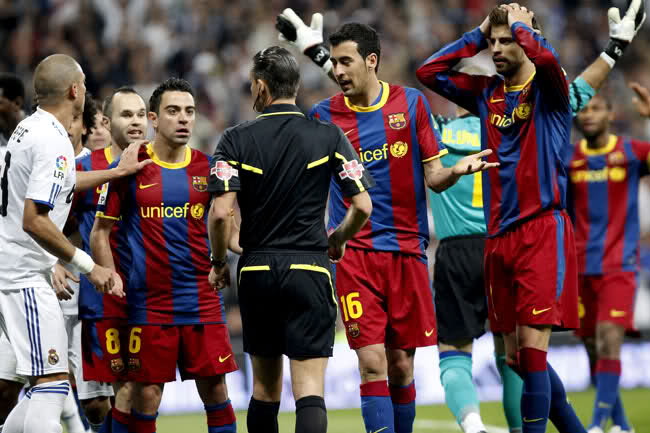
4) The referee calls a foul and suddenly he is surrounded by half a dozen players, usually from the offending team , harassing him (her) and trying to get their 2 cents worth in. Barcelona are famous for this and have made it a new art form called the Catalan cacophony!

5) Players taking throw-ins are another embarrassment. I watched 8 players in the Euros take illegal throw-ins and the linesmen and referee NEVER signalled an infringement!

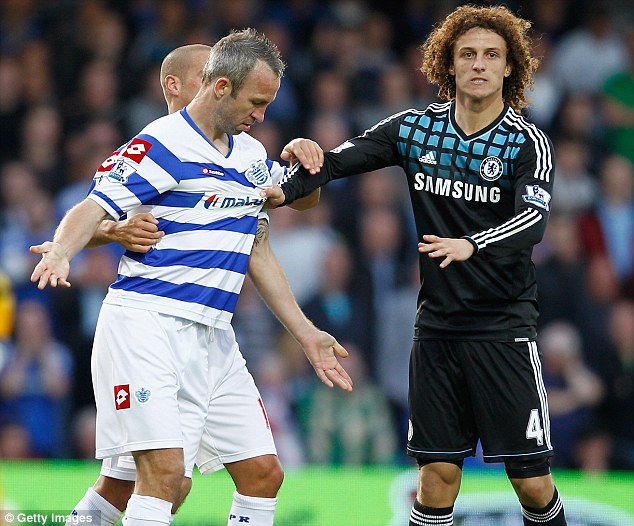
6) My all-time favourite infringement, that is rarely called, is the dual foul of shirt-pulling and holding. Players in their penalty area, particularly on free kicks and corners, seem to want to exchange jerseys or get up close and personal with their opponents, whether the referee is watching or not, as the case may be. I have, as yet, to see a foul consistently awarded by any official for this clear infringement yet it is a serious foul at any time and anywhere on the field.

7) The goalkeepers seem not to have heard that they have a time limit to get rid of the ball once it is in their hands! I counted 4 different keepers in the Euros taking more than 15 seconds to release the ball into play! If they want to waste time, they can put the ball down and play it like any other teammate but they know the referee won’t hassle them if they saunter around holding the ball so they take forever to get in back into play.

8) I am getting tired of watching grown adult ¨professional¨ Footballers becoming drama queens when they get a tap on the ankle or the shin. They roll around and thump the ground like they were recently run over by a steamroller yet less than a minute later they are up and running like demons. This play acting should be restricted to the stage and punished for bringing the game into disrepute when it is clearly exaggerated.

I could go on but I think you all get the point? Officials and FIFA have the power to reduce or eliminate these breaches of the Law yet they permit such gamesmanship, all in the name of getting on with play or avoiding nitpicking. I remember when I spoke to Sir Stanley Rous at a dinner in honour of my country’s 100th anniversary in Football and what he said has remained with me to this day: ¨A good referee is firm but fair and applies the Laws of the Game with equal care to the letter AND the spirit of such Laws¨. We need more ¨good¨ referees don’t you think?

Written by weedonald

Thanks to weedonald for today’s post. The internet is populated by self appointed experts, but today’s author is eminently qualified to talk about the art of refereeing. Here is a brief résumé of his history relating to football:

With 50 years of involvement in Football at all levels, international, national and local as a referee, coach and organizer/administrator, I am a total addict. My profession as a school psychologist and later as a consultant in Human Resources, afforded me the time to get involved and stay active until my retirement in 2010. When my wife permits it, I still love to volunteer coaching little kids and to officiate the occasional match as well. I was involved a great deal in women’s soccer and was one of two in my country to create the first adult women’s league in my province. I am certified as a Class C Coach and a national referee as was also an NASL official for 5 years. I adore the Arsenal and consider Wenger, under the circumstances , to be the penultimate manager of any professional team in Europe. I also like the game Barcelona play on the field but less so off it. My nickname comes from my mother who was born in Scotland and always called me weedonald while calling my twin brother an unprintable acronym.


Is Szczesny Good Enough For Arsenal?

June 11, 2012

Poor old Wojciech.

He was so excited about being Poland’s out-and-out Number One as they set out to try and win the Euros on home ground.

Instead he woke up on Saturday morning knowing that his main contribution to the national cause may turn out to be helping to ensure that Poland fail to qualify from the group stages.

Let’s face it, if Poland couldn’t manage to beat a Greek team that would struggle in League Two, their chances of progressing much further are slim indeed.

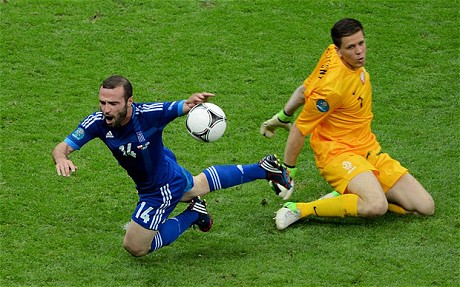
His nightmare day comprised two huge blunders: first, making an ill-judged lunge for a cross when it was always unlikely he could get there before either his central defender or the Greek forward.

I haven’t seen such a bad case of miscommunication between a goalie and a centre back since… er…  oh… Szczesny and Koscielny in the 2011 Carling Cup Final. Whoops.

As if gifting Greece (who were then playing 10 against 11) an equalising goal wasn’t enough, shortly afterwards Szczesny brought down a Greek attacker in the box for a clear penalty and an automatic red card. Our Pole’s blushes were spared slightly by the fact that his replacement saved the penalty. However, Szczesny’s dismissal had taken away Poland’s numerical advantage and was probably instrumental in them subsequently failing to grab a winner.

You have to feel sorry for Wojciech. As he walked off the pitch following his red card he looked to be one consoling word from a team mate away from bursting into tears.

But he only has himself to blame for both incidents and, truth to tell, for those of us who have watched him all year between the sticks for Arsenal, they are not a great surprise.

When Wojciech became first choice ‘keeper at Arsenal some contributors on Arsenal Arsenal took to calling him “World’s Number One.”

Around about that time I wrote a Headline Post here saying: “Right now Wojciech Szczesny is a raw, inexperienced player with bags of promise and the chance of becoming great in the future. A bit like Alex Manninger, Stuart Taylor and Richard Wright before him.

“In his performances for the first team this season he has been good but far from exceptional, which is entirely as you would expect for a 20-year-old making his inaugural steps in the top flight. All of which makes the fashionable hysteria about his talents premature, not to say ridiculous.”

I’m not trying to say “I told you so” because in that same article I argued that we should promote Fabianski and keep Szczesny as second choice – a suggestion I’m glad M. Wenger ignored.

But the fact is that Szczesny made many mistakes in his first season as Arsenal’s number one and his blunders for the national team are in keeping with the poorer aspects of his ‘keeping for us: namely, impetuosity; miscommunication and poor concentration.

So does all this mean we should reconsider his position at Arsenal? That we should bring in a Premier League veteran for a year or two until Wojciech has matured?

I would like to hear your views, but mine is this:

On no account should we remove him as our Number One.

For all his shortcomings, Szczesny has shown enough bravery, character and shot-stopping prowess to suggest that he can grow into a goalkeeper to rival legends like Jennings, Seaman, Wilson and Lehmann.

All he needs is age and experience. Age will take care of itself, but his experience will progress more rapidly if he plays every first team game (which, in turn, will end up making his “game age” greater than his birth age).

Even experiences like Friday’s will help make him a better ‘keeper.

In our forthcoming 2012-13 season I have no doubt that Szczesny’s faults will cost us points on occasion. But his strengths will win us points and his contribution to the team’s character cannot be overlooked.

Over to you.

RockyLives


Was Na$ri Right?.

June 10, 2012

We will play in the Champions League 2012-3 Tournament, but wow, it was close.

We were limping down the final straight, and had it not been for a stunning turn of pace from Mr Gibbs, we would have probably ended up in the next race.

Sure we recovered from a dreadful start, and this was followed by a few truly memorable games against the likes of Chelsea, Spurs and City. However, all this good work was so nearly undone by apathetic displays against Wolves, Wigan and Swansea.

See a pattern? Yip, me too.

So, enter S. Nas$ri. I read a comment on here where he apparently stated something along the lines of not leaving us for the cash, after all he could have stayed at Arsenal picking up the weekly envelope without having to put in much sweat and toil. He then stated, most alarmingly, that he wouldn’t have been the only one!

I am not going to point a finger or two, but merely make a suggestion. When it comes to motivation you can look at The Manager, but I’m not sure this is completely fair. Did players like Keown or Adams need a little chat from their managers? Of course not.  Can you imagine any player in a team with one of those two not pulling their weight, as I don’t think it would have been The Manager putting the boot in at half time.

Arsènes’ greatest side was littered with Fighters and Leaders. Since the departure of Vieira, I am convinced it has been the lack of a true leader that has cost us unnecessary dropped points. Being “up” for the big games is easy, but I’m afraid there have been far too many Match Reports and Comments on here this season where the implication has been that it was our concentration and commitment over the full 90 minutes that has been questioned.

We all have differing views on where holes need to be plugged and the type of player to do the filling.

The one signing that for me would make the biggest difference is less about the footballing qualities and more about leadership qualities.

Written by MickyDidIt89


Can North London solidarity exist?

June 9, 2012

Neighbourly disputes must be the oldest cases heard in any court around the globe. We argue with our next door neighbours, countries go to war with neighbouring nations, football fans fight supporters from another neighbourhood.

Tottenham and Arsenal fans look the same, they live in the same area, many are related to each other. So why the hatred?

I am guilty of hating Spurs for many years simply because other Gunners did and until my gorgeous gardener and Tottenham supporter enlightened me. He told me about Henry Norris’ dealings and about the Portsmouth game. I must admit I was quite shocked. If that was true, then I could understand them hating us. I started the research and oh my God, he was right and there was more.

Tottenham Hotspurs has been founded since 1882, four years before Arsenal. They moved to White Hart Lane in 1899, fourteen years before we muscled in on their territory. Unsurprisingly the emergence of another club in North London, less than 5km away had not been well received by Spurs supporters. They and Clapton Orient protested, but permission was granted for us to move to the beloved Highbury. Little did they know then, that we are not only going to get even closer, but to completely overshadow them for decades.

Spurs hate Arsenal because we muscled in on their territory 99 years ago, but did they not pull just about every trick in the book to secure a move to the Olympic Stadium, which is bang in the middle of the West Ham territory?

The relationship between the two clubs worsened in 1919, when football resumed after the First WW. That year Tottenham were relegated to the lower league, because 4 years earlier they finished last, yes 20th. Two top teams from the lower league as well as Arsenal who finished 5th were promoted to the top league. Tottenham were furious and blamed Arsenal for taking their place in the top league.

Nobody, except perhaps for Henry Norris, knows the rationale behind those moves and we might never know, however the fact that Spurs were relegated had nothing to do with Arsenal; they went down because they finished at the very bottom of the table. Arsenal or not, they would have been relegated and therefore THFC’s main reason for hating us simply cannot not justified.

Another reason often brought to the table by Spurs’ fans is Arsenal’s home game against Portsmouth in 1928. It was the last game of the season and Tottenham needed a favour; unless Arsenal won, Spurs would be relegated. We lost to a very poor Pompey team and Spurs were relegated, again. Some wild allegations followed, suggesting that Henry Norris rewarded the Arsenal players with luxury gifts, ie fridges. Again, these are anecdotes rather than facts and therefore I do not deem that as a genuine reason for hatred.

During the WW2 the unbelievable happened – Tottenham shared their stadium with the enemy, The Arsenal. While Highbury had been requisitioned for the war effort, League football was suspended and Highbury became a cornerstone of London`s defence plans. While the training pitch was used for storing materials and weapons, the main pitch was used as a training ground for the Islington Air Raid Precaution team. The brand new West Stand became an air raid shelter for residents and the lush East Stand a first aid centre. For the next 5 years we had no stadium. The Germans did what nobody else managed – they brought the two clubs together, united against the Nazis.

Sadly, almost as soon as the war ended, the hostility resumed on both sides.

Most recent reasons for Spurs fans to justify their hatred of everything that’s Arsenal are: Gunners smell – a sewer run through the pitch in Woolwich and the new stadium is built on the rubbish dump site; Arsenal are arrogant cheats and the most boring team in EPL; and last, but not least – Wenger poisoned the whole Tottenham team in 2006 to rob them of 4th spot in the table.

Tottenham are an old and proud club, with many trophies and a solid fanbase. They play some exciting football, have a good team and without a sugar Daddy figure, they like us are competing at the top level. You might not feel sorry for them for losing their spot in the CL qualifiers, you might even laugh at them because of it, but with your hand on your heart you must admit that they deserve the Champions League place more, much more, than Chelsea do.

To summarise, there is plenty of history of mutual dislike, but very little to convince me that it can be justified by either of the Clubs.

Is it possible that we could heal the wounds and unite against the South West Londoners? Could we let THFC play on our pitch when they are building their new stadium? Ok, sit down, gosh some people are jumpy! It ain’t going to happen!

I am going to try to be kinder or rather less abusive towards the Tottenham fans; I will not wish them ill or laugh at their misfortunes. And I sincerely hope they do well in the coming season, as long as they don’t do as well as Arsenal, of course.

Written by evonne


Do we Really need another Defensive Midfield player?

June 8, 2012

Almost all Arsenal fans are desperate for a DM. Why?

Well, because there is a collective belief that our defensive vulnerability stems from the lack of a strong, disciplined DM. One can point to a number of goals conceded which have come as a result of MF’s being too far upfield, or too central, or too slow in back-tracking. Is it the players or the system?

Let us assume it is the personnel and start with Alexander Song Billong. Is Song too attack minded to be our holding midfielder? Can he tackle? Does he have enough tactical awareness and if not, can he be taught? In my opinion, he is an excellent player but one who is inconsistent; he can be brilliant in one half and totally incompetent the next. His ability to find RvP with the dinked ball over the defence has given him a number of assists, but has it also reduced his effectiveness as a DM?

The assist for RvP’s goal at home to Dortmund was one of the highlights of the season and would indicate Song can play well higher up the pitch, but is he really good enough to be our creative MF? Not in my opinion.

Frimpong and Coquelin are certainly more focussed defensively, yet both are too young and inexperienced to take such a responsibility. Coquelin looks to have all the skills necessary to be a first team regular and yet there are doubts that he can step up and take Song’s place. Would a midfield of JW, Arteta and Coquelin be creative enough or defensively solid?

Frimpong has many positives but two severe injuries at such a young age and in a player whose main attribute is as a hard man must raise questions.

Ramsey and Diaby are both too offensive to be considered for the role. If I were Mr Wenger I would be looking to sell Diaby (not that anyone will buy him), and send Ramsey on loan. Ramsey will become a fine player but needs to get physically stronger and more confident in order to influence a game.

Or is the problem the system? Early Wenger teams had the luxury of excellent DM’s in PV4 and Gilberto Silva. I guess AW hoped Flamini or Denilson could have carried on the tradition but it wasn’t to be. Those early teams had very consistent defenders who rarely left their  own half. Apart from one or two exceptions and set plays, can you remember TA, Bould, Sol, Kolo, Gallas, Keown etc going over the halfway line? However, times have changed and so has our playing style, other than Mertesacker all our defenders have attacking ability and are prone to venture forward, it is the DM’s role to cover such eventualities – but what if the defenders stayed  in position?

In Big Raddy’s opinion, the problem lies at the feet of Song. He is a wonderful player but not disciplined enough to play in an Arsenal team which is set up in this fashion. It is no coincidence that we struggled without the discipline of Arteta. If we buy another DM and include Song, it leads to Arsenal playing with two DM’s which doesn’t fit our attacking style. So, we would buy this player because Song isn’t a good enough DM. And yet Song IS a fine player and adds much to our team, the problem is how and where to play him.

Do we need a defensive midfielder? Absolutely, but how Mr. Wenger develops a midfield choosing from: A new DM, Song, Arteta,Diaby, Ramsey, Rosicky, Lansbury, Denilson, Frimpong, Coquelin, Wilshire and Oxlade-Chamerlain, I have no idea.

Written by BigRaddy


Andrei Arshavin – One Last Hurrah

June 7, 2012

Transfers are very much on my mind, but it’s tough as I have no idea what my budget is. I am going to hazard a guess that I have £10m before I have to launch into the “sell to buy” category. We already have Podolski to ease the pressure on Robin, so where is strengthening needed. I say a more creative advanced midfielder, and a defence stiffener.

In line with my well voiced policy that we should only bring in better than what we have, then it’s tough, no impossible, on my budget. Or is it?

I think our CB’s will be fine, so I’m going to lash out all the dough on an experienced DM. A De Jong type.  

As for my AM, I say think about this:

Friday June 1: Russia 3 Italy O.

Russian League Champions: Zenit St. Petersburg.

Captain of Russia: Andrei Arshavin.

The match report for the Zenit game against Dynamo Moscow in Sovetsky Sport noted that Arshavin was “the hardest-working and most dangerous player on the field”. Hardest working!! Let’s face it, Dick Advocaat would not select AA as Captain if he had commitment and attitude problems.

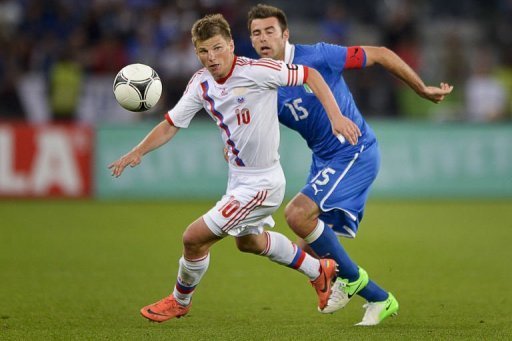
With Arshavin back as AM there would be no hindering the opportunities for understudies as AA is 31, and this would allow plenty of games for whoever Arsène sees long term for that role. Andrei  has always wanted to play in the middle just behind the striker and that’s where we should start him. I was staggered by how trim and fit he looked in this picture playing on Friday.

I’d get him back, play him where he wants and tell him (as Ferguson did to Cantona) not to bother tackling and tracking back. With a tough defensive midfield behind him, we may actually see the real Arshavin in Arsenal colours.

It may only be for one season, but perhaps that’s exactly what we need. Our Russian could just flourish in One Last Hurrah.

Written by MickyDidIt89


Arsenal win the Premier League for the 7th time in 10 years

June 6, 2012

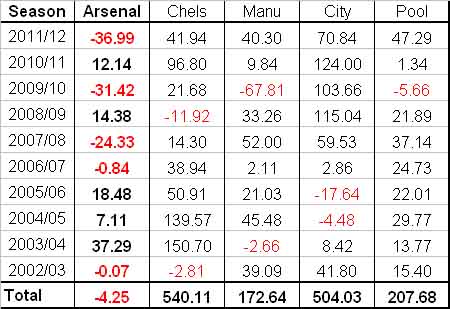
OK, technically we’ve won the PL once in the last 10 years if you want to be pedantic – but my cunning handicapping system based on money spent in the transfer market has revealed that we’ve actually won 7 times and come second on the other 3 occasions.

Don’t worry, this came as quite a revelation to me as well – after all, some would say that we have under achieved recently under Arsène Wenger.

So how do I arrive at this astonishing conclusion? It’s quite simple; I am factoring our ability to compete financially with the teams that have finished above us into the equation. By now you may be sensing that my tongue is planted firmly in my cheek – and it is. But there is a serious point, in fact there are several serious points….. read on……

Here is my Financial Fair Play Premier League table for the last 10 years.

The ‘Position’ column on the right is where Arsenal should have finished if FFP (or actually my conveniently manipulated version of it) were in place. I have taken points away from every club that has spent millions more than Arsenal in that period = financial handicapping. We should, by right, be battling against relegation if our performance reflected our net spending in the transfer market.

So what do I base this ludicrous assertion on? Well have a look at the comparative spending of the big 5 clubs over the last 10 years.

There is a mere half a billion difference between Manchester City and Chelsea and the Arsenal … and guess what, one won the CL and the other the EPL this season so I think we can accept that sooner or later big spending pays off if you judge success in terms of trophies.

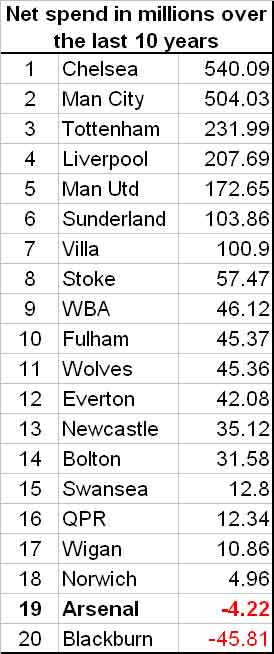
The table below shows the net spend of last season’s 20 Premier League clubs over the last decade. Arsenal is in nineteenth place with a balance of minus £4.5m.  Only Blackburn are below us. The real under achievers are Totnum who are third with a net spend of £232m and Liverpool in fourth with a net spend of £207m – and not a Premier League title between them to show for it. So maybe 200m is not enough, but 500m gets the job done. Or maybe those two clubs are just poorly run?

Even relegated Wolves have a net spend of £50m more than Arsenal over the same period and that with only a brief flirtation in the EPL.

Chelsea top the list. As everyone knows, they entered a new era when Russian billionaire Roman Abramovich bought the club in 2003, but they are run a very close second by Manchester City who were bought by the Abu Dhabi United Group 5 years later in 2008 and will undoubtedly outspend Abramovich over the next few years.

The statos amongst you will no doubt correct me on some of my figures but what I think everyone can agree on is that Arsenal cannot compete with City or Chelsea in the transfer market. Usamov is currently not in a position to inject his millions into Arsenal and I for one hope he never is, but that is another debate.

Personally I am very sceptical about the effect of the real FFP as I cannot see UEFA penalising the biggest clubs in the world in a way that would encourage the formation of breakaway leagues. However, I believe that Manchester United, Liverpool and Totnum will be reigning in their spending in the future and the two Spanish giants are almost certain to be affected by the impending crisis in the Spanish banking system.

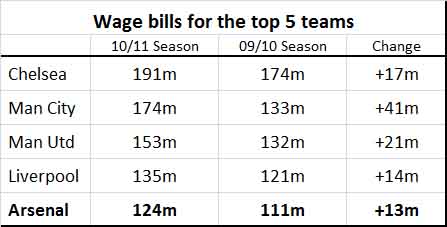
Like all arguments based on statistics, there is always another way of looking at things. In this case, the problem is that if I was to recalculate my version of the FFP table and to base it upon expenditure on wages instead of net transfer spending, then Arsenal would not rate as highly. In fact, if you based expected league position on wages alone, Arsenal are about where you’d expect.

The basic maths shows that we pay disproportionately high wages in relation to the amount we spend in the transfer market when compared to pretty much every other PL club (I haven’t checked the all). This policy was no doubt borne of necessity due to the costs associated with building the Emirates – but do we have to persist with it in 2012?

My hope is that we are rethinking our wage structure and some of those players who have been rewarded handsomely but failed to achieve the potential we saw in them, will be moved on this summer. If Mr Gazidis and his team (who quite frankly haven’t impressed me so far) can renegotiate some more lucrative sponsorship deals and increase revenue worldwide, then we should have the financial clout to fend off all but City and Chelsea in the domestic transfer market. We should also be able to reward our top players at the ‘market rate’.

The other teams with aspirations of being able to compete at the top (tots and pool) know that they have to build a 60,000 seat stadium to generate the income required – and as every Arsenal supporter knows, the true cost of that is 5 or 6 years of difficult transition and financial prudence.

Our footballing style and club ethos may be enough to make up the rest of the disparity between us and the super rich teams but it won’t be easy. The football hierarchy for the EPL has been set for the foreseeable future and Arsenal are in a great position to be the ‘best of the rest’.

It’s going to be an interesting few years ahead. The landscape of the Premier League has changed forever. The early portents for our future development will be revealed by this summer’s transfer activity. I believe we will inevitably continue to be a feeder club to the super rich teams but we should be the front runners in signing any player we target when we are not in competiton with the big spenders.

The big question is: will we continue with our current policy, or will we increase the amount we are prepared to pay for top players as our revenue increases?

Written by Rasp

Disclaimer: I gathered the stats reproduced in this article from what appeared to be reputable sources. The odd figure may be a point or 2 out but the overall picture is correct I believe.


Arsenal’s Best Ever Transfer Manager

June 4, 2012

We judge managers on many criteria, the most obvious of which is winning trophies.

But not far behind the acquiring of silverware comes the ability to find great players and bring them to The Arsenal.

In those stakes there are some interesting contenders for the crown of our club’s best ever “picker”.

Read on… then vote for the one you think has been the best in this regard.

Bertie Mee

Bertie’s appointment from physio to manager in 1966 was a big shock to most people (him included – he insisted on a clause in his contract that he could return to physiotherapy after 12 months if the management thingy didn’t work out). Bertie had a strong core of players to build on, but he brought in (or promoted from the youth team): George Graham (Chelsea), Bob McNab (Huddersfield), Pat Rice (youth), Charlie George (youth), Eddie Kelly (youth), Ray Kennedy (Port Vale), Sammy Nelson (youth), Liam Brady (youth), Frank Stapleton (youth) and David O’Leary (youth). Pick the legends out of that lot! However he also recruited Peter Marinello, Alan Ball and Bobby Gould, none of whom were great successes at Arsenal.

Arsène Wenger

Like Bertie Mee, Arsène was able to build on some great foundations when he got the best job in football in 1996. The George Graham back four was still in place and the club had also acquired a certain talismanic Dutchman. But our new French coach made signings that would really bring back the glory days: Vieira from Milan; Petit from Monaco; Anelka from PSG; Overmars from Ajax; Henry from Juventus; Ljungberg from Halmstad; Campbell from Hell; Toure from ASEC Mimosas and more. In 1998, 2002 and 2004 those players brought us huge success and some stunning football.  Since then we have seen many other fine players arrive under Arsene’s stewardship (Van Persie, Fabregas, Vermaelen, Sagna, Walcott, Wilshere, Oxlade-Chamberlain), but seven potless years have also led to questioning as to whether his “picking powers” are on the wane.

Terry Neill

Terry was at the helm from 1976 to 1983. During that time he took us to three FA Cup Finals (sadly we won only one of them), plus a Cup Winners Cup Final (lost) and a third place finish in the league in 1980-81.  His key signings were Malcolm MacDonald (from Newcastle), Alan Sunderland (Wolves) and Pat Jennings (the Swamp). Graham Rix was his most notable promotion from the youth team. Supermac, in particular, was a great signing who really lifted the club. He scored 42 goals in 84 appearances for us before injury brought an untimely end to his career.

Herbert Chapman

Chapman spent several years failing to achieve much success after joining Arsenal from Huddersfield Town in 1925, but after winning the FA Cup in 1930 he oversaw one of the most successful periods ever in our club’s history – an era of dominance that ended prematurely with Herbert’s sudden death from pneumonia. His most significant signings included such legendary Arsenal figures as Alex James (Preston NE), Cliff Bastin (Exeter), David Jack (Bolton), Eddie Hapgood (Kettering) and Herbie Roberts (Oswestry).

Billy Wright

Billy managed Arsenal from 1962 to 1966 and his reign brought no major trophies. However, he helped lay the foundations of the success that would follow a few years later. Billy’s transfers included Bob Wilson who arrived from Wolves and Frank McLintock, from Leicester. Both would go on to be vital members of the 1971 Double side, Frank as the captain. Billy also promoted several promising youngsters into the first team, including Peter Simpson, John Radford, Peter Storey and George Armstrong, so he could certainly spot a player.

George Graham

The “famous back four” will always constitute Gorgeous George’s most lasting legacy to Arsenal. When he took over as manager in 1986 he found Tony Adams, Paul Merson, Micky Thomas, Paul Davis and David Rocastle all waiting for him. Graham was quick to make Adams his captain and to put his faith in this outstanding crop of young players. But he had to transfer in the other components of the legendary defensive unit: Winterburn from Wimbledon; Dixon and Bould from Stoke and Keown from Everton.  When you consider that George also brought us the joy of watching the likes of Ian Wright, Alan Smith, Anders Limpar and David Seaman, you can see how effective his transfer instincts were. However, in his later years the signings (or promoting) of players like Kiwomya, Carter, Morrow, Hillier, Helder, Jensen and Selley provided a bit of a knock to his reputation.

So, who do you think has been our best picker of players ever?

RockyLives