Oi, Wenger, spend some money.

August 4, 2014

One day chicken, next day feathers; I trot this line out at times like this as it always seems to strike the right note.

On Saturday we were already dreaming of where in Islington we would be standing as the bus drove by with our players holding the EPL up high and just one day later we were wondering, more seriously than we had done for a while, just how likely the chances really are of signing Khedira.

Well, I was anyway, shallow moi? You just can’t have enough new toys; that’s what I say.

I actually think that that signing is far more likely than we are allowing ourselves to dream but anyway back to the game.

This is where I should say that is was only a friendly and we shouldn’t read too much into it but grrrrrr, I hate losing. I am sure Wenger learnt a lot from the two games and should be able to pick a formidable side to face City next week.

If Wenger wants to win that game rather than simply give players pitch time then Rosicky is surely a must start; he linked the defence with the attack and moved the play forward with a greater intensity than any other player was capable of yesterday. Rosicky also freed Ramsey up to burst forward with a far more effect against Benfica than he was able against Monaco.

I know it is wrong to start pointing fingers this early on; it was only a friendly as I made clear above – but we are Arsenal supporters and that is what we do. lol

Giroud – really?

I know things didn’t go exactly as planned against Monaco but we all know that amongst our squad we have a very good first team and the one thing we lacked last season: a fast, creative, goal scorer with great control has now been procured. Sanchez is going to give us everything we lacked up front last year and the EPL should be scared, very scared.

Ollie obviously still has a place, there will be teams that suit him more and he can be deployed when needed.

Wilshere?

I can’t, I shouldn’t; it really is too early for that one. All I would say is that I did notice a little boy in the middle of the park pointing at Jack while mouthing something about an emperor and not having any clothes on. OK I lied about it being too early.

Chambers seems more assured that Miguel which was a bit of a surprise to me, maybe, as GIE suggests, he should have gone out on loan earlier.

I was also surprised to read people disagreed with my comment that I expected Chambers to spend the same amount of time on the bench as Jenkinson did last season.

What? Is he going to play ahead of the BFG? No. Is he going to play ahead of Koscielny? No. Debuchy? No, so how is he going to play more than Jenkinson? Come on people, keep up.

Debuchy was almost anonymous yesterday which I liked; he did everything he was supposed to do and did it well, without fuss. And here’s the kicker, his crosses are so much better than Sagna’s, I know I am probably telling some the incredibly obviously equivalent of grass is green but it needs to be said.

So much for Wenger learning not to over use Ramsey, that man is going to work so hard that Welsh pit ponies will feel sorry for him.

And lastly, if you ever wondered why I don’t do match reports after we lose? Well now you know, I am a miserable git.

But this will all change next week after we beat City.

COYRRG

Written by LB


Arsenal 5 Benfica 1- a great afternoon’s entertainment

August 3, 2014

Well, what a great afternoon’s entertainment that was?

Plenty of new players to see for the first time, confirmation that others are moving in the direction we hoped for — and goals!

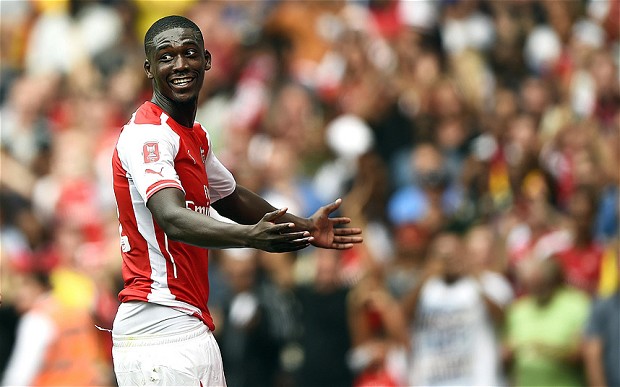
Lot’s of goals. I know the expression goes “from the sublime to the ridiculous”, well somehow Sanogo has managed to go from the ridiculous to the sublime.

Once again he started the game with all the control of a puppy with a beach ball but somehow turned this around to bag himself four goals.

And what’s more we discovered that he is a good dancer, there were some great moves going on as he celebrated his goals; well, almost, all except the last goal when he ran to the fans to do his celebration dance and some how managed to trip over his feet. Everyone howled with laugher in the pub and the inevitable thought of “from the sublime to the ridiculous” returned.

Sanogo

The thing I like about him above all is how he always plays with a smile on his face; he is very, very confident, and yet somehow he manages to carry this off without a hint of arrogance. There never seems a moment when things start to get him down — miss a sitter, no probs I’ll get the next one. The only thing that was completely unexpected was that this time he did get the next one and the one after and the one after that, four times in all.

He seemed to have some kind of injury towards the end and to my absolute surprise I actually cared. Well done Yaya more of the same please.

Around this time in the pre-season I think that most of us usually have a good idea of what is going to happen as regards to players in and players out; well, normally but yesterday when the team was announced along with the subs I realised I still haven’t got a clue who will be with us at the start of the season. There still seem so many possibilities for players to be sold or go out on loan.

It was good to see Campbell in the glorious red and white at last, he took his goal well. The problem is that he, Ozil, Walcott, Sanchez, Ox and Gnabry all play out on the right, I know it is possible to make the case that some of them can play in other positions as well but there is no hiding the fact that that position is a little over crowded and at least one must surely depart?

The other position around which we can surely expect change is the central defence: Monreal as a CB – really? Vermaelen is obviously shopping around, where was Diaby today and I for one will not rule out Khadira’s arrival until the shutters are firmly down on this transfer market. See what I mean there are still so many more possibilities for change.

I expect to see Callum Chambers on the bench or playing as much as Jenkinson did so last season. He had a very reassured debut and I certainly agree with GIE that he is CB in waiting, a position that requires far more skill and maturity than a right back.

Everyone else played their part well: Rosicky appeared sharp as did the Ox. And finally we got to see the player we had all been waiting for: Alexis Sanchez. While just sitting on the bench the man projected an image of being a “star in waiting” and the Chilean certainly didn’t disappoint when he came on; the man oozed class. But the stand out player of the afternoon was, of course, Ramsey, what a power house we have in the still young Welshman. Go Rambo.

A very happy afternoon, onwards and upwards.

Written by LB


Arsenal and Saturdays are back.

August 2, 2014

The Emirates Cup. What’s it all about then?

Well, it’s the first get together of the season at The Emirates. Four teams playing two games each over two days. A competition in its seventh year, it begins at 14:00 today with Valencia playing AS Monaco, followed by Arsenal taking to the field against Benfica at 16:20.

It’s a fitness sharpener, a chance for mates to get together, and it will be the weekend when many of the next generation of supporters get their first taste of seeing The Arsenal, and we all remember that day.

It will be the first glimpse of our new signings, and fans may well see Sanchez, Chambers and Debuchy, while Ospina is definitely ruled out.

I will be particularly interested to see how Joel Campbell performs now that he’s back in the squad.

For those going, there’s a sense of “thank God, the summer’s over”. Hour upon hour of pretending to be in interested in some bloody awful sport to fill the gap. “Ok, I thought, I’ll really get to grips with the Tour de France as that’ll occupy me for two weeks. Then the English bloke fell off after ten minutes. Athletics? Oh blimey, no Usain Bolt, forget it. Synchronized diving? Nope.

Today, however, the wait is over. Fans get to see their second home again. Some can even get there early to see the wonderful new posters hanging around the ground on their elegant galvanized steel posts. Something for everyone today.

Most importantly, the sacred turf. Ahhh…sigh.  Many of us mow lawns, and many of us do the Arsenal Head Groundsman Stadium thing. You know damn well what I’m on about. The lines one week, wide ones, narrow ones, little circles the next. For me the highlight of any seasons’ first game is that first glimpse of the green carpet laid out before you as you enter the arena. The promise of so many memories that will be forever engrained in your memory over the coming season. Hope. Expectation. The unknown.

I won’t do any kind of team sheet, as it would be purely guesswork ahead of two days of change, but if you are going, enjoy seeing your chums, getting back into the familiar surroundings of your pre-match routine, and knowing that finally, all is once again as it should be.

Our weekends are back, and they start today.

MickyDidIt89


Arsenal’s Olympic footballers – heroes and the future

August 1, 2014

As we have seen, the relationship of the FA in the home nations with the Olympics has been a twitchy affair. This was touched upon briefly during the discussion on GN5’s fantastic post on the first Football World Cup in 1930, and subsequently in my posts.

Football was played at the Olympics for the first time in the 1900 Summer Olympics. Two demonstration matches were held between the three club sides. Upton F.C. represented team GB and won. Likewise, the competition in the 1904 Games was also between club sides.

National teams competed for the first time in 1908, though France had two teams. Great Britain won in 1908 and in the following Olympic Games in 1912 as well. We have revisited this part of the Olympics football history earlier.

When the Olympics returned after the war in 1920, Norway defeated Great Britain in the first round. There was great disquiet with the FA and the IOC falling out with each other over the participation of professionals. Ironically, even if Norway were not a professional side, there were good grounds for complaint.

In 1921, the Belgium Football Association first allowed for payments to players for time lost from work, followed by Switzerland and Italy amongst others. In 1923, the Football Association requested FIFA to consider their statement of 1884 as a criterion for selection: “Any player registered with this Association … receiving remuneration … of any sort above … necessary expenses actually paid, shall be considered to be a professional.” FIFA refused, and consequently, Great Britain and Denmark withdrew their participation in football at the 1924 Olympic Games.

Subsequently a rift between FIFA and the IOC developed, and in turn led to the establishment of the Football World Cup. After clarification of amateur status, team GB participated in Olympics football again in 1936, and after the war, in 1948, 1952, 1956 and 1960. Great Britain did not participate in the football competition for 1964, 1968 and 1972 Olympic Games. In fact, after the FA abolished the distinction between amateur and professional players in 1974, it stopped entering a team.

Prior to 1984, men’s Olympic football was only played by amateur players. By the 1992 Games teams could use professionals, but were restricted to players under 23 years old, with only three over-age players allowed per squad. This is the setting for this final part of the story of Arsenal Olympians.

Sadly, however, a new crisis emerged. Since 1992, the UEFA U21 Championship has acted as the qualifying tournament for the UEFA nations, which each of the Home Nations enter. On three occasions, teams from Great Britain have finished in the qualifying positions: Scotland (1992 and 1996) and England (2008). However, the Scottish FA refused to field a team in 1992 and 1996 because such a team would have to participate as Great Britain, which they considered as detrimental to the independent status of Scottish national teams. Likewise, the English FA refused to field a team in 2008.

A century from the start of this story, Great Britain qualified for the 2012 Games and fielded an Olympics football team at home. This team had a substantial Welsh presence, prominently featuring our very own Welshman Aaron Ramsey. Ramsey scored a penalty during normal play and another during the penalty shootout in the quarter-finals, but the British team went out in penalties to South Korea, which also featured another Gooner.

Olympics 2012 Day 1 Men Football - Aaron Ramsey Together with the 5 (and a half) Gooners featured in the previous edition, Ramsey completes the story and celebration of Arsenal players’ contributions towards the Great Britain Olympics team. But what about our foreign players?

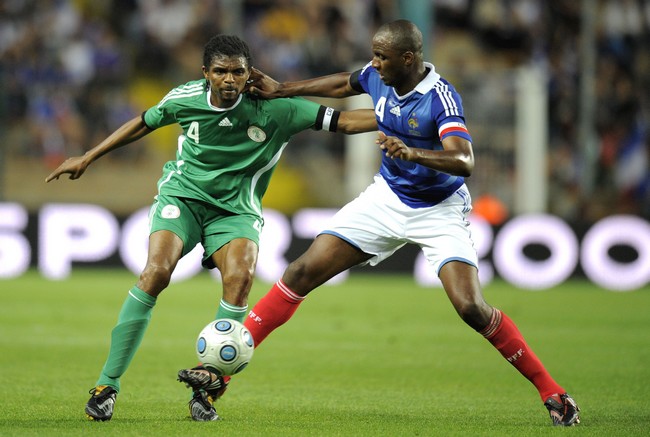
There are two stars of this show, the first being one Nwankwo Kanu, (born 1 August 1976), or simply Kanu, who became Arsenal’s third Olympic gold medallist in the 1996 Games. He was a member of and later captained the Nigerian national team for 16 years from 1994 until 2010. He is one of few players to have won the Premier League, FA Cup, Champions League, UEFA Cup and an Olympic Gold Medal.

FOOTBALL/FRIENDLY GAME/FRANCE v NIGERIA

Kanu joined Arsenal from Inter in 1999. His debut for Arsenal, against Sheffield United in the FA Cup, was a highly unusual match. With the score 1–1 and ten minutes to go, the United goalkeeper, Alan Kelly, kicked the ball out of touch so that treatment could be given to an injured player. When the ball was thrown back into play by Ray Parlour, although it was intended for Kelly, Kanu was unaware of the circumstances. Thinking it to be an attacking move, he chased the throw-in down the right wing unchallenged, and centred the ball for Marc Overmars, who promptly scored to make the match 2–1. Immediately after the match Arsenal manager Arsène Wenger offered to right the error and replay the match; in the end, Arsenal won that match 2–1 as well.

Kanu quickly became known for his goalscoring prowess from the bench, and became very popular among the fans for his two-fingered salute – something that he later explained was based on the team’s nickname, The Gunners – which started in 1999 against Middlesbrough. Kanu was named African Footballer of the Year for the second time in 1999, and in 1999–2000 he scored 17 times in 50 matches for the Gunners, including a hatrick in fifteen minutes against Chelsea to turn a 2–0 deficit to a 3–2 victory. Kanu won the Double with Arsenal in 2002, an FA Cup in 2003 and the Premier League title in 2004. In all he played 197 games for Arsenal (nearly half of them as a substitute), scoring 44 goals. In the summer of 2004, he moved to West Bromwich Albion on a free transfer.

In 2008, Kanu was voted 13th in the “Gunners’ Greatest 50 Players” poll. As well as winning the Olympic gold in the football event at 1996 Olympics in Atlanta, Kanu participated in the 1998 and 2002 FIFA World Cups.

The 5th and final Gooner to win an Olympics gold medal was Lauren (Etame Mayer). Commonly known as Lauren, he was one of the ‘Invincibles’. He also won an Olympic Gold Medal at the 2000 Sydney Olympics with Cameroon. Earlier the same year, he also played for the Cameroon team that won the Africa Cup of Nations.

Etame Mayer, Yao Aziawonou

Lauren joined Arsenal in the summer of 2000, just after his gold medal honour for Cameroon. Lauren’s first season with Arsenal was blighted by injuries. He eventually ended up becoming the club’s first-choice right back, replacing Lee Dixon. By the time Arsenal had won the Double in 2001–02, Lauren was an integral part of the Arsenal defence.

In 2002–03, Lauren suffered a calf injury and again missed part of the season, but nevertheless recovered in time and won an FA Cup winners medal. He was a consistent member of the Arsenal first team during 2003–04 and a became known as one of the ‘Invincibles’ after the club went the whole season unbeaten. Lauren made his 150th appearance for Arsenal during the record breaking run and Arsenal won the Premier League title, giving Lauren his second League winners’ medal.

Lauren won a third FA Cup winners’ medal in 2005, as Arsenal beat Manchester United on penalties after a 0–0 draw in the final; Lauren scored the first of Arsenal’s spot-kicks. However, during 2005–06, Lauren suffered a knee injury and spent nearly a year out of the game. He never played for Arsenal again. In January 2007, Lauren joined Portsmouth.

Better times were ahead though, playing in the Cameroon team that won the 2000 Africa Cup of Nations. He also played in the gold winning team at the 2000 Olympics, ironically against Spain, who could have selected him were it not for his choice of Cameroon.

And finally, here are Arsenal’s other Olympians. In the 1996 Olympic Games, the same year as Kanu won Olympic gold, two other future Arsenal players played for the French team: Robert Pirès and Sylvain Wiltord. Subsequently, 5 Gooners played for their respective countries in the 2008 Olympic Games: Alex Song for Cameroon, Thomas Vermaelen for Belgium, Gervinho for Côte d’Ivoire, Emiliano Viviano for Italy and

Park Chu-Young for South Korea. Park also represented South Korea in the 2012 Olympic Games, this time as one of the three over-age players in the team.

So, finally, here is the score sheet. 15 Olympians (6 from Great Britain) and 4 Olympic gold medallists (2 of them British). Could be better? Perhaps, if the FA wee to consider Olympic football as a means to develop young players.

This seems unlikely. As of Great Britain’s elimination from the 2012 Olympics, there are currently no public plans to reform the team for future Olympic Games. In fact, Alex Horne, in his role as chief-executive of the FA, has stated that the FA would not support a future men’s football team at the Olympics.

However, since other footballing nations, particularly non-European nations appear to consider the Olympics as important for youth development, perhaps this is a good space to watch for and spot future stars. Perhaps this is where some Gooners were watched as well. Where are the scouts?

Written by Arnie.


R.I.P — Alex Forbes 1925-2014

July 31, 2014


Alex Forbes has passed away at the age of 89 he appeared in 240 games for Arsenal over an 8 year period, scoring 20 goals.

-images-f-forbes_alex

Alexander Rooney Forbes was born 21 January 1925 in Dundee Scotland He started his career playing wartime matches with Dundee North End, before signing for Sheffield United. He was a regular for United in the first two seasons of competitive football after the war ended, and made his debut for Scotland, against England on 12 April 1947. However, he was sidelined by an attack of appendicitis midway through the 1948-49 season and could not regain his place afterwards.

Transfer-listed by the Blades, Forbes signed for Arsenal (after being persuaded by the Gunners’ Archie Macaulay, who was a friend of his) in February 1948 for £15,000. He made his debut against Wolves on 6 March 1948. Nicknamed “Red” (for the colour of his hair) and known for his hard tackling, he picked up a First Division winners’ medal in his first season at Arsenal, making 11 appearances that season. Forbes managed to eventually displace his friend Macaulay from the Arsenal side, becoming a regular for seven seasons. He went on to win a second title in 1952-53, and picked up an FA Cup winners’ medal in 1949-50.

He continued to also play for Scotland, eventually picking up 14 caps for his country. In all, Forbes played 240 games for Arsenal, scoring 20 goals. However, injury blighted his final season with the Gunners – a problem with his knee cartilage demanded an operation, which restricted him to five appearances in 1955-56. Having lost his place to Dave Bowen, Forbes moved to Leyton Orient in August 1956. He spent a season there before seeing out his career with Fulham.

After retiring from playing, Forbes spent some time coaching the Arsenal reserves and youth teams. He later emigrated to Johannesburg, South Africa, to coach children at a local private school, Yeshiva College of South Africa. He was also chairman of the South African branch of the Arsenal supporters’ club. He recently had a hip replacement.

Forbes is the last surviving player from Arsenal’s 1950 FA Cup Final winning team.

059-1948-arsenal-players-souvenir-brochure-19

GunnerN5 is proud to say that I watched the majority of Alex’s home games for Arsenal, he was a rough and tough player to played with his heart hanging out of his shirt.

Rest in peace Alex, you were the last remaining player from Arsenal’s 1950 FA Cup Final winning team.

GunnerN5


My wish list for the coming season.

July 28, 2014

All in all, last season, we improved our points tally and got the monkey off our back by winning the FA Cup and hopefully we can really build on this and carry on the momentum.

Here are a number of things that will help us progress.

First and foremost we need there to be fewer injuries especially long term injuries. There is no doubt that the loss of Ramsey and Walcott restricted our attacking and counter attacking options. Ramsey will be key for us in attack and hopefully he can develop a good understanding with Sanchez, who I am sure will be a revelation and combine this with an ever improving second season from Ozil. Throw Giroud into the mix, who will hopefully gain more confidence from the 22 goals he scored last season, then add an increased number of goals from Podolski and Cazorla and maybe even Ozil himself and the options of increasing our goal tally are spread more evenly.

Wilshere has, IMO, a make or break season and if what he says is true we want to read about his on field improvement, not his private life.

Our defence has to be drilled better, especially against set pieces, and lessons have to be learnt from the four ‘Away thumpings’ we got last season. That puts more emphasis on the coaching staff to make sure that things improve.

Following on from that we need a better ratio of points returned against the other top teams, not only for the three points but for confidence.

I don’t want to see us, time and time again, stumble out of the blocks straight from the kick off and when we do take the lead in many games we must go for the jugular and put games to bed.

Diaby – is he really reincarnated? Let’s hope so as surely a fit Diaby is a bonus for the team even if he manages half the games this coming season.

Wenger has done his buying early as he said he would but I feel we still need perhaps one more player.

I am glad that Szczesny has actually now got competition for his place (Wenger’s words) but as the season rolls on we will see if that actually comes to fruition or not.

Some of the understudies will play a part and others perhaps will go out on loan but we still have nearly five weeks until the window closes and I have a feeling that not all of our business is done.

We have every chance to win the Title with a bit of luck and 100% commitment from whoever plays. More rotation may just be the key.

kelsey


Arsenal in New York – nah it’s all about Thierry Henry

July 25, 2014

In his press conference yesterday Arsène  joked with journalists that he had only taken one striker to New York as he hoped that Thierry would play one half for Arsenal 🙂

Later in the interview Arsène  was asked about his best Thierry Henry moment. The goal he chose was the goal against Leeds in the FA Cup in 2012 where Thierry made his very brief comeback in an Arsenal shirt.

I was there at the Emirates that night and it was a special night even before the Thierry goal. The air was filled with expectation. Parents had brought very small children, those that were too young to have seen the King play previously and now they were going to get their chance.

There are lots of videos on ‘youtube’ of the goal but this one isn’t overlaid with funky music, it’s just commentary and the sound of the Emirates erupting and cheering a hero.

Arsene said he liked this goal the best because it made Thierry so happy to have scored it and that all the other goals were ‘business as usual’. Arsène felt it cemented Thierry into the hearts of Gooners, I would say he was already there.

If you can pick a favourite Thierry Henry goal let us know about it, for many – myself included – one won’t be enough. Be self indulgent – there will never be another Thierry Henry and we were very lucky that he played for Arsenal.

peachesgooner


Olympics football – Arsenal’s amateur heroes

July 24, 2014

The past few weeks have been partly about celebration. Celebrating the gold winning exploits in the World Cup of our three proud German Gooners, and who knows, by the end of the transfer window this may yet turn out to be four German Gooners. Hush, hush!

Along the way, the Germans overcame the French team that included three Gooners, one of whom has since left Arsenal to be promptly replaced by another one at the same position.

Together, we were enthralled by the fantastic performances by our new Chilean Gooner, our as-good-as-new Costa Rican superstar, and maybe even the Colombian Gooner. Hush, hush! The singleton Gooners on the Belgian and Swiss squads had decent campaigns. Overall, quite a lot to celebrate then! No wonder Gooners around the world are going around with their grins spreading ear to ear.

At the same time, there were sombre thoughts as well, not least in the poor returns for the England team. Our two good guys in the England team had mostly futile excursions, and so did our Spanish Gooner. It seems World Cup glory requires years of preparation, and a thorough system through which young players can emerge. Surprise, surprise!

Understandably, youth development has been in the air. As I have argued in Part I of this series, in most leading footballing countries, Olympics men’s football plays an important role in the development of young players.

This then brings us to the questions of today’s post. In its long history, have Arsenal had many significant heroes who shone at the national level in the Olympics men’s football tournament? And if so, who were these heroes?

At the outset, there is a confession to make. We do not expect many such players. Why? First, because Great Britain does not usually qualify for the Olympics football competition and even when they do, they usually do not enter a team. The reasons for this are complex, and I will go into that later in the series. But just to set the perspective, a Great Britain football team has participated only in 9 Olympic Games since inception of national Olympics football: 1908 (prior games in 1900 and 1904 used club teams), 1912, 1920, 1936, 1948, 1952, 1956, 1960, and finally after a long break in the 2012 Games.

Second, until 1992, only amateur players competed in the Olympic Games, at least officially, and since then Olympics football has been officially designated as largely an under-23 tournament, with only three over-age players allowed per nation. Hence, Olympics football players would not normally be expected to play for Arsenal. However, Olympics may be a good place to scout for players, and some such players may have come to play for Arsenal when they turned professional, or more lately, when they emerged from the academy.

Today, I focus on the amateur Olympics football era. Only 5 Olympian amateur footballers for Great Britain were signed by Arsenal after turning professional, all of them British. They are Harold Adrian Walden and Gordon Rahere Hoare (1912, both Gold medallists), Bernard Joy (1936 Games), Stanley Charlton (1952) and Laurie Brown (1960). In addition, Maurice Edelston, who played for team GB in the 1936 Games was a wartime guest footballer for Arsenal. Let us find out a bit more about these 5 players, and a sixth as well.

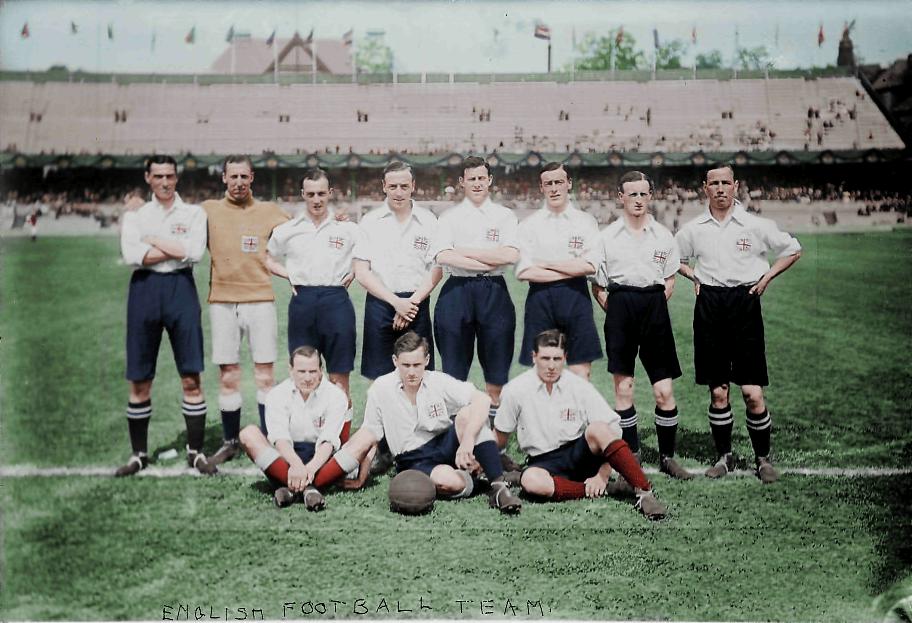
Olympics 1912 team (1)The Football Association entered a Great Britain national amateur team in the 1912 Olympic Games. The team won the gold medal, though the IOC accredits Great Britain and Ireland with the medal. Walden and Hoare were key members of this team.

1912 British Olympic Football Team – Harold Walden back row, 4th from left, Gordon Hoare back row, 3rd from right

Harold Adrian Walden (10 October 1887 – 2 December 1955) played in all three matches and scored eleven goals: 6 goals in the 7-0 decimation of Hungary, all 4 goals in the 4-0 semi-final victory over Finland, and one goal in the 4-2 victory over Denmark in the final. Hoare scored 2 of the other 3 goals in the final. Walden holds the record of being the ‘Highest British goal scorer within the Olympics’ and is still the fourth highest goal scorer overall within the Olympics.

Walden was born in Umballa, India, where his dad was serving with the 2nd Cheshire Regiment. His family returned to live in Manchester in 1889. He joined the army in 1902 and served in India and Ireland. He played for the Army against the Navy in 1910 and 1911, and also served in World War I, rising to the rank of captain. After the war ended he joined Arsenal and played six times for the Gunners, scoring a single goal and in four friendlies, with his debut coming on 12 February 1921.

On retirement from football, Walden carved out a second career as actor in theatre and films. He played the lead role of ‘Jack Metherill’ in the 1920 film ‘The Winning Goal’, and also played himself on stage in his football shirt in the 1948 film ‘Cup Tie Wedding’. He became part of the famous Ernest Binns Arcadian Follies in the 1940’s. He fell on hard times and in the early 1950’s his Gold Medal was sold.

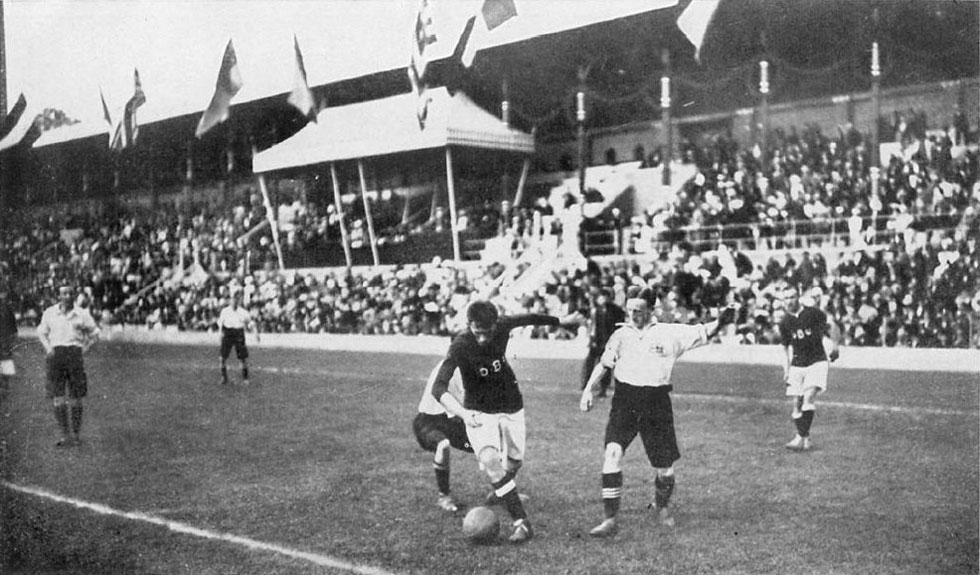
Olympics 1912 - GB vs Hungary - Walden

Walden – extreme right, with the ball

Gordon Rahere Hoare (18 April 1884 – 27 October 1973) scored two goals in the final. He joined Woolwich Arsenal in 1907, making his League debut in a First Division match against Sheffield Wednesday on 20 April 1908, the last day of the 1907-08 season. Although he played 11 League matches in 1908-09, scoring five goals, unhappy at the lack of regular first team football and moved to Glossop North End in December 1909.

Hoare returned to Woolwich Arsenal in December 1910. He scored six times in fourteen games for Arsenal in the 1910-11 season but was once again dropped at the start of the following season, unable to oust John Chalmers and Charles Randall from the front line. He rejoined Glossop in February 1912. In total, Hoare played 34 times for Arsenal, scoring 13 goals.
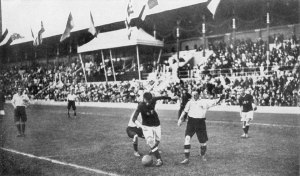
Olympics 1912 Stockholm Football Final - Hoare

Hoare – Front right

Hoare and Walden were the first Arsenal players who played football for Great Britain in the Olympics, and they both won gold medals. Arsenal then had to wait an awfully long time to find another Olympic gold medallist. More on that later. Now, let us focus on some other amateur players played in the Olympics and later signed for Arsenal.

Prior to and following the start of the World Cup, the relationship between the FA and IOC turned sour, most notably in British protests against other nations fielding professional players. As Arsenal star and Olympian Bernard Joy in Association Football (1960) wrote: “Out of pocket expenses were paid far in excess of the reimbursement for hotels and travelling. … [Payments] for time lost from work, were made for playing and training, and teams were taken off for intense preparation together. Whatever the reason or excuse, thinly-veiled professionalism was rampant.”

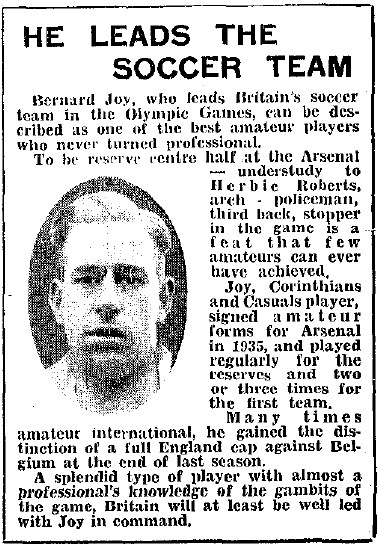
After some protracted negotiations, a GB football team was entered in the 1936 Olympics in Berlin. They lost in the quarter-finals 4-5 to Poland, but Arsenal player and captain Bernard Joy scored 2 goals.
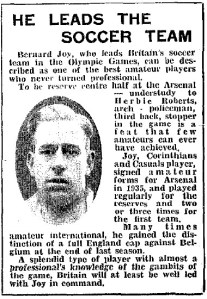
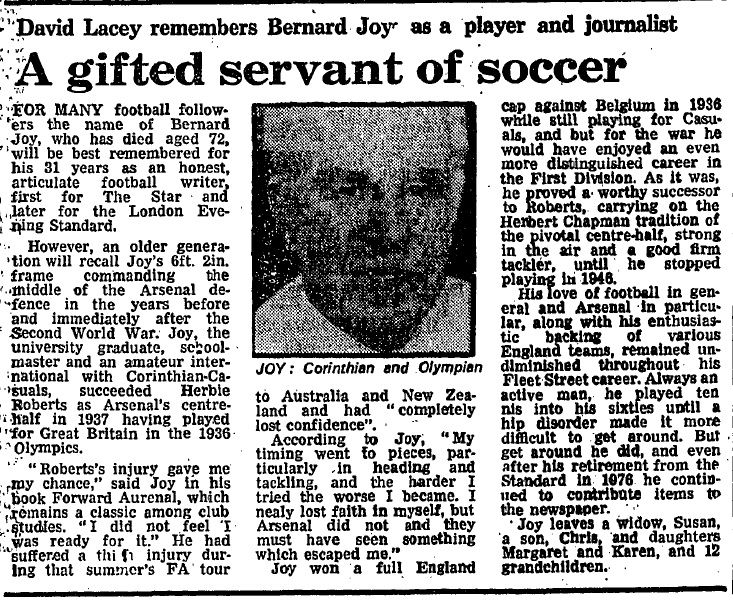
bernard-joy-olympianBernard Joy (29 October 1911 – 18 July 1984) joined the then First Division champions Arsenal in May 1935. Joy mainly played as a reserve, only playing two games in his first season – he didn’t make his debut for Arsenal until 1 April 1936 against Bolton Wanderers. Arsenal won the FA Cup that season but Joy played no part in the final.
Joy 2

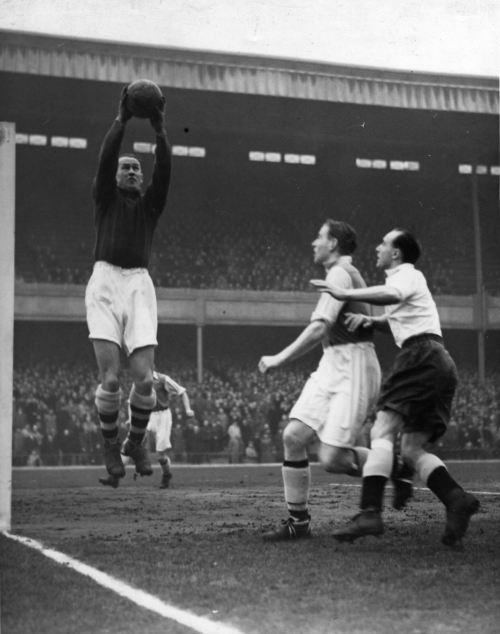
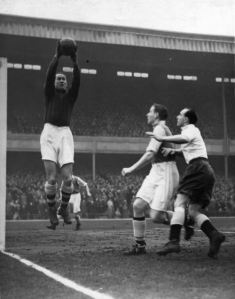
Highbury 1939. Wilson (Arsenal) saves while Bernard Joy (centre) holds off Hunt (Bolton)


However, he did gain recognition at international level soon after, when on 9 May 1936, he played for England in their 3-2 loss against Belgium, making him the last amateur to play for the national side. Given the nature of professional and amateur games in the modern day, it is unlikely Joy’s record will ever be taken by another player. Although Joy was playing for Arsenal at the time, he was still registered as a Casuals player and he is recorded in the England history books as playing for them at the time, not Arsenal. Interesting! 😛
 

Joy book

Joy continued to play for Arsenal, mainly deputising for the Gunners’ established centre-half Herbie Roberts. Roberts suffered a broken leg in October 1937 and Joy took his place in the side for the remainder of the 1937-38 season, winning a First Division winners’ medal, and then, with Roberts having retired from the game, on through the 1938-39 season (earning a 1938 Charity Shield winners’ medal in the process).

With the advent of World War II, Joy joined the Royal Air Force, though he still turned out for Arsenal (playing over 200 wartime matches) and won an unofficial wartime England cap. In June 1940, he was one of five Arsenal players who guested for Southampton in a victory over Fulham at Craven Cottage. He also appeared as a guest player for West Ham United later in World War II making two appearances. He retired from top-flight football in December 1946.

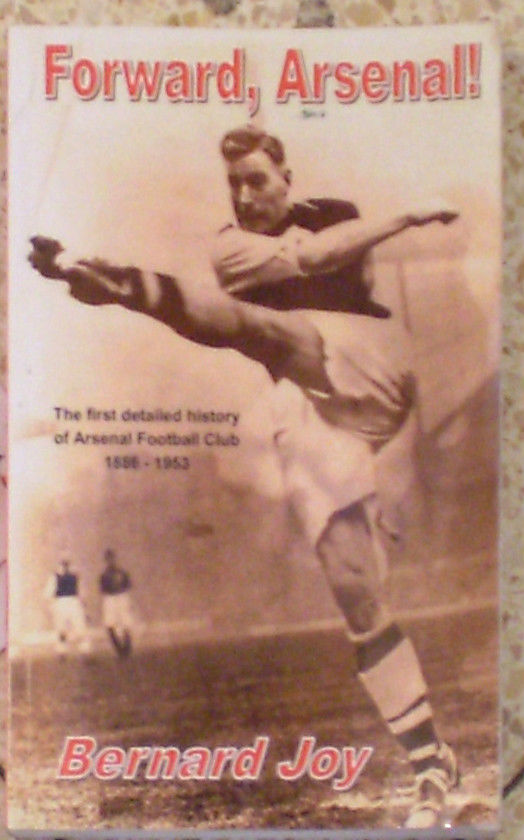
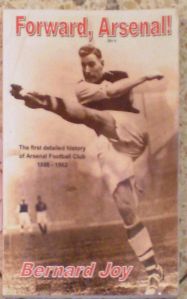
In all, he played 95 first-class (that is, non-wartime) matches for Arsenal, though he never scored a goal. However, with Arsenal, he won the First Division in 1937-38, and the FA Charity Shield (now the FA Community Shield) in 1938. Finally, Bernard Joy wrote perhaps the first authoritative history of Arsenal Football Club.

bernard-joy-obituary

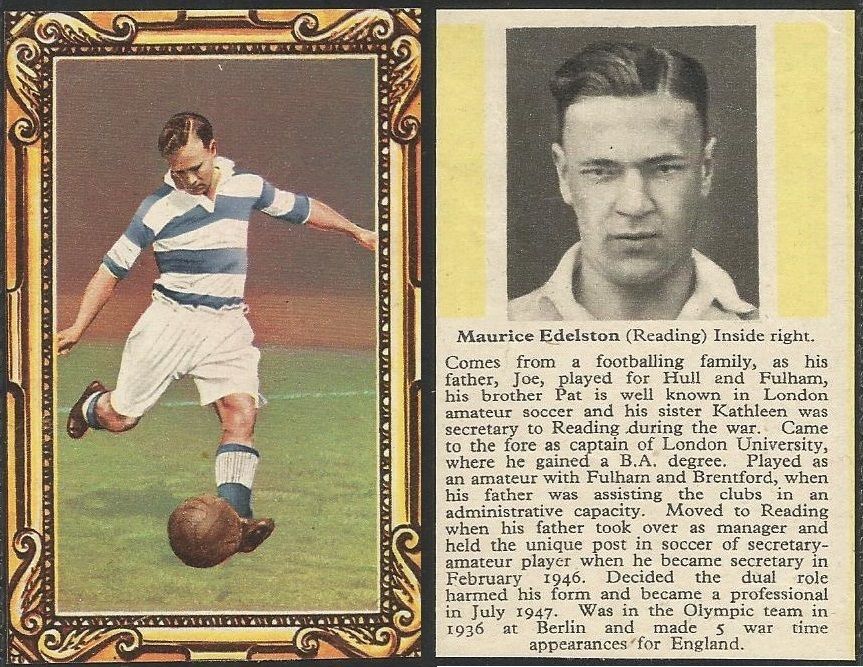
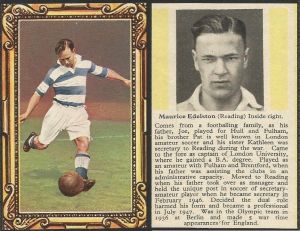
The 1936 GB Olympics football team led by Bernard Joy also included Maurice Edelston (27 April 1918 – 30 January 1976) who was a wartime guest footballer for Arsenal. Later on, he became a brilliant commentator and is mostly remembered in this role.
Maurice Edelston


Next up is Stanley “Stan” Charlton (28 June 1929 – 20 December 2012) who was a stand-by player for the 1952 Olympics team. In November 1955 Charlton joined Arsenal and succeeded Len Wills as the club’s first-choice right back. He made his debut on 24 December 1955 against Chelsea and was an ever-present in the 1956–57 and 1957–58 teams. He played for the London XI in both legs of the semi-finals of the 1955–58 Inter-Cities Fairs Cup against Lausanne Sports. Before quitting Arsenal in December 1958, he had made 110 appearances, scoring three goals (all of them in the FA Cup).

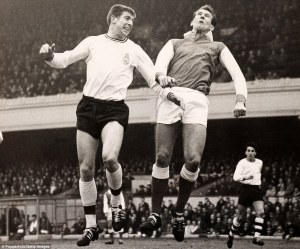
The final Olympian who later turned professional and played for Arsenal was Laurence (“Laurie”) Brown (22 August 1937 – 30 September 1998) who played in the 1960 Olympic Games in Italy (Rome). Great Britain failed to progress to the knockout stage and came eighth overall. The British team lost 3-4 to Brazil, drew 2-2 with hosts Italy and defeated China 3-2. Brown scored 4 goals, 2 against Brazil and one each against Italy and China.
Laurie Brown

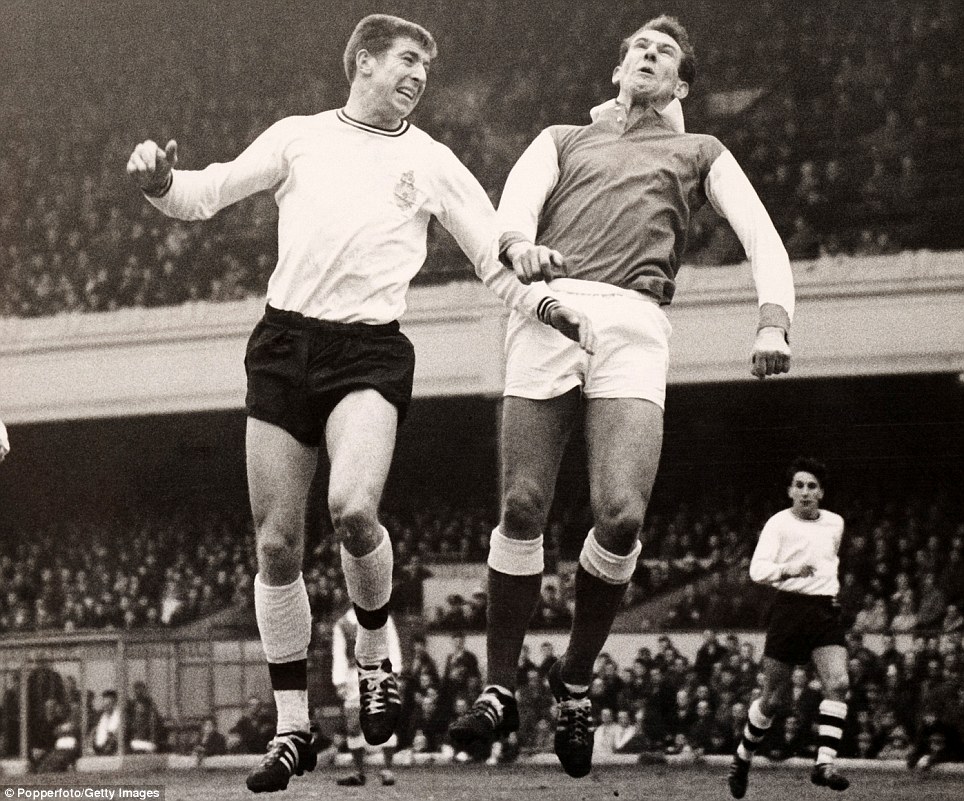
In August 1961 he signed for First Division Arsenal, and immediately became a first-team regular in the Arsenal side. Brown amassed 109 appearances for the Gunners in two-and-a-half seasons, scoring two goals. At the time, Arsenal were the less successful of the two north London sides, and Brown made the surprising move up the Seven Sisters Road to Arsenal’s deadly rivals, Tottenham Hotspur in February 1964. 😦 Brown became one of the few players to play for both clubs.

That’s it for this time, folks. A glimpse of a mostly forgotten part of our history. 5 (and a half) Olympians and 2 gold medallists. Next time it will be the turn of our youth Olympians.

Written by Arnie


Give Us An ‘F’: Alternative Arsenal Alphabet

July 23, 2014

First off, get yourselves out of the gutter.

Just because we’re dealing with ‘F’ words does not mean that the tone of this fine blog will be in any way compromised.

No f*cking way.

So we are onto the sixth letter in our Alternative Arsenal Alphabet – and it’s one that throws up some fine entries to this anthology.

As always, please feel free to add your own suggestions in the comments.

F is for…

Firsts

The Arsenal have been responsible for many “firsts’ – a lot of them initiated by the great Herbert Chapman who managed the club in the 1930s. To list but a few…

First club to use floodlights.

First to use undersoil heating.

First club to install turnstiles.

First (and only) club to have a London Underground station renamed in its honour.

First ever game broadcast live on the radio was an Arsenal game (Arsenal v Sheffield Utd, 1927).

First ever game broadcast on TV was an all-Arsenal affair (Arsenal v Arsenal Reserves in 1937).

First game ever to appear on Match of the Day was Arsenal at Liverpool in 1964.

First match broadcast live in 3D (Arsenal v Man Utd in January 2010).

I could go on but you get the point: we are The Arsenal – the greatest club in the history of world football. (Incidentally, our N17 neighbours have absolutely no firsts, but they do have 11 number twos turning out on a regular basis).

Fire

Did you know that the North Bank was destroyed by fire in 1941? The blaze was caused by a visit from Herr Hitler’s Luftwaffe, who somewhat rudely dropped a bomb on our fine stadium. Fortunately these days the only German aerial threat is when the BFG goes up for a corner.

Finals

OK, do you know how many (fully competitive) finals we have played in over the years?

The answer is 31, made up of 18 FA Cup Finals, 7 League Cup Finals,, 3 Cup Winners’ Cup Finals and 1 each of the Fairs Cup Final, Champions League Final and UEFA Cup Final. Out of that 31 we came home with the silverware on 15 occasions.

Film

Under ‘A’ I mentioned the 1930s film The Arsenal Stadium Mystery. It has since been drawn to my attention that there are many movies in which The Arsenal has featured in some (often very small) way. For example: in The Full Monty there’s the celebrated scene in which the men are taught to dance with one arm in the air by being told to emulate the famous Arsenal back four. Then there was Fever Pitch, the film based on Nick Hornby’s memoir of growing up as an Arsenal supporter. Among the lesser well known is the brief appearance of a bloke in an Arsenal shirt in the 1995 film ‘Hackers’. I know you might sniff at such a fleeting glimpse of an Arsenal shirt, but in ‘Hackers’ the chap wearing it was busy boffing Angelina Jolie at the time (I’ve always wondered whether Chas has an alibi for that day)…

There are many more film references to explore. If you would like to read about them here’s the link:   http://www.arseweb.com/other/movies.html

Friendship

No, not the end-of-the-night, drunken, arm-around-your-best-mate saying “I really love you, honest” sort of friendship. I refer to The Bank of Friendship in the Blackstock Road – a fine, outstanding example of an Arsenal boozer. I probably should have included it under ‘B’ but as I forgot, it’s getting a look-in here. It was always my favourite post-match pub while we were at Highbury and I’ll never forget the party there when we clinched Arsene Wenger’s first league title in 1998 (the game where we beat Everton 4-0, the scoring capped off with a Tony Adams volley). There was so much rhythmic jumping up and down in the bar that the whole building was vibrating and the glasses on the top shelf above the bar were shuffling merrily along to the edge of the shelf and falling off, one after the other. I don’t think the landlord really cared – he must have made a fortune that day.

Fighting

You don’t often see a punch-up at The Arsenal these days and, sadly, if you do it’s more likely to be between two Arsenal supporters. But back in the days before segregation of fans was introduced it was not uncommon to see some full-blooded brawls both inside and outside the ground. As I recall, Arsenal fans were never really known for having a feared “firm” of hooligans (unlike Chelsea, West Ham, Leeds United, Manchester United, Millwall and so forth). Even so, I knew plenty of Gunner loons who were not averse to a bit of fisticuffs. Still, there’s no question that it’s a good thing those days have long gone and most people now go to football for the football, not the fighting.

RockyLives


Are the Oligarths looking after their own money?‏

July 23, 2014

Morning Gooners,

Now I know we don’t do politics, religion and all those things that make the world go round, but I felt I had to put a few words together to discuss the following. Many supporters have been asking for one of our major share holders to use his billions to buy Arsenal FC outright and spend some of that vast wealth on players.

Many supporters don’t care where Usmanov’s money has come from. He is a business man, who has his billions in many pots, but where his money has actually come from no one can say for sure.

Chelsea’s owner Roman Abramovitch is also running a big football club, it’s reported that he started off selling matches on street corners, and then branched out selling rubber dolls from his pokey little flat. He must have sold a lot of matches and dolls to build his wealth to six Billion.

Usmanov is another that has amassed an eleven billion fortune, rumoured to have come from minerals and other means, but no one seems to know the actual truth. These two billionaires are not alone in Great Britain judging by the papers, who recently named six russians that were all multi billionaires.

With the trouble between the Russians and Ukraine where things are getting warlike, I noticed that our Prime Minister, David Cameron has threatened sanctions on Russian deals, and wait for it, he has also stated that the Russian billionaires funds which are sitting in British banks may be held, and will not allow those billionaires to use their funds, until this Ukrainian business is settled.

Now I am far from a financial wizard, but that suggests to me that the kind of action that the Prime Minister is suggesting, is saying that their money is not really theirs, but is being looked after by them for the Russian Government.

Looking at what is happening, has made me think that what the Russian Government has done, is syphon of the country’s wealth, and given it to certain people to look after, until this money is needed. It’s been smuggled out of the country, so the Russian public are not aware of it. Of course these so called billionaires have to act out the rich man, but when you’re holding a billion what’s a yacht or two, or even a football club, lets face it yachts and football club money can be redeemed, Mayfair Apartments can be sold and so on.

Now wouldn’t you take on a job like that, live like a billionaire, and find a safe haven, invest a bit in a business and look the part. Putin runs the country, and also lives like a wealthy man, but with him he is hungry for power. And when the shit hits the fan, he always has vast wealth being held, and could disappear at the snap of a finger,

Now I may have it all wrong, and all these people may be straight down the middle, but I have a sneaky feeling that I am not that far wrong, I have always been against Usmanov’s money being used  at Arsenal, and even if I’m wrong I am still glad we do it our own way and don’t need a ‘Sugar Daddy’.

Written by Steve Palmer