Only One Arsène Wenger

July 22, 2011

Hey Arsène, how many big pots are we going to win this season?


Why we need to stick to the Wenger Revolution

(And why it is necessary to keep reminding us of this)

By three methods we may learn wisdom: First, by reflection, which is noblest; Second, by imitation, which is easiest; and third by experience, which is the bitterest.
Confucius

The beautiful game is seldom played beautifully. Many of us are football addicts and will watch any game however mediocre it promises/ turns out to be, and I am exactly the same. But, we all notice the difference when we watch a truly beautiful game: only then will we express ourselves in superlatives and will even the most prosaic fan become poetic, only then are our needs for the beautiful game fully satisfied and are we truly happy, and only then will a game become engraved in our memories – become immortal so to speak.

Looking a bit closer at how football clubs approach the game, one can see four distinct variants, depending both on the level of success and the aspiration to play football that is pleasing to the eye. These are:

  1. Strong focus on ‘result-football’, with an inherent low aspiration to play beautiful football, but also with low levels of success: mediocre, uninspiring football by far and large, played by the majority of clubs within UK/Europe.
  2. Strong aspiration to play beautiful football, but low levels of success: attractive, praiseworthy but naive football, played by a small number of clubs – West Brom under Tony Mowbray,  and last season’s Blackpool are some good recent examples.
  3. Highly successful football, but with low levels of aspiration for attractive, beautiful football:Chelsea under Mourinho, almost every successful Italian club (the exception being AC Milan in the early nineties), Inter under Mourinho, Manchester United in recent seasons, etc.
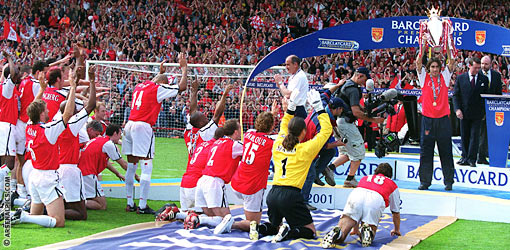
  4. Highly successful football that is also very attractive and beautiful to watch: Barcelona in recent years, Milan in the early nineties, Ajax in the seventies and mid-nineties, Arsenal in the late nineties and during the ‘Invincibles’ era.

Of course there are more variants, but out of these four extremes only the fourth one represents the sort of football that people speak about many decades later, the sort of football that becomes immortal.
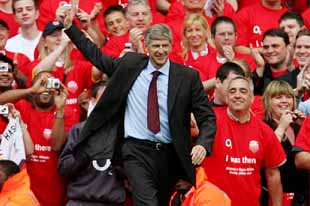
 

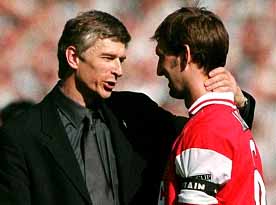
Arsène Wenger is a dreamer, a Don Quixote, an idealist, and a genius. He somehow wants to win pots by playing beautiful, total football, with a team that is built from within the club, on the affordable but risky concept of combining the development of youth players with the purchase of rough diamonds, that can be made to shine within 1-3 seasons. On top of that, he wants our club to adhere to a self-sustaining financial model i.e. live within our means. I, like many other Gooners – but definitely not everyone – love Arsène Wenger for this highly principled, romantic and yet competitive approach to the game and our club. It is currently unique within the UK and in Europe.

I believe the world is crying out for leaders, in all sorts of professions and sports, who can combine competitiveness – and I will not have anybody say that Wenger is no longer ambitious – with a vision, and a set of principles and virtues. Wenger, more than any manager in Europe, has all of these qualities in abundance. He could have walked away from Arsenal many times, to clubs where he would be free to continue with his philosophy and principles on how the game should be played, and more importantly: where he would have been given an almost unlimited cheque book to sign whoever he wanted, in order to complete his quest for beautiful, highly successful football. I believe he decided to stay with Arsenal to both remain loyal to our fantastic club – during the challenging period of transformation for Highbury to Ashburton Grove – and achieve something truly remarkable, in the hardest way possible.

Arsène Wenger is not perfect, and neither are we, nor is any manager: c’est la vie. I do not believe in the tacky ‘Arsène Knows’ mantra. But, what Wenger is trying to achieve: winning pots through highly attractive football on a self-sustaining financial model is unbelievably important, for Arsenal as well as football in general. He does not get enough credit for this, not from the media and not from the fans.

During the Wenger years, we had more than a good taste of highly attractive, and yet successful, football. We have become accustomed to it, but in recent years we have been famished of success (but not beauty). Yet, this is the time to remain faithful, to breath-in and breath-out, to give Arsene a chance to push us to the next level. Demanding success, even when it has been relatively so long since we won anything, is not going to help. Arsene wants it more than anybody else, so why push him even more? It is counterproductive.
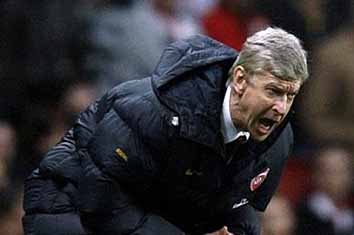
 

Even if some fans would rather want us to ditch our style/ aspiration to play beautiful football, in order to win something again, there is really no way back. The third variant is not an option for us. We do not have the funds now, and most likely not for the next decade to come, to compete with Chelsea, Manchester Cityand possibly also Manchester United and Liverpool. These clubs will always be better equipped in assembling teams that win cups the ‘calculated way’, without a strong aspiration to play the game beautifully. Neither should we want to have those sorts of insane funds, but that is a discussion for another time.

No, for us it is all or nothing, The Wenger revolution cannot be stopped: the rocket has left the earth’s atmosphere and it is our only chance for success. It will come, maybe this year, maybe in two or three years, and when it comes it will be so good, that not only we, but many generations after us, will still eulogise about it.

In the meantime, try to relax and enjoy the ride: there will be plenty of beautiful football again this season, thanks to the genius and aspirations of Arsène Wenger.

“To live only for some future goal is shallow. It’s the sides of the mountain that sustain life, not the top.”  Robert M. Pirsig.

TotalArsenal.


Nasri or £20million?

July 17, 2011

The question is clearly a gross oversimplification of the complex chain of negotiations involved in football transfers, but many supporters are prepared to believe that Arsène Wenger means what he says and intends to keep Samir Nasri whether he signs a contract extension or not.

Personally I find it hard to believe that the club would let him go on a free in a year’s time when he could add £20m (or thereabouts) to the coffers this summer.

Even so,  if we accept AW’s assertion that Nasri is going nowhere is true, let’s examine the pros and cons on the assumption that he does not intend to sign a new contract with Arsenal.

Pros if Nasri stays

  • We would have the services of a top player who has been an integral part of our midfield for another year.
  • He could be the difference between us qualifying for the CL or not and the money earned by doing so outweighs the loss of a selling fee.
  • We would not be weakening ourselves and strengthening one of our top four rivals by allowing him to go to manu or city.
  • We would be sending out an important message to the football world that we won’t be bullied.

Cons if Nasri stays

  • We would forego a selling fee reported to be in the region of £20m
  • Hopefully we will still have Cesc in addition to Song, Wilshere and Ramsey. Add to that Arshavin, Diaby, Walcott, Rosicky and possibly Frimpong and it would appear that we have an abundance of midfielders.
  • He could pick up an injury and miss a large chunk of the season.
  • What if he can’t motivate himself such is his disappointment at not being allowed to leave?

Opinions seem to be divided on the issue. I’d be interested to know what the groundswell of opinion among supporters is so please feel free to express your preference by participating in the poll below. The results are open for all to see by clicking on ‘View Results

False premise

It is entirely possible that all the speculation is based on a false premise. The exercise is purely hypothetical and the whole furore may have just been engineered by Nasri’s negotiating team to get him the best deal possible. Many will say “sell him as long as we spend the money to buy a top player (defender)”.

I think the only two alternatives the club should consider are:

We do everything to encourage him to stay including a sizeable pay rise and repeatedly tell the world he is not for sale

or,

We sell him even if it is to a top four rival.

A possible outcome could be that he signs a new contract with a buy-out clause that allows him to leave in a year’s time. This way both parties retain their dignity and Arsenal will get a good price in addition to his services for one more year.

The idea of  a ‘gentleman’s agreement as a form of  ‘contract’ seems to have arisen from the circumstances surrounding Cristiano Ronaldo’s exit from manu. We all know the famous Samuel Goldwyn quote regarding verbal contracts.

I don’t think any top club has ever admitted to striking such a deal which would rely on honour and integrity, both of which are in short supply in the Premiership as Mancini  graphically demonstrated only yesterday. Buy-out clauses (often ludicrously high) are common and may be the norm in contracts with the top players so I would expect any new contract signed by Nasri to include an exit strategy.

I want to keep him and keep him happy. Cesc will almost certainly go back to Barca some time in the next few years and the future of Arsenal’s central midfield may well be in the capable hands of Wilshere and Ramsey, but for the timebeing I want to retain the artistry and experience of Nasri but not at the cost of £20m for one season – that’s too high a price.


Arsenal Supporters Anonymous – The Twelve Steps

July 15, 2011

Written by chas

1.  We admitted we were powerless over Arsenal Football Club – but that our lives had become unmanageable without it.

2.  Came to believe that a Football Club greater than any individual could restore us to unity.

3.  Made a decision to turn our will and our lives over to the adoration of Dennis Bergkamp as we understood him.

4.  Made a searching and fearless moral inventory of ourselves as supporters of our beloved team.

5.  Admitted to Patrick Vieira, to ourselves and to anyone else willing to listen the exact nature of how wrong it is to support the spuds.

6.  Were entirely ready to have Thierry Henry remove all our defects as supporters.

7.  Humbly asked Robert Pires to remove our shortcomings as worshippers.


(Haha, looking for pictures of Bobby, I came across this… what a cracker!)

8.  Made a list of all players we had unjustly criticised, and became willing to amend our opinions of them all.

9.  Made direct amends to such players wherever possible, except when to do so would fly in the face of all that is sane.

10.  Continued to take personal inventory of our opinions about the squad and when we were wrong, promptly admitted it.

11.  Sought through prayer and meditation to improve our conscious contact with the footballing gods as we understood them, praying only for knowledge of their wishes for the team and their power to influence dodgy referees.

12.  Having had a spiritual awakening as the result of these steps, we tried to carry this message to Arsenal supporters worldwide and to spread these principles at every game we watched or attended.


Arsenal Pounded out of the Top Four

July 1, 2011

Some transfer rumours are pure fabrication, some are speculation and a very few have genuine substance – having said that, it is unwise to dismiss all the current stories surrounding Arsenal players when they stall over signing new contracts and are a year away from leaving on a free.

Make no mistake, Cesc wants to go to Barca and Clichy and Nasri are looking elsewhere for big money (and possibly the notion that they may be more likely to win trophies). I believe there is truth that manu have shown interest in Nasri, city are looking to buy Clichy and are prepaed to offer Nasri silly money, and pool are also interested in Clichy.

It is likely that all of those clubs can and will offer a better deal to our players than Arsenal will table. The top four is now a case of perm any 4 out of the top five as Liverpool have shown their intent by spending big and spending early. Three out of our four rivals are looking to cherry pick players from our squad with only the canny new manager at chelski biding his time.

We are becoming a feeder club for the other top clubs and that may mean that the miracle of CL qualification that we have achieved on a minimal budget over past years is coming to an end.

Why? Well I think there are three main reasons.

1. We are being outpriced.

2. Some players have run out of patience, they are entering the peak years of their playing careers and want to taste success

3. The aura of Arsène Wenger’s managerial brilliance borne from the days of the Invincibles is wearing thin.

Where does that leave Arsenal and Arsène Wenger? If we sign Gary Cahill, some of my faith will be restored as there are plenty of cheaper options out there and we will have chosen to pay the extra for proven PL quality.

Gervinho looks like a good player, but is he any better as a striker than Bendtner? His price tag and past goals per game record would suggest not. We can only consider ourselves as moving forward if the players we bring in are better than those leaving (and not potentially in 3 years time) and in the case if Cesc and Nasri, that would be a very tall order.

Losing the Carling Cup was a humiliation. To restore belief (not just talk about it) we have to make our mark in the transfer market especially if we let big players go.

Our manager’s reputation has changed in the perception of many from a visionary genius to an over-cautious spendthrift stuck in his ways and if that perception has entered the minds of our players then we are in trouble.

Arsenal may now be being viewed by potential new signees as the most effective way of showcasing themselves to one of the ‘big’ clubs – “one good season at Arsenal and Barca will come in for me”

I know I’m going to be branded as negative, ungrateful, delusional and just plain wrong, but please don’t bother listing all of AW’s achievements, I am well aware and profoundly grateful for all he has done, but now he has to show that he can compete in this new era of football.

Like it or not, our position has changed in relation to those around us and we need to rethink and regroup, or we have to accept the inevitable that the Holy Grail of CL qualification will fall from our grasp.

Written by Rasp


Arsenal Pays The Price For Project Youth …… Twice

June 28, 2011

It is widely acknowledged that the strategy of bringing through young players was the only way for Arsenal to try to maintain their prominence at the top of the Premiership whilst paying for the Emirates Stadium.

It worked brilliantly, mainly due to an exceptional balancing act by Arsène Wenger. We did not flatter to deceive – we deceived, and for 5 years we proved the critics wrong. Managers are often applauded for bring their club up a division; well Wenger’s feat certainly ranks as highly.

I don’t believe the term ‘Project Youth has ever been used by AW or the club and is seen by some as an indictment rather than an accolade, but for the purposes of discussing past and future recruitment, I shall continue to use it here whatever your personal feeling is about it’s efficacy.

Arsène Wenger was the architect of the plan and in truth he was just being pragmatic because he had few other choices. He cites many advantages to bringing through young players together, but it is apparent that his growing frustration in the latter part of last season was due to his disappointment that it had not brought all the rewards he had envisaged.

The sad truth about P.Y. is that there is a sting in the tail. Now that we have established a stable financial model, the team built around Fabregas is beginning to crumble and reinforcements are required.

Herein lies the problem. The wages paid and the erratic performances of some of those players has meant that suitors are not exactly queuing for their services, and when they do, the valuation often falls short of what the club would expect.

From past dealings, it does not appear that Silent Stan is likely to throw 30 million at Arsène for a marquee signing and I doubt the manager would spend it if he did, so the club is in the predicament of either hanging on to players who have disappointed or selling cheaply and therefore reducing the funds available for ‘quality’ replacements.

Arsenal is a top European side who perennially feature in the Champion’s League. We generate vast amounts of money on the pitch and commercially but we play a different game from the other clubs and personally I’d rather buy within our means if SK keeps his promise not to saddle the club with debt. If we had debts like Barca or Manu, I’d be more happy for us to spend money we don’t have – what the hell!!,  but when you’ve trodden one path so successfully for so long, why change?

And so we are in a waiting game. Waiting to see what kind of offers (if any) we will get for the likes of Bendtner, Clichy, Eboue, Almunia and Denilson. Waiting to see who of those we have been scouting are still available if and when we sell. Waiting for Barca to come up with the right offer for Cesc …… which may happen sooner rather than later if  recent reports are to  be believed.

There is a world of difference between selling a player who is no longer wanted in which case the buyer knows he can call the shots; and selling a player who you want to keep. In most cases, you are in the driving seat when you don’t want to sell. Unfortunately, when that player only wants to go to one club, even that advantage is diminished.

I expect Cesc’s departure will trigger the purchase of a replacement midfielder, most likely Ricardo Alvarez, in the same way as Bendtner’s sale will create the funds for the possible signing of Gervinho or A. N. Other striker. Balancing (reducing) the wage bill is every bit as important as finding the money to buy players.

The power lies largely in the hands of others. The clubs we are dealing with know this and it gives them the upper hand. So prepare yourselves fellow Gooners for a frustrating summer. Project Youth was the only choice we had in 2006 and it continues to restrict our choices in 2011.

Written by Rasp


Is Arsène Wenger too much of a Romantic?

June 15, 2011

‘Ars-zen and the art of motorcycle maintenance’

‘Zen and the art of motorcycle maintenance’, by Robert M. Pirsig is one of my favourite books. It is a complicated and challenging story about the concept of and quest for ultimate ‘quality’, and it is full of insights I have been able to use in my personal and working life, ever since I finished reading the book a few decades ago.

The most important lesson from the book for me was Pirsig’s view that most people are either ‘Romantics’ or ‘Classics’. He explains this by pointing out the different ways in which owners of motorcycles view their beloved machines. The Romantics love what the machine can do for them: the exhilarating speed, the freedom to travel wherever you like, the feeling of fresh air in your face; the ability to ‘sense the journey’. The Classics however, love to take the motorcycle apart, and want understand how the machine exactly works; including each compartment, component and subcomponent. They simply love looking after their motorcycles by understanding their machine to the finest detail.

Pirsig believes that Romantics often hate to look after the maintenance side of things, and vice versa, that the Classics don’t really know how to enjoy and experience something to the full (like riding a motorbike). Pirsig points out in his book that happiness as well as the ability to do a job really well (produce real quality), is best suited by combining the Classic and Romantic paradigms.

I have often wondered whether Arsène Wenger tends towards being a Classic or a Romantic:

A few years ago Johan Cruijff was asked by a Dutch journalist to describe Arsène Wenger (prior to a CL game between PSV Eindhoven and Arsenal in Holland). Cruijff said something down the lines of :

‘Wenger always sticks to a system of attacking football with high ball possession/circulation and pressure on the opponent all over the pitch; he will not adjust his system to counteract/benefit any perceived strengths/weaknesses of opponents. He believes in his system and that’s it.’

To me this sounded like Cruijff was indirectly describing Arsene as overly romantic: not much need to painstakingly analyse the opponent and adjust tactics and team-talk, just believe in our way of playing football and we will win. Last summer, Cesc Fabregas is believed to have said something similar to this in an interview he gave to a Spanish journalist.

Furthermore, on Friday 10 June, Red Arse pointed us towards an article in the Mirror, in which Tony Adams was being quoted saying:

‘ No disrespect to Arsene, but George’s [Graham]  coaching ability, defensive structure and technical ability, for me, is far better.

“No injustice to Arsene, but it’s his strength, and that was George’s particular strength. They say coaches are the best thieves and I think he stole it off Terry Venables.

“I think Arsene Wenger is a magnificent physiologist and psychologist. Those are the areas where he excels. He’s a lovely man and he has the respect of all the players he’s ever worked with.’

So once again, I wonder whether TA is indirectly describing our manager as too much of a romantic i.e. is Arsène not spending enough time on the ‘maintenance’, the essence, of our defensive (coaching, defensive structure, technical ability, buying the right quality and type of players)?

What do you think: is Wenger too much of a Romantic, and if so what should be done about it?

TotalArsenal


Arsenal, poor men sitting at a rich man’s table?

June 11, 2011

Such is the vacuum in good news about Arsenal at the moment that our site which is graced by a plethora of great writers (and many not shy of giving their opinion) cannot generate a post for today ….. except this modest offering.

Everything is currently just speculation in the transfer market, but the pattern of hierarchy in the movement in players is much as most of us would have suspected.

The idea that manu would not spend has been blown out of the water and they look prepared to spend plenty more, the chavs and city will snap up any top player who is swayed more by money than fooball ethics (= most of them). Similarly Liverpool have signalled their intent to buy quality to give them a chance of success imminently rather than for the future. It is likely that totnum will receive good money for one or two of their players and you have to admit that ‘arry has a good track record in the transfer market.

So that leaves the Arsenal, clinging on to the hope that Cesc, or Nasri or both will stay. Apparently Nasri wants 110K a week, should we give him the money (we wouldn’t give Cashley an extra 5K) Will that cause a mutiny in the dressing room amongst lesser paid players – should we care?.

Let’s face it, whether we like it or not, we are the poor men at the top table. It’s no secret. We may have to settle for scraps again. Would you rather Benzema for £20m of Gervinho for £12m? the former has a better goalscoring record and that is what we need, a proper No.9, but will the extra £8m mean more to the Board?

These are just thoughts to leave with you as I’m off to play cricket and to clear my mind of the rather depressing scenario that is currently developing. Have a good day and remember we are all fellow supporters who share a love for Arsenal and should respect the way others express their views.


What should Arsenal fans realistically expect us to achieve next season?

May 30, 2011

Today is going to be a very slow news day on the blogosphere. The transfer rumours are only just gaining momentum and most expect Arsenal to either take second pickings behind the big spenders or to sign players who would not be targets for other top clubs.

Following on from yesterday’s debate, I thought it would be interesting to have a benchmark at this point to refer back to at the end of the summer, or at the same time next season.

The question I would ask is…. “What should Arsenal fans realistically expect us to achieve next season?”

Our happiness or disappointment is simply a measure of how the outcome compares to our own individual expectation.

For Arsenal to have progressed next year I would expect the following:

1. Top 3 in the Premiership

2. Top of our group in the CL and reach the quarter finals

3. To win a cup competition if we choose to put out our strongest side

4. To have shored up the defence

5. To have a strong finish to the season

These are just talking points, but it would be interesting to see how the expectations of the ‘cup half full’ers’ compare to those branded as being half empty. Paradoxically, the level of expectation is likely to be inversely proportional to the level of optimism.

What would be the least you would be happy with as an Arsenal fan at this time next year?


Should Arsenal emulate Barca or Manu?

May 14, 2011

In the absence of a post this morning I thought I’d write a short piece and ask this question that has been playing on my mind. It is over to the technically gifted observers to develop the debate and flesh it out with tactical analysis.

We are shortly to see how these two highly successful yet differing footballing cultures match up in the Champion’s League final. It’s a one off game, so the answer will not be definitive, but it is nevertheless a mouthwatering prospect.

The main difference I can see is that Barca is overflowing with talent and invariably manages to get the best out of their gifted players. They have superior players in every game and a system that maximises their potential, and that is why they are winning La Liga and in the CL final.

Manu are also going to win the Premiership and join Barca in the final, but they have managed to win or at least gain a draw in many games whilst not playing the best football. This is not a criticism, if anything, it is to be greatly admired.

Arsenal, like Barca, has many gifted players. We compare our team to the opposition man for man before a game and conclude that ‘we should win’. But we lose when we should win as frequently as Manu win when they should lose.

Why is this?

My answer may not be popular. We have some fantastic players but most are not at the level of their Barca counterparts. With our budgetary constraints we are unlikely to ever be able to compete with Barca for buying top players. So we should forget the rather high brow distraction of thinking we are the English Barcelona and examine how we can be more like Manu (sorry chary)

Manu have the advantage of a winning dynasty that permeates throughout the current side. They are not the greatest group of players but they are a very good team. They have a rock solid defence and respect the basics of football. They have strength at the back, power and passing ability in midfield, pace on the flanks and goalscorers up front. Add those traits to a steely determination instilled by their manager and it becomes obvious why they are so successful.

How could we make Arsenal more like Manu? – it sickens to even ask the question, but if we want to add trophies to our much admired playing style, I think that is exactly what we have to do.

I’m not going to answer the question…. over to you…


Arsenal – The Times of our Lives?

April 1, 2011

Written by Red Arse

Have you ever wished you could go back in time to see the Gunners of an earlier era?

Now for those scientifically inclined, I know it is not possible to go back in time, and we could have an interesting chat as to why that is, but let’s just dream that it is possible for a moment!

What would be your choice? Would you go back in a ‘time machine’ to the beginning, in 1886, to see history unfold, to see how the Arsenal got up and running and to witness our founding?

Who were these ordinary/extraordinary working guys from the Woolwich firm, ‘Royal Arsenal’ who founded our club? We were nicknamed: The Gunners: because the firm was an armaments factory. The guns (cannons) that we are associated with since and which are on display outside the Arsenal Museum and the Emirates, were made here, and would have been used on ships of that era.

We were originally called “Dial Square” from the designation of one of the armament workshops. Then at Christmas time in 1886, the name was changed to “Royal Arsenal”. We were also, for a time, known as “Woolwich Reds” and “Woolwich Arsenal” until finally we became Arsenal Football Club, in 1914, and were henceforth always referred to as “The Arsenal”.

Wouldn’t it be great to be a fly on the wall, so as to hear the machinations over the move from Woolwich, in South London, to Highbury, in North London, and our subsequent political elevation to the old First Division, courtesy of Sir Henry Norris, much to the chagrin of the cockerel lovers?

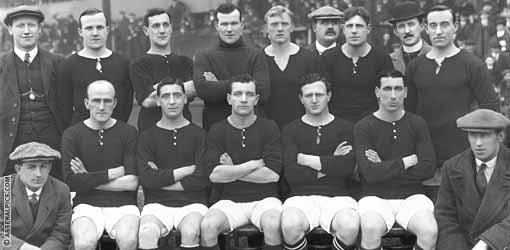
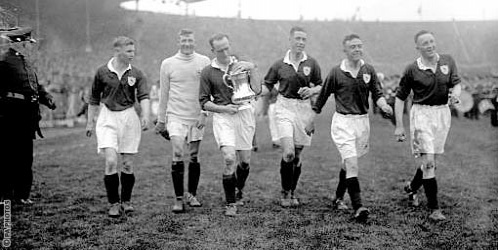
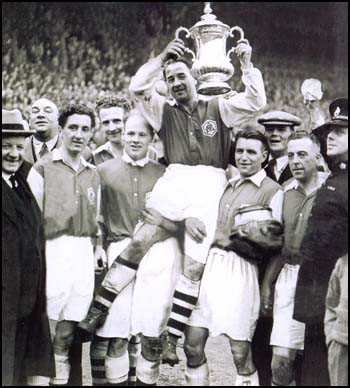
If that is not to your taste, how about the 1930’s which, under Herbert Chapman, began with a famous 2:0 FA Cup Final win over Huddersfield? That was the start of a sublimely successful era with some of the all time great footballers of that or any other era playing for us. Our cup winning team, that day in 1930, included Cliff Bastin, and Joe Hulme, celebrated wingers of contrasting but complementary styles, with both possessing deadly accurate crossing ability and blistering shots.

How about watching the Jack Wilshere/Liam Brady of those years; Alex James was a footballing genius, if there ever was one, despite wearing the longest baggiest shorts ever designed to embarrass mankind?  Other names to leap out of that team line up were Lambert Jack, and Hapgood. It would have been a joy to be there and witness the start of one of our most successful periods.

Another FA Cup Final victory came along in 1936 with many of the same names cropping up along with that of one of our all time best forwards, Ted Drake, who scored in the 1:0 Cup Final win over Sheffield United.

The decade was full of League titles too, commencing in 1931 and encompassing 1933, 1935 and 1938. Who would not have wanted to see that period through the eyes of those who lived through it?

Or, perhaps, you would prefer to experience the next key period for trophy success in the late 1940’s and early 1950’s when under manager Tom Whittaker we won titles in 1948 and 1953, together with another FA Cup win in 1950. From what I have heard of this era, following on from WW2, it was still a desolate time for many, and the football must have been a desperately needed opiate to make up for the post war drudgery.

The first Arsenal “Double” year of 1970/71 through to the current season is a period many of you were fortunate enough to witness first hand.

But would you not want to go back and again experience the excitement and euphoria of the trophy winning George Graham era?

In 1987, we won the old League Cup under George, and then in 1989 came that fabulous last minute, Mickey Thomas goal that won us the old First Division title, before we went on to win it again in 1991, followed by the League Cup and FA Cup double in 1993, as well as the UEFA Cup Winners Cup in 1994 with an Alan Smith special.

We all know that George’s teams, though remarkably successful, could not hold a candle to Arsene’s entertainingly skilful little ball players, and their style still leaves many shuddering at the thought of going back to it. But isn’t that what many fans are now calling out for. “Sod the style”, they say, “we want trophies” they yell. Well, first go back and look and remind yourselves what you might be letting us all in for!

Over the 40 years from 1970 until today, it has been possible to bask in the glory of the teams and see the brilliance of wonderful or charismatic players like Charlie George, Frank McLintock, George ‘the Stroller’ Graham, Denis Bergkamp, Thierry Henry and all the others, as we won FA Cups, League and Premier League titles and Doubles.

There are so many other times, games and players you might like to go back and experience first hand, not least during the changes that happened in professional football as a result of our own George Eastham’s successful court battle over players’ salaries.

Known for his short arms and deep pockets, how did his team-mates of the time, Joe Baker, Geoff Strong, Geordie Armstrong and Alan Skirton react? Did they play better as a result?

Yes, if a time machine was available, I would simply be unable to resist going back to see the stars and events that surrounded our wonderful club from its foundation in the 19th century.

There is such a wealth of history about Arsenal and you and I are all part of it!

So, how about you? What era would you go back to? What players would you like to see? And why?