Koscielny for Captain?

July 22, 2012

Koscielny to be our new captain, now that he has agreed a new five-year contract?

The Guardian has been reporting this weekend that Koscielny has agreed a new five-year contract, and if this is true then that is fantastic news.

With TV and Mertesacker already on long contracts, it should mean that we can finally expect some consistency in our central defence.

Over the last few days, we have discussed the importance of consistency in our defence, and it also became clear that most of us believe Koscielny is our best central defender at the moment.

I reckon Laurent would also make the perfect new captain for Arsenal, and if it is true that he signed a new contract – and the Guardian appeared to be very sure about it: “Laurent Koscielny, meanwhile, has agreed a new five-year contract”, then he will definitely get my vote.

For many seasons, ever since Vieira left, a great number of Gooners have been saying that Arsenal lacked real leadership on the pitch. Many of us are longing for the powerful, outspoken, ‘heart on the sleeve’ leadership during the years of Adams and Vieira. Henry and Fabregas were brilliant at leading by example but most of us felt something was missing: they were not naturally born leaders and as a result were struggling with some vital aspects of leadership we were craving for.

Robin van Persie was a fantastic captain last season, however much it pains me to say that. But, even if he were to stay, which is very unlikely now, he should never be our captain again.

Arsenal is desperate for a new, very capable leader on the pitch. A good captain leads by example, is extravert on the pitch, can galvanise a team when we face adversity, is an excellent liaison manager between the management and the rest of the squad, has authority and diplomacy in dealing with discipline issues on and off the pitch, and plays for Arsenal with total conviction.

I reckon Koz has all these qualities, although he might have to develop one or two once he has become our captain.

You are invited to vote for our new captain at the end of this article. To help you make up your mind, I have summarised below the key characteristics, as I see them, of good captaincy of our beloved Arsenal.

A good captain:

• Leads by example: not just with good personal performances, but also with high energy-levels/commitment, and a never-say-die attitude. He never spares himself, always gives everything and plays with his heart on his sleeve. He will also stand up for his players and let nobody be bullied by the opposition;

• Is blessed with a high level of social-emotional intelligence: he understands what is going on inside other players, and is able to support them accordingly, on and off the pitch;

• Is extravert: he is not a constant shouter, but he likes to talk to this fellow players and make himself known when things are not going right;

• Is a great communicator with the crowd/fans, and an ambassador for the club. He understands what the fans want and are concerned about, and gives good interviews to the press, by always representing the club professionally and with real passion;

• Is a great ‘liaison-manager’ between the players and management. He has got the respect of Wenger, the coaches and the players, and is able to translate messages, up and down, and down and up, effectively;

• Is a team player/ team builder: he will regularly praise, on and off the pitch, contributions made by others and helps the team in becoming a strong unit.

A new captain should also be on a contract that has at least two more years to run, and ideally more than that. It should also be a player who has a passionate, rather than a calculative, commitment towards our club: one who is likely to stay for a long time.

Luckily, we have a number of candidates for the captaincy role, and I am sure, we will all have our preferences.

Please, feel free to elaborate on your choice for captain with a comment.

Thanks for taking part!

TotAl.


No team has won the Premier League without a centre half.

July 20, 2012

Can a team win the prem without one?

To start a debate on this subject we need some caveats and small preface questions;

What’s the difference between a centre half and a central defender?

Is it only a case of different names for the same position? Am I engaged in nothing more than semantics? Are there actual differences in playing styles? And if so from where does the difference arise?

In the land where football began the defensive back line consists of full backs and centre halves, or centre backs, on the near continent those playing in the traditional centre half position are known as central defenders. Now is this just a case of you say “tomato” (American accented) I say tomato (English accented)?  My summation is “No” its not only a serious question it goes to the very heart of why our defence has been so leaky, and moreover its at the core of why we haven’t gotten our hands on any of home made silver wear recently. I’d go even further and state until we have a centre half in the back line winning any of the 3 home grown competitions may prove to be beyond us. Why do I say this? Well………..

Football on the near continent is primarily played full square on the ground. The leagues of real significance as we all know are in descending order The Spanish, Italian and German. That’s not to say the others aren’t important, we as a club for example have imported widely from outside of these three biggies. France, Holland and Belgium have served us very well with their player offerings. Of the three big European leagues only the German league has any form of aerial bombardment included in its play and even that doesn’t compare with the type of play so often seen in the premier league. In Europe the English Premier League is seen by many Europeans as the most exciting league to watch, with its fast paced all action helter-skelter style, but the league is also seen by many of the same, as the least tactically aware. The kick and rush style with long balls played over the top isn’t a tactic you’ll come across on the continent, and as stated above the type of aerial bombardment that’s common place in Britain is not elsewhere. So this is where the divide begins.

A typical centre half in Britain is raised with this style of play and has developed a way of dealing with it which differs greatly from a typical European central defender. What’s the difference? To answer this question I want to go back to our last great league winning defence. It wasn’t inherited as some of the uninformed like to put forward, it was built by Arsene. It contained the recently retired Sol Campbell. A more typical no nonsense centre half I submit it would be hard to find. What was the secret of this defence? Sol’s Head! Play a ball in over the top and Sol would beat whoever its intended target was and “head” it back where it came from. Fire a ball into the area from a set piece and rest assured if the keeper didn’t catch it Sol would “head” it away and out of the danger zone. I lost count how many times this would happen in games.

It’s actually in the manor that a CH will move forward and attack the ball that significantly shows the difference in approach between the two types of player fulfilling the same role. CD’s instead of moving forward to attack a ball will wait stationary, or move back to give themselves room to bring the ball under control. What does a typical central defender do that’s so different? European central defenders have developed a style of play to deal with long balls played over the top. Their natural instinct is to allow the ball to drop to the ground and immediately bring it under control, and play it out from the back turning defence into attack. What’s wrong with that I hear everyone ask? Nothing! Absolutely nothing! Except in the fast paced rough and tumble of the premier league as the typical CD lets the ball drop he’s liable to have one or two of the opposition all over him like a rash. Which if its inside his own area is very dangerous and so makes playing the ball out from the back very difficult, our centre halves are raised with the idea that if the ball lands at your feet the best way to play it out from the back is launch it into row “Z”.

You see teams who play long balls over the top (think of everyone favourite Stoke) tend to rush forward and crowd the box. It’s also often been a strategy successfully employed by Taggart & Co especially in the last 15 minuets when they are either behind or desperate to force a win. Bringing up the infamous Taggart aka Sir Alex Ferguson reminds me to add a caveat. Are there any Grey areas in this Centre Half Central Defender divide? As with most things in life there most certainly are as illustrated by an ex charge of Taggart’s Jaap Stam. A central defender who played more like a centre half than most centre halves, JS as a player wasn’t particularly mobile and certainly couldn’t be called quick, but he was very strong and determined and he read the game well, and he had that trait that a centre half just has to have “A head” and Jaap Stam headed more balls away from Man U box in the 3 short years he was with them than anyone else.

This brings up a further observation why did the Campbell Toure partnership work so well? If a CH is so important why not have two? Well let’s look at how the partnership worked. A long ball gets punted up field towards a target man normally a centre forward whose job it is to nod it down into the path of an on rushing midfielder or attempt to bring it under control and hold it up while reinforcements arrive. As it’s in flight and on its way Sol sees the danger and jumps in sync with the striker. Now either he wins it out right in which case the ball is on its way back where it came from or he misses it but with Sol’s help so does the striker. If they both miss it behind them as the ball drops to the ground Kolo T mops up. Again I can’t even begin to calculate how often this sequence took place, but if we could bring up those stats I’d hazard easily more than 10 times per game.

After going 49 games unbeaten with this defensive system why wasn’t it continued? It was! I think most of the top teams analysed how and why Arsenal had been so successful and emulated the formula. I think we as a club were the only ones who didn’t; perhaps we were too close to the action. I’d say our system was most successfully copied by everybody’s favourite player of the moment John (I isn’t a racist is I Cashley) Terry and his defencive partner Ricardo Carvalho at Chelsea. Taggart successfully employed the Ferdinand Vidic model. While most recently the CH CD combo was still being work by Lescott and Toure (again). Why wasn’t it continued at Arsenal? Well Sol left for Portsmouth under strange circumstances i.e. his “Head” wasn’t on straight? Too much pressure, or whatever, and we’d ended up with William Gallas by default as a result of the Cashley Cole affair. In other words without much analysis we went with what was available to us.

The upshot of which was we suddenly had two European style central defenders in our back line and were without a centre half for the very first time, in our clubs history. The rest as they say is history! We had one of the least effective defences in the league. Without realising it, or even meaning to Arsene had proved a point about two CD’s and the Premier League. Many said the previously oh so dependable Toure just couldn’t play with Gallas. Not exactly true, played together on Tuesday or Wednesday nights in the CL they were fine, but the combination didn’t work for the Prem. How could it? Without a centre half to relieve the pressure on both the keeper and the defence in general our defence was suddenly under the microscope. If the keeper couldn’t replicate “safe hands” Seaman and collect high balls we would be pressured into conceding, and we were. We became the team that couldn’t defend set pieces and that perception lasted until very recently. In point of fact I don’t think we are particularly strong on set pieces even now. We did have a respite though when for a short period our defence was bolstered by the returning old Mr Campbell. In that short interlude our leaky bucket defence became almost water tight again, and I looked forward to the following season, knowing once again we might have a chance at the title, fate however would cruelly intervene. Sulzeer Jeremiah fell for and married a Geordie Lass and moved north so she could stay near her roots. (Love will do funny things to a man) I blame that bloody Woman! She probably cost us the title. Mind you I blame my wonderful “better half” whenever I can’t find a pair of socks or a clean shirt. Yes I admit it I’m a dinosaur.

What’s to be done? Well…………First off try to remember that successful centre halves or successful central defenders come in pairs, so partnerships have to be formed. Next up a very quick analysis of our current defenders. (With the centre half central defender debate firmly in mind).

1) Let me start at the furthest end of the spectrum by saying there are in the words of the song “reasons to be cheerful”. We now have for the very first time in an age a proper British style centre half in the squad. Step forward Kyle Bartley, he may well be only a prospect but at least we’ve got one. Why am I happy about this? Well I’ve followed KB’s progress and as this article expounds I’ve wanted a CH back in our squad for an age. I’ve wanted KB to be promoted into the first team for an age. He might be unproven in the Prem but at least we’ve got him. I hope he can be paired up!

2) I want to continue with the much maligned Johan Djourou. JD is a little bit of a hybrid he’s neither a centre half nor a typical central defender. That might be because he’s Swiss? I honestly haven’t seen enough Swiss football to know if there are any reasons for a player to develop CH tendency’s in the Swiss league. He can and does do a bit of both. When partnered with Le Kosh he immediately played more of a CH role heading everything he could. JD was a successful defender for us, as the stats show when he wasn’t played out of position and partnered correctly. Every team needs 4 CH/CD’s and I’ll be saddened if he goes although like RvP his injury record reads like a hospital casualty department list.

3) I’m choosing Vermaelen next simply because like JD is a bit of a hybrid and KB apart the closest we have to a CH he attacks the ball in the manor of a CH certainly not like a CD. You find TV5 running forward to jump and meet an incoming ball in the manor of a CH. However he also plays in the typical CD style by playing out from the back, which probably comes from his Ajax background. When fit he’s probably currently our first choice centre back.

4) Laurent Koscielny is the most typical Euro style CD we have and he is probably the best CD any of us have seen at the club. His intercepting skills are a joy to watch and if he had a CH of the quality of our dear old Sol partnering him we’d probably have the best defence in the prem. That’s how highly I rate him.

5) The BFG? I just don’t know I haven’t seen enough of him in an Arsenal shirt to really make a judgement. He’s not a CH and he seems to be a one off CD.For a big man I’m yet to see him attack an incoming high ball. He’s worryingly slow for a modern day CD because since the changes took place to the off-side rule (Passive – Active – 1st phase 2nd phase). Neither Tony Adams nor Bouldie would be deemed quick enough and the BFG’s slower than them. He does have some admirable qualities as a defender though, he’s bloody big, strong and therefore intimidating and he reads the game well and it seems he can marshal the other defenders. For me the jury’s still out.

Written by richie


The Arsenal-Milan Hybrid – a new tweaked strategy next season?

June 30, 2012

Written by Sagar Tarkhadkar

The recent signings of Monsieur Giroud and Herr Podolski has excited Gooners all over the globe. Providing we keep our Captain Vantastic , we will have a fearsome attack consisting of 3 strikers who contributed to approximately 114 goals in the 2011-12 season. Add to that the pace and directness of Walcott, the dribbling, mesmerizing feet of Gervinho and the technique and youthful exuberance of the Ox, and we have a versatile front three providing an array of attacking options suitable for any kind of opposition on any given day.

However, a lot has been discussed about our midfield options ever since Fabregas and that ‘chinless guy who sits on the bench’ departed last season, in addition to the Wilshere injury. Honestly, Arteta, Song, Rosicky, Ramsey have done admirably well to steer our boat through the dark, muddy waters and get us to that 3rd place finish. But it is a known fact that to compete for the title and CL, we need an additional midfielder in the middle of the park, and as such we have been linked to defensive as well as attacking midfielders in the past couple of months. I won’t certainly speculate as to which specific player we should sign and we shouldn’t, because I feel that Wenger has a better idea than all of us as far as benefit of the team is concerned. But I would certainly like to contribute an idea, which I feel Wenger might implement next season, given his affinity for versatility he likes in his midfielders. I give you the Arsenal-Milan hybrid:

Arsenal for the past few seasons have played with a 4-2-3-1 formation, which can double up into a 4-3-3 or a 4-5-1 whenever needed. Most of the attacking play goes through a central advanced playmaker, and two wingers who dash into the box, along with overlapping wingbacks. This attacking formation is generally supported by two central midfielders, one who is a box to box type, while the other who is more like a destroyer or a pivot as some like to call it. The main idea is to keep possession for as long as the playmaker finds a chink in the armor and provides a defense splitting pass to the strikers. The pivot shields the defence whenever the fullbacks bomb forward.  The evolution of Song, from a destroyer to a more complete rounded midfielder has opened up a plethora of possibilities that Wenger can exploit next season. Given the rumour that Wenger is in the market in search for a defensive midfielder so as to exploit Song’s attacking instincts, and the fact that Wilshere is well on his way to fitness next season, we certainly seem to have an embarrassment of riches in the middle as we have them upfront.

Ac Milan generally play with a 4-3-1-2 formation in which the advanced playmaker/centre forward is shielded by 3 defensive midfielders, one of which doubles up as a deep lying playmaker(regista or the Pirlo role). This provides more stability in the middle, but somehow it lacks the width which can be exploited more in the English game.

In case we do sign a proper defensive midfielder as rumored, we can see Song/Arteta , the new CDM and Wilshere/Arteta lined up in the middle next season, which can offer us more stability in the middle of the park and help us boss the midfield . This is also favorable for the defence which leaked in 49 goals, most of them on the counterattack, due to Song’s and Vermaelen’s adventurous forays forward. As far as the playmaking role goes, instead of playing a proper trequartista, we can play two deep lying box to box playmakers who will share duties of both attack and defence, while the pivot maintains balance in the middle. We already have 4 apt midfielders of that box-to-box quality in Jack, Song, Arteta and Coquelin. In addition, we are fortunate enough to have someone of RVP’s caliber, who can mostly double up as a false 9, fall back and provide assists for Podolski and Walcott who can cut in. Giroud’s addition on the bench allows us to switch to a more attacking 4-4-2 in case we need to chase a game, as well as it provides RVP some rest. It also allows us to switch to our original 4-2-3-1 with Giroud as a target man against a few lesser teams.

On the attack, both the box to box players can playmake, keeping possession with the pivot. The wingbacks can bomb forward and switch with the wingers who can cut inside. On defence, all three midfielders can clog the centre thus cutting off all channels of the opposition attack, and then on the counterattack, RVP can fall back, thus temporarily switching to the Milan formation and allowing Podolski/Walcott to be temporary strikers in the box. The main idea is to always keep the pivot available to shield the defence and gather possession, forcing the opposition to make turnovers and avoid any counterattacks. Also, I feel that if we have a single playmaker as we do now, opposition can crowd him out thus making our attack impotent(as they did with Fabregas).

What I am suggesting is that we do not need to change our formation altogether but just tweak it a bit. Wenger likes playing to our strengths and as I mentioned earlier, we are fortunate enough to have many players who are versatile enough to play in more than one position admirably (RVP,Song, Arteta,Wilshere,Oxlade) Our already fearsome attack, but with a sprinkling of the Milan solidity will certainly help us win a few titles and put a smile on all Gooners’ faces. This is my first attempt at writing a post about the team that I love and I hope you all will certainly share your views on it.


Fundamentals of Football

June 29, 2012

I have decided to write this piece in a bid to react to what really makes a good football player (Reactionary to “is this the time to sell Walcott?”) particularly when it comes to delivering in the required playing position. I believe the knowledge of the facts of an issue will result in better formulation of opinions.

The fundamentals of football relates to the following:

1. The Player

2. The Team

3. The Formation

4. The Positions

So we will consider the fundamentals of football within the spectrum of these four key aspects

1. The Player

There are basic requirements needed for an individual to qualify as a football player.

a. Ball Control: Ball control is primarily the ability to position a ball such that it favours the overall objective of getting a goal. In other words, to get a goal, a player must be able to receive a pass, make a pass and shoot at goal. Basic skills needed here are Foot Control of Ball, Chesting, Heading (Nodding), Kicking (Shooting), and Movement (Running, Jumping, and Sweeping)

b. Ball Possession: In the event where the opposition has the ball, a player is required to possess the basic ability:  technical or physical or both to dispossess the opponent of the ball for the purpose of gaining or regaining possession. For example Marking and Tackling

c. Team Play: when it is a game, it only means there is more than one. There is no such game with only one person involved. At least there must be the player and the coach, and in this discourse, there are more than one and thus the necessity for Team play.

d. Knowledge of the rules.

2. The Team

The Team that will play football and win will have the following basic requirements

a. Desire to win: Since football is a game, it is just thus a fact that if there is no desire to win, there is no need to play. Of course somebody will say you can play for pleasure, but I dare ask ‘is there any pleasure in Loosing?’ Desire to win or lose will be betrayed by Urgency, Grit, Determination, Believe etc.

b. Tactics: There must be the development of a tactic to overcome the opposition.

c. Tactical discipline: The ability to see out a game according to tactics must be present in a team

d. Knowledge of the rules.

3. The formation

The fundamental requirements of any formation are

a. Departments: Ranging from Defense, to Mid-field, to Attack, A formation must possess those three. Each of these three may be sub-divided to accommodate details (Positions).

b. Balance: To assist in the overall objective of overcoming the opposition, the team must be able to achieve result without any department faltering.

4. The Positions

Each Position in The Department, in The Formation and in The Team defines qualities that are fundamental to The Player. Therefore, taking the fundamentals required from a player and defined in the position the player must play are here listed

a. Defense: Stamina, Tackling, Vision, Swiftness, Link-up play, Game Reader

b. Mid-field: Stamina, Tackling, Vision, Swiftness, Link-up play, Hold-up play, Distribution, Dribbling, Game Reader.

c. Attack: Stamina, Tackling, Vision, Swiftness, Dribbling, Finishing,

Considering these fundamentals, to succeed at the top top level like Arsene will normally say, A player must possess all the afore mentioned qualities in degrees that qualifies him as a professional and additional qualities that distinguishes him for the position, for the formation, for the team and also not forgetting for the opposition. In reacting to if Theo Walcott is a necessity or a player Arsenal should do away with, I think we need to consider what Theo has that is peculiar to him. Speed, Penetrating run, Accurate pin-pointed cross-in (Grounder or Lofted), and lately superb finishing, I think he is a player suitable for teams playing Highline or generally lack tactical and positional awareness. Also, considering he is 23 years old, I think it is only logical to allow him develop other innate skills that a player can only get as he ages and hope he turns out the kind of player that can show up for any kind of opposition.

I believe with these submission, we can fairly assess a player and determine if he is suitable for Arsenal or not.

Thank you.

Written by Timmy


Robin van Persie – one of the best No. 10’s

June 27, 2012

“Because he[RvP] is one of the best no10’s in the world” – Van Marwijk.

The Dutch national manager Bert van Marwijk opted to play RvP behind the striker, in the no10 position, against Portugal last Sunday. He was desperate to turn things round and for once he gave in to the strong calls in Holland to play Huntelaar, the Bundeslega top scorer, and RvP, the PL top scorer, together up front.

It was a daring decision to put RvP in the no10 position. Holland has a few players who believe it is their god-given right to play there, and can become very disruptive if they are being played elsewhere, or even worse, being placed on the bench. During the last World Cup, the likes of Sneijder and van de Vaart have competed aggressively and publicly over who should play in the position that is simply the Holy Grail for any aspiring Dutch attacking footballer.

When Van Marwijk was challenged during a press conference over the debacle against Portugal – the third game they lost in succession, meaning they had to leave the tournament with nil points, after setting themselves the highest possible target – the journalists were keen to find out why the manager had opted for Robin van Persie in the hole position, at such a crucial game. Van Marwijk’s answer was typically short and to the point: “Because he is one of the best no10’s in the world”.

Robin van Persie might have been chosen for the no10 position by the manager, but that does not mean anything; so it appeared. He got no service whatsoever, despite making himself available continuously. Van Marwijk also played Sneijder (left midfield) and vd Vaart (central midfield) and it was simply asking for trouble. The Dutch team had no shape, except for the first twenty minutes or so, and there was hardly any cooperation, desire to make the runs, to close down, or to simply work for each other.

An utter disgrace and I feel truly sorry for the likes of Van Bommel and Matthijsen who now lost out on their last chance to win a major tournament with their national team. Van Bommel has been the physical and mental glue for the Dutch national team in the last few years, but he simply could not drive the team forward anymore; with very dire consequences.

I am sure we will hear more on this in the next few weeks, but I wonder what our Boy Wonder is thinking about it all at the moment. I reckon he will be gutted as this was a golden opportunity for the Dutch team, and him, to win a major trophy. The Dutch will have to rebuild now and it could take another twenty years before they reach a final of a major tournament again.

What is an exciting thought, though, is whether Robin van Persie is indeed one of the best no10’s in the world.

Dennis Bergkamp has said on a few occasions that the ‘Shadow Striker’ position would be ideal for RvP. It looks like Giroud has been bought by Arsenal, and he would be a welcome addition to the earlier purchase of Podolski. And if so, two new strikers of good quality will have been added to the squad. They are the sort of players who should fit in straightaway and can make a real difference.

Apparently, Arsène believes Podolksi, Giroud and RvP can play together up front, and as per LB’s post a few days ago, this would leave us with an embarrassment of riches in our attacking positions. How is Arsene going to fit in the likes of RvP, Podolski, Giroud, Theo, Arshavin, Gervinho, Chamakh, Park, Vela, Ryo, Campbell, and the Ox?

So, there can be no doubt that a number of the above players will be sold or loaned out before the end of the transfer window.

For a long time, I was convinced that RvP was going to stay at Arsenal. But the lack of clarity after his ‘informal’ meeting with Arsene and Gazidis before the Euros, has made me doubt again my earlier optimism.

Clearly, the meeting between them is, and might always be, a black box for us. But if we take the premise that RvP indeed loves Arsenal, and would like to stay if he feels the club has done enough in the transfer window this summer to be a serious competitor for the title and Champions League, would the offer to Robin to play in the Nr10 position not be a major selling point – the icing on the cake? I think it would.

And with him moving into the hole position, Arsenal need two proven strikers for the 50+ games we will play, in order to cover adequately for suspensions and injuries. The likes of Park and Chamakh have not convinced since they joined us and Theo, Vela and Campbell are probably not (yet) of the quality required to really make the top striker position a great success next season.

It seems conceivable that RvP will have asked for proven quality additions, and in Podolski and Giroud Arsenal have just done that.

Of course, there is still a good chance that Arsenal have simply been more pro-active this summer and that Giroud and the Pod are direct replacements for RvP and Chamakh, but I don’t want to think like that, yet.

The thing is, RvP did not just become our top goal scorer last season, but as a captain he has also injected a new spirit; a new culture into the team. This would be very hard to replace and I just cannot imagine Arsene taking it lightly. If RvP leaves we would be in another transitional year again, and we would run the serious risk of becoming a club in perpetual transition. I believe Wenger is a very ambitious man and is fully aware he needs to start holding on to his top players, if he ever is going to win something again. I also feel the club has entered a new (financial) era now.

That’s why I believe RvP will not (be allowed to) go this summer, even if he does not sign a new contract. Even the BoD will realise that cashing in on RvP will not be a wise decision this time round.

It seems to me very likely that RvP will be played in the shadow striker position next season. It will be interesting to see whether Arsenal will play 4-2-1-3 again or whether we go for 4-4-2 next season.

The latter formation might suit RvP more as I don’t think he is a natural playmaker, with great overview and in possession of an array of deadly through-ball skills. He is neither a Dennis Bergkamp type of player, nor a Cesc Fabregas type, and I think he will be a nr10 player ala Rooney at Manchester United (in terms of type of player), but only better of course LOL!

He would be absolutely deadly in that position and we would significantly improve our tally of goals from outside the box next season. He would also be closer to the midfield and therefore better able to captain his team.

I would love to see RvP in the nr10 position and I believe Van Marwijk is a top quality manager, who has a close relationship with our captain. If he thinks RvP is one of the best no10’s in the world, then I am not going to disagree with him.

And I think it is all part of a master plan by Wenger to keep our Boy Wonder happy and hungry at our beloved Arsenal next season.

TotalArsenal.


Arsenal Question Time

June 23, 2012

Morning all. No surprises last night with Germany progressing to the semi-finals. I wasn’t sure they wanted it until Greece equalised but then they went about their business with a typically cool Germanic air to break the Greeks hearts. They will be hard to beat.

To fill in some time before “life” starts again, on August 18th when we play Sunderland at home, GunnerN5 has set the following quiz to test  your knowledge on Arsenal history.

1. Q. How many times have we appeared in the FA Cup Final?

2. Q. How many times have we won the FA Cup?

3. Q. What season did we have the most wins – and how many?

4. Q. What season did we have the least wins – and how many?

5. Q. What season did we have the most losses – and how many?

6. Q. What season did we have the least losses – and how many?

7. Q. What season did we score the most goals – and how many?

8.   Q. What season did we have the least goals against – and how many?

9.   Q. What season did we get the most points – and how many?

10. Q. How many seasons did we play in the 2nd Division?

11. Q. How many seasons did we have in the 1st Division?

12. Q. How many seasons have we played in the Premier Division?

13. Q. How many games did we play in the 2nd Division?

14. Q. How many games did we play in the 1st Division?

15. Q. How many games have we played in the Premier Division?

16. Q. How many consecutive seasons have we played in the top flight?

17. Q. How many people have managed Arsenal?

18. Q. How many total trophies have we won?

19. Q. How many of our managers have a winning % above 60%?

20. Q.  How many of our managers have a winning % below 50%?

Have fun and good luck, we’ll put the answers up later today.


What is Arsenal?

June 20, 2012

I spent too long on Monday explaining how little as fans we really know our team. Instead I tried to emphasize the anomaly that the club is, in a league of slightly predictable anomalies.

We know what Man United is. We know that when we look at the parts of the machine, there are few players in that team we would like over ours. We could say the same about Chelsea and City, Spurs and Newcastle and so on. Actually, I bet out of all of the above teams, the most players we would want from any one team would probably be Newcastle – which is strange no?

We know how City, United, Chelsea and ourselves will get on. We know how Stoke, Everton, Liverpool and Villa will do. We know because like Malcolm Gladwell writes in Blink, “The key to good decision making is not knowledge. It is understanding. We are swimming in the former. We are desperately lacking in the latter.” Or, “We have, as human beings, a storytelling problem. We’re a bit too quick to come up with explanations for things we don’t really have an explanation for.” Or even, “being able to act intelligently and instinctively in the moment is possible only after a long and rigorous of education and experience”

If you haven’t read it, it is worth a go as it makes sense a lot of the time. As does his book Outliers and The Tipping Point. All lend themselves brilliantly to analyzing, or at least appearing to analyze sport. In Outliers, Gladwell’s premise is that to be extremely good at anything, to be regarded as a genius in your field, you have to spend 10,000 hours practicing that activity as some kind of apprenticeship. The funny thing is, if we start supporting from an age of 8 or so, and we think about football on and off for 4 hours a day, we will have completed our 10,000 hours by the age of 15! And what the hell do we know at 15? Certainly what do we know about football? Have you ever heard teenagers argue about football? It is like listening to chimpanzees fighting. So therein lies the rub. We have hundreds of thousands of over-qualified experts, unheard in the melee of genius-turd, spouted off like some Sony Bravia advert in which we are both the paint and the sprinting clown. Football is the boring block of flats.

You see the thing is, we have no idea what we are talking about. None. Even football managers and players talk a bad game. They might tell a good story, or be able to explain some interesting insight into why circumstances transpired in a favourable or unfavourable manner based on a decision they made or didn’t make. But the one thing they don’t get any better than us, is the meaning and qualification of what it is to be a football fan. So they need to do their job without acknowledging us or they end up sinking to our level. We all have strange and lucid gut feelings based on the hours accumulating meaningless and trivial facts and bias that bring no reward to our lives. Most people do things/work on areas of themselves to make them seem more attractive. The generating of football knowledge is not one of them.

We give ourselves over to something weaker and more secretive than religion. There is a flexible and odd moral code that can bridge the disgusting (I’m thinking of the songs about Adebayor and Hitler being a Gooner because he killed Jews), to the amazing (Muamba, the pre-match laying of flowers by the Arsenal players at Anfield ’89).

The amount of time we spend trying to think things through is directly at odds with our real feelings. Feelings about a Wenger who mirrors the worst in all of us. His inability to budge from his self-belief/opinion, his myopia to suit his needs, his devotion to that which he truly cares about (parity within pay and stability/family life within the group). All of these things are things we see or believe we see in ourselves. Much of that which we love or hate is mirrored in our own beliefs and failings. Why should football be any different?

Anyway, I digress. What I am trying to explain, is that the game itself and the ritual around it are two very different things. One is steeped in tribalism, camaraderie and emotional abandonment. The other is the achieving of immediate objectives based on the qualities of one team to try to beat or hold another team. I am going out on a limb and assuming few teams go out to lose (in any sport).

So then we have the challenge of what makes a fan, set against what makes a professional footballer. From here on in, the links and comparisons could decend into the hilarious. I apologise if I let go of the reins. If I do, this will be both in surrealism as well as experimental sentence structure.

An English fan is an amalgam of branded clothes and sportswear, beer, regular (if unreliable) sources of opinion and conjecture, spurious recollections of the past and projections for the future. A studied and dissonant rabble of solipsists resembling the French Foreign Legion and in the main, suffering some type of physical and psychological atrophy. (Woooah horsey!)

The fan reacts on the hoof and thinks in detail at a later stage. The fan loses all sense of discipline because the abandonment is the drug that invigorates a meaningless and often one-way faith. The real fan doesn’t care about their self-image, because they have long-since recognized that they come a very distant second to the physical demands in the overwhelming emotion that is blind faith.

The quality player is (mainly) fit, disciplined, single-minded, aware of their duty and the impact it has on a team, a good decision maker and able to do so in an instant under stress/pressure.

Why have I spent so long trying to establish this? Because Arsenal is a crazy anomaly that occasionally tries to play like the crappiest fans (8-2 L), but let themselves down by reluctantly and more frequently resorting to skill (5-2 J).

So much as I would like to talk about the merits of Arteta, Wilshire’s absence, defensive indiscipline, us being a selling club and so on, I find myself having to justify why I want to talk about it in the first place. For all the tactical inefficiencies and genius displayed by the various factions of the team, I find myself worryingly overcome by my own fits of rage at the inane, docile, simian and discombobulated expressions too often worn in recent times by the likes of Eboue, Vela, Almunia (who always looked like a homeless person caught defecating in a backstreet), Djourou, Song, Arsharvin, Clichy, Chamakh and so on and bloody so forth.

With that in mind, caring about whether van Persie stays, or if Podolski will be a hit almost seems meaningless. The amount of time we have invested in our madness has already elapsed and taken its true form. The delusion that success on the field, will bring the fan some kind of moment of clarity is as nonsensical as manufacturing and using a home-made catheter when your junk and bladder are in perfect working order.

Man United fans are miserable. Man City fans have been and are already miserable. All fans are bloody miserable because it is that state of being which we enjoy. We just tend to confuse it with thinking. The temporary elation in success brings us worryingly close to a realization that the meaning of football is to chew us up and spit us out. Results and achievements are ephemeral and the solipsism of the fan is what it is really all about. Wenger and his strange habits show he is human and suffering his own madness. Good. Serves him right.

Written by fergalburger


The problem with refereeing – A SIMPLE SOLUTION

June 14, 2012

I have read countless commentaries, posts, even complete blogs dedicated to finding a way to ¨fix¨ what is ¨wrong¨ with modern Football. Apparently many of the proposed solutions all have one thing in common and that is their requirement to either change or adapt the Laws of the Game in order to ¨improve¨ the likelihood of fairness and ¨eliminate¨ the hazards of referee incompetence,bias or poor form and to promote a more ¨level¨playing field.

While this paradigm may have some merit, the focus of my post is to suggest that, before changing anything, we need to enforce one simple solution that would create the groundwork needed to make a big difference in how the game is played. That solution is to apply the Laws as they were meant to be applied and to enforce them within the powers accorded to the officials. Doing this will ensure that players begin to respect the spirit of the Laws and not just the letter, recognize the authority and primacy of the referee in applying those Laws and begin to realize that diving, cheating, harassing and play-acting are NOT acceptable grey areas and loopholes in today’s Game.

Let me provide some basic examples of how the officials fail to enforce the basic Laws and permit a certain laissez-faire attitude to infiltrate the Game:

1) Free kicks – as most Football lovers know, a direct or indirect free kick requires that the offending team must keep a minimum of 10 metres from the ball unless the team awarded the kick chooses to take it quickly and without the referee’s signal (or it is in the goal area) and the ball cannot be moved away from the original spot where the foul occurred, yet this happens ALL the time. When I hear the idiots at EUFA and FIFA whine about video replays taking too much time, yet they tolerate the referees being forced to spend up to 2 minutes or more to setup the 10 metre distance like a parking attendant aligning cars, then I ask where the problem is! Most referees try and enforce the Law and punish encroachment but many just let the kick be taken to get play on. We do need to see officials enforce the 10 metre rule as they do for a penalty.

2) Corner kicks – How many times does the kicker place the ball over the corner circle,despite the linesman being right there? Out of 18 corner kicks I have seen taken during the Euros only 2 were properly placed. It isn’t the 2 inches they gain that makes a difference, it is the flaunting of the Law with the officials turning a blind eye that makes the difference.

3) The kick-off at the start of each half or after a goal often sees the team with the ball having a player half way over the centre-line, yet that is not permitted. The referee is right there and just turns a blind eye.

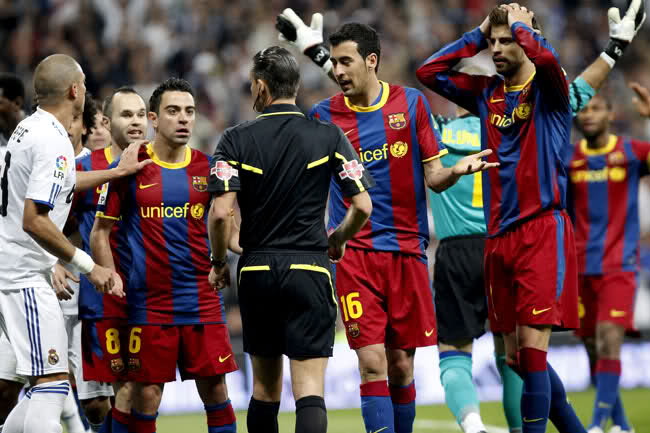
4) The referee calls a foul and suddenly he is surrounded by half a dozen players, usually from the offending team , harassing him (her) and trying to get their 2 cents worth in. Barcelona are famous for this and have made it a new art form called the Catalan cacophony!

5) Players taking throw-ins are another embarrassment. I watched 8 players in the Euros take illegal throw-ins and the linesmen and referee NEVER signalled an infringement!

6) My all-time favourite infringement, that is rarely called, is the dual foul of shirt-pulling and holding. Players in their penalty area, particularly on free kicks and corners, seem to want to exchange jerseys or get up close and personal with their opponents, whether the referee is watching or not, as the case may be. I have, as yet, to see a foul consistently awarded by any official for this clear infringement yet it is a serious foul at any time and anywhere on the field.

7) The goalkeepers seem not to have heard that they have a time limit to get rid of the ball once it is in their hands! I counted 4 different keepers in the Euros taking more than 15 seconds to release the ball into play! If they want to waste time, they can put the ball down and play it like any other teammate but they know the referee won’t hassle them if they saunter around holding the ball so they take forever to get in back into play.

8) I am getting tired of watching grown adult ¨professional¨ Footballers becoming drama queens when they get a tap on the ankle or the shin. They roll around and thump the ground like they were recently run over by a steamroller yet less than a minute later they are up and running like demons. This play acting should be restricted to the stage and punished for bringing the game into disrepute when it is clearly exaggerated.

I could go on but I think you all get the point? Officials and FIFA have the power to reduce or eliminate these breaches of the Law yet they permit such gamesmanship, all in the name of getting on with play or avoiding nitpicking. I remember when I spoke to Sir Stanley Rous at a dinner in honour of my country’s 100th anniversary in Football and what he said has remained with me to this day: ¨A good referee is firm but fair and applies the Laws of the Game with equal care to the letter AND the spirit of such Laws¨. We need more ¨good¨ referees don’t you think?

Written by weedonald

Thanks to weedonald for today’s post. The internet is populated by self appointed experts, but today’s author is eminently qualified to talk about the art of refereeing. Here is a brief résumé of his history relating to football:

With 50 years of involvement in Football at all levels, international, national and local as a referee, coach and organizer/administrator, I am a total addict. My profession as a school psychologist and later as a consultant in Human Resources, afforded me the time to get involved and stay active until my retirement in 2010. When my wife permits it, I still love to volunteer coaching little kids and to officiate the occasional match as well. I was involved a great deal in women’s soccer and was one of two in my country to create the first adult women’s league in my province. I am certified as a Class C Coach and a national referee as was also an NASL official for 5 years. I adore the Arsenal and consider Wenger, under the circumstances , to be the penultimate manager of any professional team in Europe. I also like the game Barcelona play on the field but less so off it. My nickname comes from my mother who was born in Scotland and always called me weedonald while calling my twin brother an unprintable acronym.


Has Arsène Finally Found The All-Conquering Formula?

June 13, 2012

Youth + Wenger-Gems + Established Quality Players =

The All-Conquering Formula! (But we need to hold on to our players….).

We at the Academy, feel that Arsene could have given some of the kids a chance and maybe put them on the bench and given them a run-out, especially in games where you’re winning 3-0, but I also understand he has to get results and he’s super-cautious.

Liam Brady – Head of Youth Development at Arsenal (at some time back in 2003, maybe earlier).
Recently, I have been reading ‘The Glorious Game: Extra Time’, by Alex Fynn and Kevin Whitcher in order to relive the early years of Arsene Wenger once more. The above quote by Brady made me realise again how different Arsene’s approach had been regarding creating, building and choosing his squad as well as his first team, back in the first half of his managerial time at Arsenal.

Nowadays, Arsene gets regularly criticised for putting his faith far too much in young players, for not dumping underperforming youngsters (quickly enough), and for not buying enough experienced, top-quality players. But back then it was quite the opposite, as young talents where given very few opportunities to break through into the core squad:

“The immediate future was shaped not by the produce of the Academy, but the manager’s activity in the transfer market. On one level, this predilection for experience was perverse as Arsene Wenger had been instrumental in the development of the Academy.” Fynn, Whitcher.

There is a strong belief among fellow Gooners that Arsene’s decision to start building his teams for a large part with the outputs of the Youth Academy from the mid-Noughties, was born out of necessity. The build of the new stadium meant there was very little money available for Arsene to buy the calibre of players he was able to afford before, and so he was left with no other option than to reap the harvest of Liam Brady and co’s hard labour at the Youth Academy, in order to somehow compete with the likes of Manchester United, Chelsea, Manchester City and a few others, whilst the financial impact of building the new stadium was being smoothed out.

Although I believe there is a considerable amount of truth in that view, I am also convinced that Wenger always wanted to build his team bottom upwards: manned by the best outputs from the Youth Academy and build around a philosophy/style of football that is quintessentially Arsenal – a variant of total football, based on a Wengeresque interpretation.

Wenger wants to build something at the club with longevity, with strong roots: a system based around a philosophy that will remain the foundation for future successful teams, for decades or more to come – perhaps comparable with other former great Frenchmen like Louis XIV and Francois Mitterand who had a similar desire to leave something behind for perpetuity – in their cases, through great building schemes: ‘Les Grands Projets’ as Mitterand liked to call them.

The Youth Academy has produced some very fine outputs in the last decade or so. For good order, I must state that I consider any player who joined Arsenal before the age of 21 as a product of our Youth Academy/Policy, whether it is Wilshere who was at Arsenal from a very young age, or Walcott, Ramsey, the Ox, or even Van Persie, who all joined Arsenal at a later age. The key principle is that Arsenal is always looking for players who can (still) be moulded into players who will fit very well within the Arsenal system/philosophy of football and subsequently become top class players.

Whether Arsene had no other option than to build his recent teams around our best talents, or whether he would have done it anyway, what we can say is that Arsenal is now starting to see the benefits of investing in the Youth Academy/Policy.

Despite Arsenal having had to sell/let go, for various reasons, the likes of Adebayor, Flamini, Nasri, Clichy, Fabregas, etc recently – an unprecedented loss of talent by a English top club in such a short period of time – the current core team still shows a strong representation of Youth Academy/Policy outputs: Szczesny, Song, Theo, Van Persie, Wilshere are all first team players now, whilst the likes of Gibbs, Ramsey, Coquelin, Jenkinson, Miquel and the Ox played a considerable number of games in the first team already, and are likely to become regular first-team starters in due course.

And there is more talent in the pipeline!

On top of the successes of our Youth Academy/Policy comes Wenger’s ability to buy a rare, and yet very affordable, gem. The so-called Wenger-gems are one of the main reasons Arsenal has been so successful since the arrival of le Professeur. Even in recent times, Arsene has been able to add a number of gems: Koscielny, Sagna, Vermaelen, and Santos come to mind, and he will always be able to find them. That is not to say he never gets it wrong, but that goes for every manager.

For me, the combination of a qualitatively strong output of our Youth Acadamy/Policy and Arsene’s ability to find very good players that nobody else seems to detect, is already a strong formula for success in the near future.

It is absolutely paramount though that Arsenal hold on to their best players as much as possible, and recent comments by Gazidis to review the pay-structure/policy in order to accommodate a number of players on high/competitive salaries, would make a big difference imho.

On top of the two above mentioned pillars for sustained success, Arsene seems now able to buy a number of experienced, quality players who might not provide the club with a substantial future sales value, but do add real and immediate value to the team. There has been a change in policy since last summer as, with the exception of Arshavin, Arsene has not been buying established, fully matured (26+ years old), quality players, for years now. You could argue that he seldom or never bought such players in the first place.

But, we have all seen the difference Arteta, and to slightly lesser extent, Mertesacker have made to our team this season, and it seems Wenger will continue down this line, as per the purchase of Podolski a few months ago. It looks like Arsenal continue to be in the market for one or two more established-quality players this summer, and there is a good chance that we will be able to continue this policy for years to come.

So here you have it:

Youth + Wenger-Gems + Established Quality Players = The All-Conquering Formula.

It is also the only acceptable panacea against the deadly poison of petro-dollars being pumped limitlessly into the game by you know who.

It is very hard, and it takes a long time, to replicate what Arsenal have set up with our Youth Academy, and it is also very difficult for our competitors to find a manager who can find affordable, yet very talented gems, like Arsene does. This sets us apart and very soon we will be able to reap the rewards we all have been longing for.

Once this formula starts working properly, it will be very hard for our competitors to catch up with Arsenal again in a fair and proper way.

Manchester United will probably be there with us for the foreseeable future, although it remains to be seen how AF will be able to cope with a reduced budget and stiff competition. The likes of Chelsea and Man City will do everything to stay ahead of us through shameless and limitless financial doping, but Arsenal will be a force to reckon with as a result of its All-Conquering Formula coming to full fruition.

The biggest challenge Arsene and Gazidis face now is convincing the likes of Theo, Song and RvP that the future is blindingly bright at Arsenal, and to get them to sign new contracts.

Let’s see what will happen during this summer and beyond, but there is every reason to be very positive about both our immediate and long-term futures.

TotalArsenal.

(With a big thanks to TMHT who, with his well-reasoned and never flailing belief in a bright future for Arsenal, has inspired me to write this post!).

And the truly great thing is that most, if not all, of the above players are likely to get better every year, and that so for the foreseeable future.


Arsenal win the Premier League for the 7th time in 10 years

June 6, 2012

OK, technically we’ve won the PL once in the last 10 years if you want to be pedantic – but my cunning handicapping system based on money spent in the transfer market has revealed that we’ve actually won 7 times and come second on the other 3 occasions.

Don’t worry, this came as quite a revelation to me as well – after all, some would say that we have under achieved recently under Arsène Wenger.

So how do I arrive at this astonishing conclusion? It’s quite simple; I am factoring our ability to compete financially with the teams that have finished above us into the equation. By now you may be sensing that my tongue is planted firmly in my cheek – and it is. But there is a serious point, in fact there are several serious points….. read on……

Here is my Financial Fair Play Premier League table for the last 10 years.

The ‘Position’ column on the right is where Arsenal should have finished if FFP (or actually my conveniently manipulated version of it) were in place. I have taken points away from every club that has spent millions more than Arsenal in that period = financial handicapping. We should, by right, be battling against relegation if our performance reflected our net spending in the transfer market.

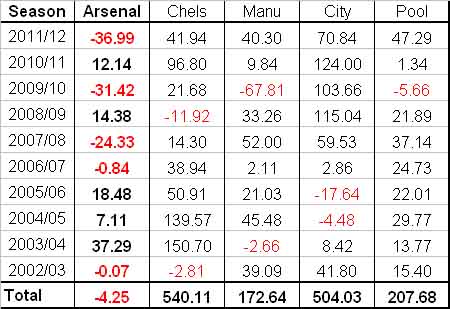
So what do I base this ludicrous assertion on? Well have a look at the comparative spending of the big 5 clubs over the last 10 years.

There is a mere half a billion difference between Manchester City and Chelsea and the Arsenal … and guess what, one won the CL and the other the EPL this season so I think we can accept that sooner or later big spending pays off if you judge success in terms of trophies.

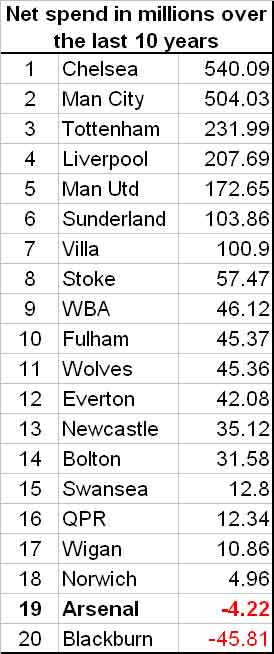
The table below shows the net spend of last season’s 20 Premier League clubs over the last decade. Arsenal is in nineteenth place with a balance of minus £4.5m.  Only Blackburn are below us. The real under achievers are Totnum who are third with a net spend of £232m and Liverpool in fourth with a net spend of £207m – and not a Premier League title between them to show for it. So maybe 200m is not enough, but 500m gets the job done. Or maybe those two clubs are just poorly run?

Even relegated Wolves have a net spend of £50m more than Arsenal over the same period and that with only a brief flirtation in the EPL.

Chelsea top the list. As everyone knows, they entered a new era when Russian billionaire Roman Abramovich bought the club in 2003, but they are run a very close second by Manchester City who were bought by the Abu Dhabi United Group 5 years later in 2008 and will undoubtedly outspend Abramovich over the next few years.

The statos amongst you will no doubt correct me on some of my figures but what I think everyone can agree on is that Arsenal cannot compete with City or Chelsea in the transfer market. Usamov is currently not in a position to inject his millions into Arsenal and I for one hope he never is, but that is another debate.

Personally I am very sceptical about the effect of the real FFP as I cannot see UEFA penalising the biggest clubs in the world in a way that would encourage the formation of breakaway leagues. However, I believe that Manchester United, Liverpool and Totnum will be reigning in their spending in the future and the two Spanish giants are almost certain to be affected by the impending crisis in the Spanish banking system.

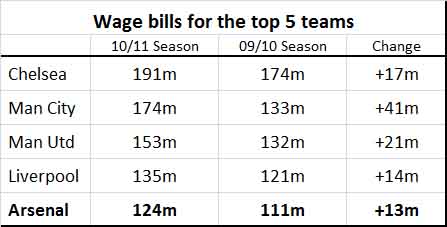
Like all arguments based on statistics, there is always another way of looking at things. In this case, the problem is that if I was to recalculate my version of the FFP table and to base it upon expenditure on wages instead of net transfer spending, then Arsenal would not rate as highly. In fact, if you based expected league position on wages alone, Arsenal are about where you’d expect.

The basic maths shows that we pay disproportionately high wages in relation to the amount we spend in the transfer market when compared to pretty much every other PL club (I haven’t checked the all). This policy was no doubt borne of necessity due to the costs associated with building the Emirates – but do we have to persist with it in 2012?

My hope is that we are rethinking our wage structure and some of those players who have been rewarded handsomely but failed to achieve the potential we saw in them, will be moved on this summer. If Mr Gazidis and his team (who quite frankly haven’t impressed me so far) can renegotiate some more lucrative sponsorship deals and increase revenue worldwide, then we should have the financial clout to fend off all but City and Chelsea in the domestic transfer market. We should also be able to reward our top players at the ‘market rate’.

The other teams with aspirations of being able to compete at the top (tots and pool) know that they have to build a 60,000 seat stadium to generate the income required – and as every Arsenal supporter knows, the true cost of that is 5 or 6 years of difficult transition and financial prudence.

Our footballing style and club ethos may be enough to make up the rest of the disparity between us and the super rich teams but it won’t be easy. The football hierarchy for the EPL has been set for the foreseeable future and Arsenal are in a great position to be the ‘best of the rest’.

It’s going to be an interesting few years ahead. The landscape of the Premier League has changed forever. The early portents for our future development will be revealed by this summer’s transfer activity. I believe we will inevitably continue to be a feeder club to the super rich teams but we should be the front runners in signing any player we target when we are not in competiton with the big spenders.

The big question is: will we continue with our current policy, or will we increase the amount we are prepared to pay for top players as our revenue increases?

Written by Rasp

Disclaimer: I gathered the stats reproduced in this article from what appeared to be reputable sources. The odd figure may be a point or 2 out but the overall picture is correct I believe.