Malicious recklessness is the new scourge of the modern game in England.
As I explained in yesterday’s post here on Arsenal Arsenal, the sort of leg-breaking challenges produced by the likes of Ryan Shawcross, Martin Taylor, Dan Smith, Karl Henry and Nigel de Jong represent a new and serious threat to the game we all love.
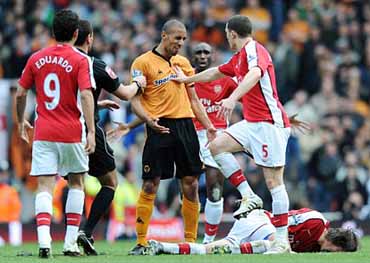
Broken legs have always been an occupational hazard in football, but they used to be an unusual or freak occurrence. Now they are becoming habitual and the players who cause them are routinely defended by their managers. This is leading to a rise in what I like to term ‘malicious recklessness’: recklessness, because the offending players are out of control; malicious, because they make these challenges in an attempt to physically intimidate the recipient.
But one group of people really can do something about this problem. It’s not the players, because the likes of Shawcross (as evidenced by his quotes this week) seem to revel in their role as out-of-control leg-smashers.
It’s not their managers, because they are prepared to accept serious casualties among their opponents if it means an extra point or two in the battle to stay in the Premier League. And, unlike many of my fellow Arsenal supporters, I don’t think Blackburn’s Sam Allardyce and Stoke’s Tony Pulis are bad people. I think they inhabit a world of public and private pressure that few of us can imagine and they will clutch at any straw to achieve their desired end. In doing so I think they genuinely believe their players are nice guys who wouldn’t deliberately break an opponent’s leg. They are too close to the problem to see that they are contributing to a culture that inevitably leads to career-threatening injuries (as Danny Murphy of Fulham eloquently pointed out last week).
It’s also not the football authorities who, as many bloggers have pointed out, are unlikely to take this problem seriously until an England golden boy is crippled by one of the EPL’s foreign legion.
Instead I believe the biggest impetus for change can come from national newspaper football reporters – the likes of Henry Winter, Patrick Barclay, Joe Lovejoy, Amy Lawrence and their colleagues. Some of them have expressed concern at the dangerous challenges that go on in the modern game, but I think there’s a more fundamental step they can take.
They (and we) need to reclaim the language of football from the Neanderthals – both players and managers – who distort it.
When Wenger criticises career-threatening challenges, the likes of Allardyce and Pulis always retort with “tackling is a great part of football and it would be terrible to lose it.” They know full well that Wenger has no problem with tackling, just with dangerous, reckless play, but it allows them to portray Wenger as a wuss who wants football to be non-contact.
The language distortion here centres on the word ‘tackling.’ Shawcross’s assault on Ramsey, Taylor’s on Eduardo do not deserve to be dignified with the name ‘tackle’ and journalists should not use it in these cases. They should refer to “Shawcross’s lunge” or “Taylor’s reckless assault.”
The word “tackle” is written into the rules of the game and should be used only for legitimate acts of football, not deliberate or reckless assaults aimed at intimidating a player.
It’s an example of what George Orwell, in Nineteen Eighty-Four, referred to as ‘doublethink,’ a definition of which is:
“To know and not to know, to be conscious of complete truthfulness while telling carefully constructed lies, to hold simultaneously two opinions which cancelled out, knowing them to be contradictory and believing in both of them, to use logic against logic, to repudiate morality while laying claim to it…”
With this in mind, every sports journalist should think twice before using any of the following euphemisms:
Full Blooded: by all means use this for a strong, fair challenge. But please let’s have no more excusing clumsy attempts to maim a player by saying the offender made a ‘full blooded’ tackle.
Committed: Michael Essien is committed; Wayne Rooney is committed; Ryan Shawcross flying into an opponent’s leg while totally out of control is not ‘committed’, he is reckless. And malicious.
Football is a Contact Sport: this phrase is the last refuge of the scoundrel. As mentioned above, it’s an attempt to deflect attention away from one’s own players’ crazy challenges by suggesting that the complainant is against tackles per se. Wrong. There is a huge difference between a strong, fair tackle and the sort of wild lunge that might break a leg or rupture the knee ligaments.
Not That Kind of Player: full credit to Arseblog for continually ramming home the sheer hypocrisy of this phrase. Yet it’s not just managers who use it – journalists too have used it, particularly over the Shawcross/Ramsey incident when all the evidence suggests that he IS that kind of player.
Late Tackle: buses are late; my granddad is late; John Cleese’s parrot is late; tackles are not late (which implies a misfortune of tardiness) – they are dangerous, uncontrolled, illegal or, if you prefer, plain dirty.
Letting The Opponent Know You’re There: when I call in on my 76-year-old Mum I like to let her know I’m there. I do this by saying ‘hello’, not by executing a two-footed lunge from behind on her lower legs. The ‘letting them know you’re there’ phrase is a euphemism for committing a violent foul.
I’m sure there are many more (all suggestions welcome please), but these are football’s version of ‘doublethink’.
If the distinguished writers who cover football for the national press start being more discerning about how they refer to maliciously reckless play, if they start to use the language appropriate for the acts they’re describing, then it will become harder and harder for those who govern football to let things go on as they are.
As the author Joseph Conrad said: “He who wants to persuade should put his trust not in the right argument, but in the right word.”
RockyLives


 Posted by RockyLives
 Arsenal News 24/7


 arsenalarsenal.net