Today’s post is a collaborative effort between GunnerN5 and Gooner In Exile and is the first in a series that will be profiling the best managers and players ever to represent the Arsenal. We will publish a poll at the end of each category to allow readers to choose who they deem to be the best of all time. The end result will establish (after 8 weeks of painstakingly researched articles) who readers believe comprises the best Arsenal team of all time.
1. Herbert Chapman: 1925-1934
He was born in Kiveton Park, near Rotherham; his father was a coal miner. One of eleven children in a keen sporting family, two of his brothers played professional football. The most successful was Harry, who played for The Wednesday in the 1900s. His older brother Tom played for Grimsby Town and yet another brother, Matthew, became a director of the same club. Herbert’s own playing career was mostly as a journeyman amateur.
His managerial career began with Northampton Town after which he joined Leeds City.
 During the suspension of league football, during WW1, he decided to help the war effort by becoming manager of a munitions factory in Barnbow. Soon after the end of WW1 Leeds City was accused of making illegal payments to players and as they refused to open their books for examination the club was expelled from the football league. Five officials including Chapman were banned from football for life. However the ban was overturned in 1921, when Huddersfield Town gave him a character reference, he then joined them as assistant manager on February1st 1921 and was appointed secretary/manager the following month. He went on to win the FA Cup in 1924-25 and consecutive League Titles in 1923-24 & 1924-25.
In the 1925 close season, Arsenal chairman Sir Henry Norris placed the following advertisement in the Athletic News.
“Arsenal Football Club is open to receive applications for the position of Team Manager. He must possess the highest qualifications for the post, both as to ability and personal character. Gentlemen whose sole ability to build up a good side depends on the payment of heavy and exorbitant transfer fees need not apply.”
 Herbert moved to Arsenal soon after, attracted both by Arsenal’s larger crowds and a salary of £2,000, double what he earned at Huddersfield Town. Arsenal’s league form was indifferent but in 1927 they reached the FA Cup Final losing 1–0 to Cardiff City. That same year, Arsenal became embroiled in a scandal over illegal footballers’ pay. Sir Henry Norris was indicted for his part and banned from football, but Chapman escaped punishment.
He showed his cunning during negotiations held in a hotel when looking to buy David Jack from Bolton. Chapman met with the barman and gave him two pounds and then said “This is my assistant Mr Wall; he will drink whiskey and dry ginger. I will drink gin and tonic. Our guests will drink whatever they choose but you will give them double of everything while Mr. Wall’s drinks and mine will contain no liquor.” His cunning worked as Arsenal paid 3,000 pounds less than Bolton had first asked.
He went on to establish Arsenal as English footballs dominate force and his football concepts and ideas served as a template for teams and managers all over the globe. He won the first trophy for the club winning the FA Cup in 1930. His 1930/31 team scored an incredible 127 goals – still a club record. He championed innovations such as floodlighting, European competitions and numbered shirts.
Tragically he passed away from pneumonia in 1934 aged 55 years.
A bronze bust of Chapman stood inside Highbury as a tribute to this outstanding manager.
Herbert Chapman’s league record –
Games 336, Won 157, Drawn 84, Lost 95,
Goals for 736, Goals against 541,
Goals for per game 2.19, Goals against per game 1.61
Points won 59.3%
Average League Position 6.25
Total # of trophies won – 2 League titles, 1 FA Cup, 3 Charity Shields.
2. George Allison: 1934-1947.
Born in Hurworth-on-Tees, County Durham, he played amateur football in Stockton-on-Tees and dabbled in writing as a sideline and eventually became a full time journalist.
During WW1 he worked for the War Office and the Admiralty, producing propaganda, and later joined the Royal Fling Corps (later renamed the Royal air Force). After the war he moved into broadcasting, joining the BBC and becoming the first person to commentate on the radio on events such as The Derby and the Grand National, as well as the annual England v.Scotland international, and the 1927 FA Cup Final. By this time, he had already formed a strong association with Arsenal and he became the club’s programme editor, becoming a member of the board of directors soon after the end of the WW1; he was first club secretary and then managing director.
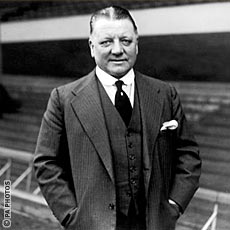 After the sudden death of Herbert Chapman in January 1934, he was appointed Chapman’s full-time successor, in the summer of that year. Arsenal had already won the League Championship twice in a row (1932-33 and 1933-34), and he made it a hat-trick, winning a third successive title in 1934-35.
He famously appeared in a 1939 movie that was set at Highbury, “The Arsenal Stadium Mystery”, where he had a speaking part as himself. Amongst his lines included one uttered at half time: “It’s one-nil to the Arsenal. That’s the way we like It.”, a line which had resonance with the team’s penchant for 1-0 score lines many decades later.
Unlike Herbert Chapman he took a hands-off approach to managing and left Joe Shaw and Tom Whittaker to take care of the training and squad discipline, while he concentrated on transfer policy and the club’s relationship with the media. He was known as being tactful, friendly and good-hearted but it was felt that he fell short in his handling of the squad and lacked a professional’s deep knowledge of the game. However his proponents have cited the amount of trophies won in his reign, although by the end of the 1930s Arsenal were no longer the all-conquering team that they had once been and he was unable to replace many of the stars from the first half of the decade. With the start of WW11 football in England was suspended; after the war ended, many of the players that had made Arsenal great had retired from playing. Arsenal finished a disappointing 13th in 1946-47, by now he was in his mid-sixties and being tired of managerial life, he decided to step down and retire from the game.
He died in 1957 after several years of illness.
George Allison’s league record –
Games 294, Won 137, Drawn 80, Lost 77,
Goals for 552, Goals against 345,
Goals for per game 1.88, Goals against per game 1.17
Points won 60.2%.
Average League Position 4.29
Total # of trophies won – 3 League titles, 1 FA Cup, 2 Charity Shields.
Written by GunnerN5 and compiled by Gooner in Exile


 Posted by Gööner In Exile
 Arsenal News 24/7


 arsenalarsenal.net