AContinuing our Summer series of articles in search of Arsenal’s greatest ever team, this week we will end our quest for the greatest forwards to include in our team. Don’t forget to take the opportunity to choose your personal favourite striker, this weeks posts will bring us bang up to date and there will be a vote on Saturday.
14. Frank Stapleton: 1972-1981.
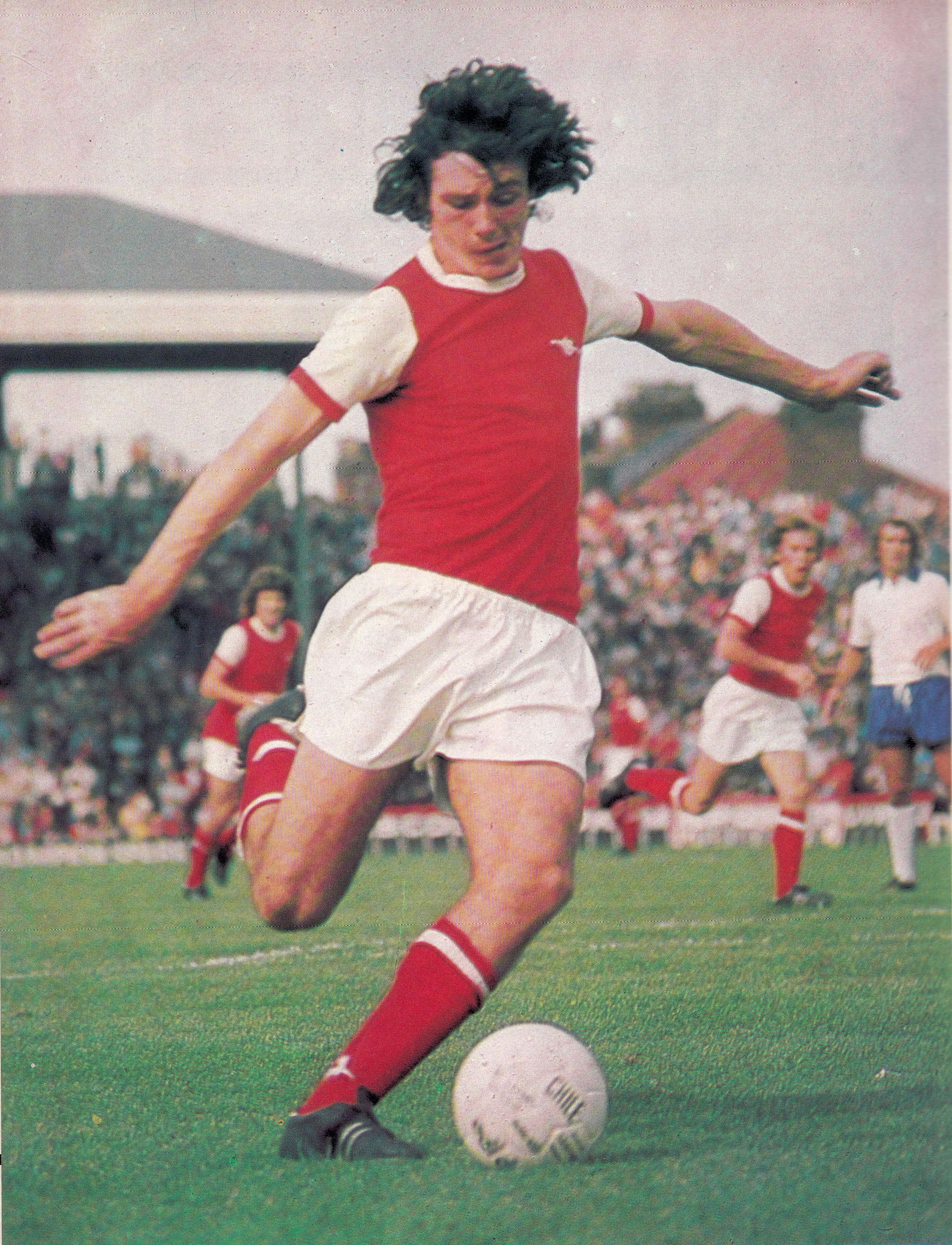
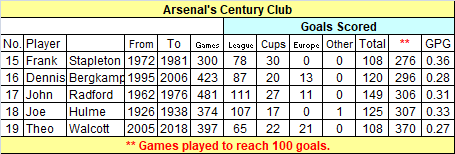
Frank appeared in 300 games over a 9 year period and scored 108 goals.
Frank was born in Dublin, he started his career with Arsenal, joining them in 1972 as an apprentice, after he was turned down by Manchester United. He made his first-team debut in 1975 against Stoke City, and went on to form a potent striking partnership with Malcolm Macdonald; the two scored 46 goals between them in 1976–77. He was Arsenal’s top scorer for the three following seasons, and helped the Gunners reach a trio of FA Cup finals; he scored one of the goals in Arsenal’s 1979 FA Cup Final 3–2 win over Manchester United, and scored 108 goals in 300 appearances in total for the Gunners.

Frank moved to Man United in 1981 for £900,000 (a fee set by tribunal after the two clubs could not agree). He helped United win the 1983 and 1985 FA Cups. It was in the first of those finals, when he scored against Brighton, in which he made history by becoming the first man to score for two different clubs in FA Cup Finals. He left United in 1987, after scoring 78 goals for the club in 365 matches.
He went on to play for Ajax Amsterdam, before returning to England with Derby County, Blackburn Rovers, Aldershot, Huddersfield Town and Bradford City, where he spent three seasons after a brief period at Le Havre in France.
After being sacked as Bradford’s player-manager in 1994, he had a brief spell at Brighton & Hove Albion in the 1994–95 season, playing two games before finally announcing his retirement as a player.
He also won 71 caps for the Republic of Ireland, scoring a then record 20 goals. he made his international debut under then player-manager Johnny Giles in a friendly against Turkey in Ankara in 1976 at 20 years of age. He scored after only three minutes of his debut when he headed home a Giles free-kick at the near post. Frank was committed to international football insisting that an “international release clause” be inserted into all of his contracts so that he could be released to play in international games for Ireland. He played a significant role in Ireland’s attempt to qualify for the World Cup in Spain in 1982. However his goals against Cyprus, Holland and France in the qualifying matches were not enough as Ireland were denied a place at the World Cup by a superior French goal difference. He was made captain of the national team for the qualifying campaign for the 1986 World Cup though Ireland failed to emulate their fine performance in the 1982 qualifiers. Frank captained the Irish team to the 1988 Euro finals and played in all of their matches during the competition including Ireland’s famous victory against England.
Frank moved to the United States to coach Major League Soccer side New England Revolution in 1996. In the 2003–04 season he briefly returned to English football as a specialist coach of Bolton Wanderers. The Bolton manager Sam Allardyce wanted Stapleton to enhance the skills of the strikers at the club and saw the Irishman as an ideal candidate, given his successful playing career.
15. Alan Smith: 1987-1995.
Alan appeared in 347 games over an 8 year period and scored 115 goals.
Alan was born in Hollywood, Worcestershire. Alan started his career at non-league Alvechurch in north Worcestershire. He then signed professional forms with Leicester City in June 1982. In his first season, he scored 13 goals in a p artnership with Gary Lineker, as the Foxes won promotion to the First Division. He spent five seasons at Leicester, scoring 84 goals in 217 appearances, before he was transferred to Arsenal in 1987.
During his time with the Gunners the team won all three major domestic trophies – two League Championships, the FA Cup, the Football League Cup (in their 1993 ‘Cup Double’) and in Europe the UEFA Cup Winners’ Cup. He scored the first goal in Arsenal’s League Championship winning victory at Anfield in May 1989, and the only goal of the 1994 European Cup Winners’ Cup Final victory against Parma. He was Arsenal’s top scorer for four consecutive seasons, and the top scorer in the First Division in the 1988-89 season with 23 goals
In eight seasons at Highbury, he scored a total of 86 league goals, averaging at just over 10 goals per season. His first league goals for the club came on 29 August 1987, when he netted a hat-trick in a 7–0 game versus Portsmouth at Highbury. His last came on 12 December 1994 in a 2–1 win over Manchester City in the FA Premier League at Maine Road. As well as his goals in the 1989 title clinching game and the European triumph of 1994, he scored a hat-trick against Manchester United in the First Division on 6 May 1991.
He only received one yellow card throughout his entire career. He retired from professional football in July 1995. Several clubs, including Watford, had expressed an interest in signing Alan just before he announced his retirement from playing
He is currently a regular co-commentator and sometimes studio pundit for various television shows. In 2011 he commentated on the Champions League final alongside Martin Tyler. On June 30, 2011, EA Sports announced that Smith would replace Andy Gray as Martin Tyler’s partner in commentating in FIFA 12. This partnership continued in the subsequent instalment of the series, FIFA 13
Smith is married to his childhood sweetheart, Penny and they live with their two daughters Jessie and Emily.
16. Paul Merson: 1982-1997.
Paul appeared in 425 games over a 15 year period and scored 99 goals.
Paul was born in Harlesden, North West London, and started his career at Arsenal, joining the club as an apprentice in 1984. After a loan spell at Brentford, then under manager Frank McLintock, he made his debut for the Gunners in November 1986 against Manchester City.
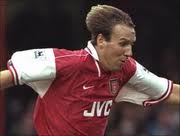 Gradually he established himself in George Graham’s successful Arsenal side of the late 1980s. By the 1988–89 season he was a regular on the right wing, at the end of which Arsenal secured the First Division title with a last gasp Michael Thomas goal in the final game of the season against Liverpool. Paul scored ten times that season; he made his debut for the England U21 side, and was voted PFA Young Player of the Year.
With Arsenal, Merson bagged another league championship in 1991, both the FA Cup and League Cup in 1993 (scoring equaliser in League Cup Final v Sheffield Wednesday) and the Cup Winners’ Cup in 1994. He also made his debut for the full England side, in a friendly against Germany on 11 September 1991.
Paul’s career was put on the line in November 1994 when he admitted to being an alcoholic and cocaine addict. The Football Association arranged for him to undergo a three-month rehabilitation programme and he returned to the side in February 1995, just before the dismissal of George Graham as manager. Under caretaker manager Stewart Houston, he helped Arsenal reach the Cup Winners’ Cup final for the second season in a row.
In 1995–96, Paul remained a regular first team player under Arsenal’s new manager Bruce Rioch and continued to play regularly during the 1996–97 season following the appointment of Arsène Wenger. In a somewhat surprising move, at the end of the 1996–97 Premiership campaign, in which Arsenal finished third, Paul was sold to relegated Middlesbrough in a £5 million deal – making him the most expensive player ever signed by a non-Premiership club. Whilst Arsene Wenger had offered a new two year contract, Middlesbrough offered double the salary available at Arsenal.
In the autumn of 1998, Paul was sold to Aston Villa for £6.75 million after wishing to be nearer to his family in the South. Subsequently he signed for Division One club Portsmouth on a two-year contract, and was instrumental in the club’s promotion to the Premiership in 2002–03.
Paul first played for the England national team in 1991, being called up by Graham Taylor. He also participated in the 1992 European Championships in Sweden. 1998 marked the end of his international career after 21 full caps in seven years, in which he scored three times.
GunnerN5



 Posted by D.I. Bongo

 Arsenal News 24/7


 arsenalarsenal.net