Arsenal’s inception came on October 4th, 1886 in the Prince of Wales pub on the edge of Plumstead Common; during a meeting of the Dial Square Cricket Club it was decided to expand the club to include a football section. According to various reports the main people behind adding the football section were David Danskin. Elijah Watkins, Fred Beardsley, John Humble and Richard Pearce.

The first day of the L.G.O.C. route 99 outside the “Prince of Wales,” on the 22 May, 1916
David Danskin (9 Jan 1863 – 4 Aug 1948) was born in Burntisland, Fife, and grew up in Kirkcaldy. He played as an amateur for Kirkcaldy Wanderers; two of his team mates were Jack McBean and Peter Connolly, who would later join him at Royal Arsenal. In 1885 Danskin moved to London to find work, and took a job, as an engineer, at the Dial Square workshop at the Royal Arsenal in Woolwich. There he met Jack Humble and former Nottingham Forest players Fred Beardsley and Morris Bates. John Humble and David Danskin are considered to have been the driving force behind the formation of a works football team, Dial Square FC.
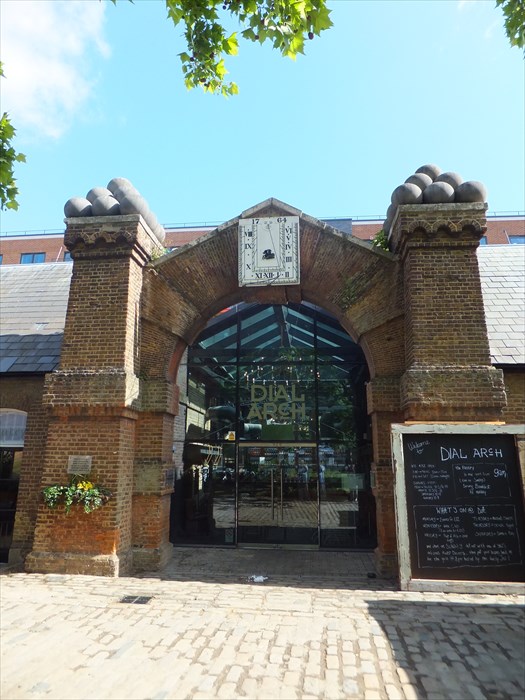
Dial Square Sundial, Woolwich
Danskin organised a whip-round amongst his fellow enthusiasts and purchased Dial Square’s first football, and captained the team in their very first match against Eastern Wanderers on 11 December 1886; Dial Square won 6–0. Danskin continued to play for Royal Arsenal, as the club were soon renamed afterwards, for the next two years. Due to an injury incurred against Clapton in January 1889, Danskin elected to step down from the side and rarely played after that.
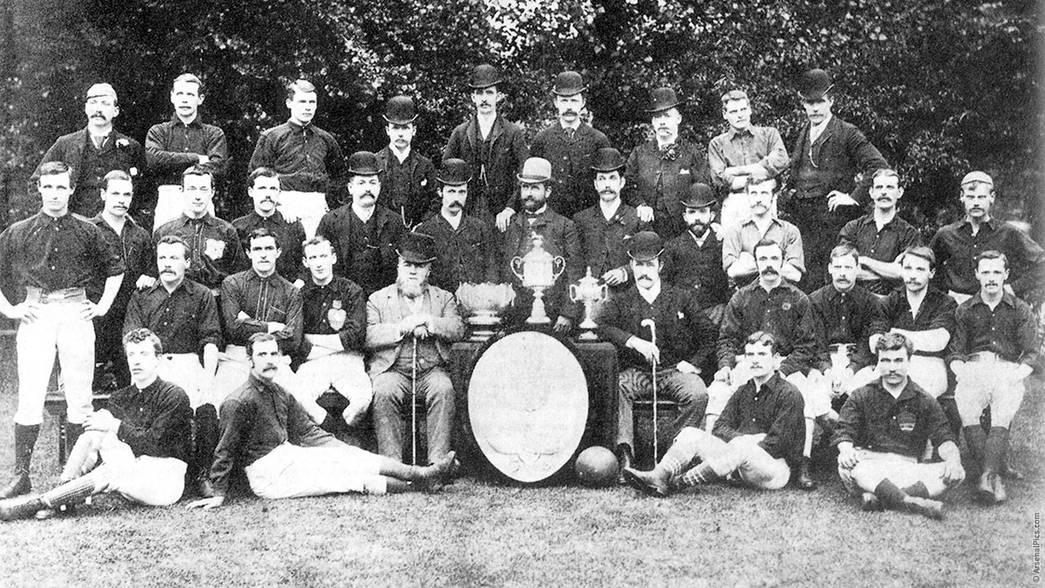
From AFC.com
Arsenal turned professional in 1891, and although Danskin stood for election to the club’s committee in 1892, he did not succeed in getting elected. He ended his official association with Arsenal and later became associated with a new works team from the area, Royal Ordnance Factories, which folded in circa 1896. He also officiated as a referee in local matches. He was still fond enough of Arsenal to attend their games, and his son Billy used to sell programmes at their Manor Ground as a child.
He later started up his own bicycle manufacturing business in Plumstead, before moving to Coventry in 1907 to work for the Standard Motor Company. In his later life he was troubled by ill-health, caused by football related injuries to his legs, and took early retirement. He died in a hospice in Warwick in 1948, at the age of 85 and was buried at London Road Cemetery in Coventry.
In 2007, to commemorate his role in the club’s history, the Arsenal Scotland Supporters Club dedicated a blue plaque to Danskin, near his birthplace in Burntisland.
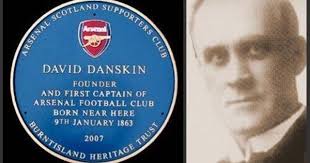
During Arsenal’s 125th anniversary celebrations, two of David Danskin’s great-grandchildren delivered the match ball for Arsenal’s 1–0 victory over Everton at Emirates Stadium as Arsenal celebrated another milestone.
GunnerN5


 Posted by D.I. Bongo
  Arsenal News 24/7


 arsenalarsenal.net